Showing posts with label 2018 VG18. Show all posts

Meet “Farout”, the Solar System's Most Distant Object Yet


An international team of astronomers has discovered the furthest object ever detected in the Solar System. Nicknamed “Farout”, it’s a small round object with a pinkish hue located 17.95 billion kilometers (11.15 billion miles) from the Sun. The color is common in ice-rich objects.

Image result for Meet “Farout”, The Solar System's Most Distant Object Yet

Its official designation is 2018 VG18 and it is 500 kilometers (310 miles) in diameter. It's the first object discovered further than 100 astronomical units (AU) from our star, with 1 AU being the Earth-Sun distance. Farout is at a distance of 120 AU, significantly further out than dwarf planet Eris, which is at 96 AU. Pluto, by comparison, is at 34 AU.

The object was discovered in images taken with the Japanese Subaru Telescope atop Mauna Kea in Hawaii on November 10. Follow-up observations to confirm the distance were conducted in December from Las Campanas Observatory in Chile.

Image result for Meet “Farout”, The Solar System's Most Distant Object Yet

“All that we currently know about 2018 VG18 is its extreme distance from the Sun, its approximate diameter, and its color,” co-discoverer David Tholen, from the University of Hawaii, said in a statement. “Because 2018 VG18 is so distant, it orbits very slowly, likely taking more than 1,000 years to take one trip around the Sun.”

Farout adds to the intriguing family of peculiar objects so far discovered beyond the orbit of Pluto. The orbits of these trans-Neptunian objects (TNOs) seem to be influenced by the gravity of a massive planet so researchers have put forward the idea that Planet 9 exists over 200 AU from the Sun. So far the search hasn’t uncovered definitive proof, but TNOs are helping astronomers understand what’s going on at the edge of the Solar System.


“2018 VG18 is much more distant and slower moving than any other observed Solar System object, so it will take a few years to fully determine its orbit,” added co-discoverer Scott Sheppard, from the Carnegie Institution for Science. “But it was found in a similar location on the sky to the other known extreme Solar System objects, suggesting it might have the same type of orbit that most of them do. The orbital similarities shown by many of the known small, distant Solar System bodies was the catalyst for our original assertion that there is a distant, massive planet at several hundred AU shepherding these smaller objects.”

While we are only just starting to understand the further rims of the Solar System, discoveries like this show that there are still many worlds out there left to find.

Astronomers Just Found a Planet Three Times As Far Away As Pluto

“I said ‘far out!’ when I discovered it, and it’s a very far out object,” said astronomer Scott Shepard from the Carnegie Institution for Science, as quoted by New Scientist. 

Image result for 2018 VG18

The tiny planet is called 2018 VG18 — later nicknamed “Farout” by the team that discovered it — and it’s about 3.5 as far away as Pluto, some 18 billion kilometers (11.2 billion miles) away. That’s more than 100 times the distance between the Earth and the Sun — and about the same distance as Voyager 2, the NASA probe that launched in 1977 and reached interstellar space this month.

Farout was spotted by the Japanese Subaru telescope in Hawaii on November 10 by Shepard and several colleagues, according to a statement on Carnegie Institution for Science’s website.

Image result for 2018 VG18

So far, Farout is still deeply mysterious. But one aspect already attracting scientific interest is its unusual orbit. Farout orbits at an unusual angle, along with other so-called “trans-Neptunian objects.”  There’s been a lot of speculation in recent years about what might be causing those astronomical bodies’ unusual trajectory.

One of the most popular explanations is the possible existence of a ninth planet, or Planet X. In fact, the astronomers discovered Farout while searching for the existence of a ninth planet, according to the statement. Most recent data suggests it could also be a group of objects within the same gravitational field.

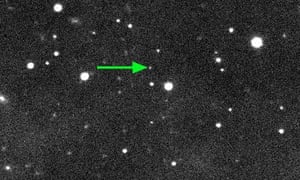
2018 VG18
 An image of 2018 VG18 captured using the Subaru Telescope on 10 November. 
Photograph: Scott S Sheppard/David Tholen

Slow and Pinkish

But we can glean at least some details about Farout. Farout is estimated to be 500 km in diameter, and to take more than 1,000 years to orbit the Sun. It also has a pinkish hue, according to the researchers.

“With new wide-field digital cameras on some of the world’s largest telescopes, we are finally exploring our Solar System’s fringes, far beyond Pluto,” said Chad Trujillo, astronomer from Northern Arizona University.

The discovery shows that even though researchers are now routinely finding planets orbiting other stars, there are still planet-sized undiscovered objects in our own solar system. It really goes to show how much there still is to learn about our relatively small corner of the galaxy.