Showing posts with label milky way. Show all posts

Scientists See Giant Structure “Hidden” Behind Our Galaxy

An uncharted region of space known as the "zone of avoidance" lurks behind the Milky Way's center – and astronomers just found an enormous, multi-galaxy structure there.
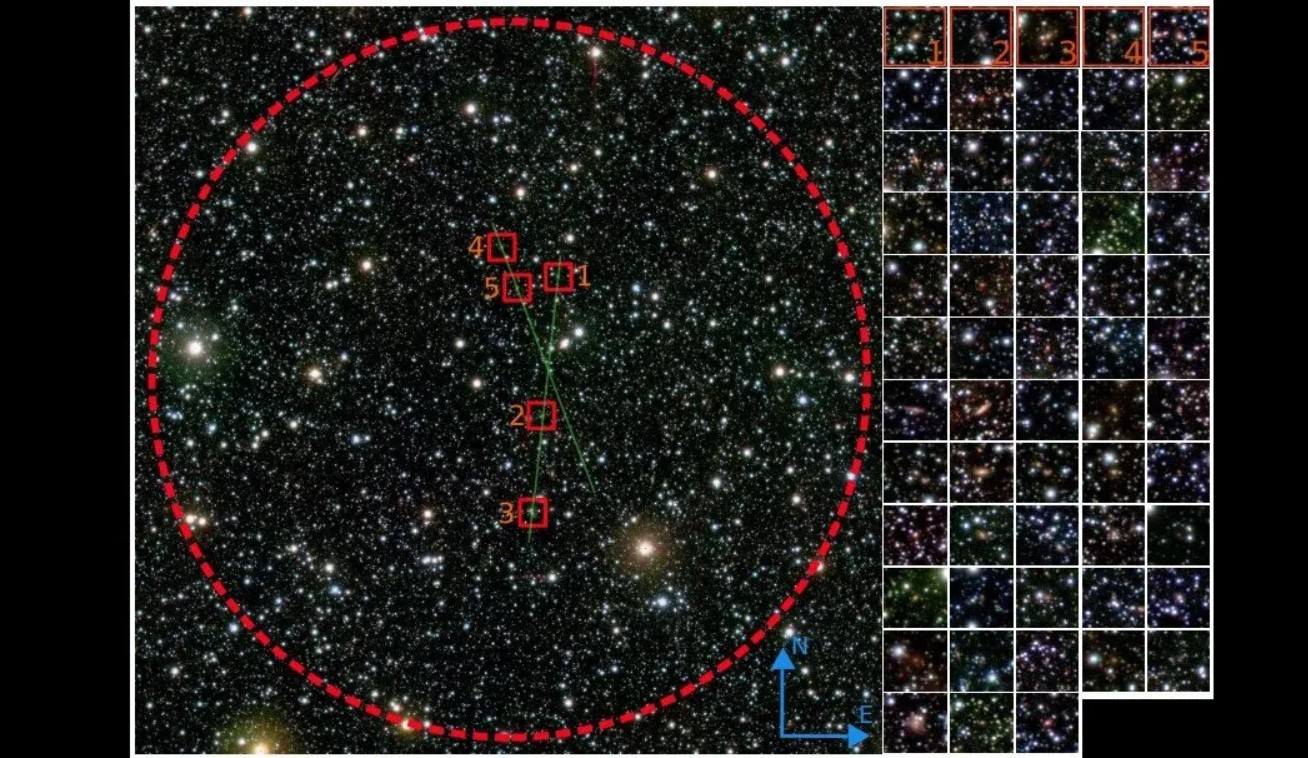

A composite image showing the 58 galaxies clustered together in the "zone of avoidance" behind the Milky Way. (Image credit: Galdeano et al. / ESO)


Astronomers have detected an enormous extragalactic structure hiding in an uncharted region of space far beyond the Milky Way's center.


This phantom region, known as the zone of avoidance, is a blank spot on our map of the universe, comprising somewhere between 10% and 20% of the night sky. The reason we can't see it — at least with standard visible light telescopes — is because the Milky Way's bulging center blocks our view of it; the center of our galaxy is so dense with stars, dust and other matter that light from the zone of avoidance gets scattered or absorbed before reaching Earth's telescopes.


However, researchers have had better luck uncovering the zone's secrets with telescopes that can detect infrared radiation — a type of energy that's invisible to human eyes, but powerful enough to shine through dense clouds of gas and dust. Infrared surveys of the zone of avoidance have found evidence of thousands of individual galaxies shining through the cosmic fog, though little is known about the large-scale structures that lurk there. 


Now, researchers have combined data from several of those infrared surveys to reveal the most colossal structure ever detected in the zone of avoidance, according to a study published Oct. 28 on the preprint database arXiv.org. (This study has not yet been peer reviewed, though it has been submitted for review to the journal Astronomy and Astrophysics).


Located approximately 3 billion light-years from Earth, the mysterious structure appears to be a large cluster of galaxies drawn together by a shared center of gravity. Using observations from the VVV Survey — a survey that studies the Milky Way's central bulge at infrared wavelengths using the Visible and Infrared Survey Telescope for Astronomy in Chile — the study authors found evidence of at least 58 galaxies bundled together in a small plot of the zone of avoidance.


Galaxy clusters are the largest gravitationally-bound objects in the universe; the largest known clusters contain hundreds of thousands of galaxies bunched together. Unfortunately, it's impossible to tell just how wide or massive the newly discovered cluster is, given the vast distances and myriad obstructions sitting between the cluster's stars and Earth. 


However, the mere detection of this colossal object shows that the zone of avoidance may not be as inscrutable as was once thought. Future infrared studies — including potential observations by the James Webb Space Telescope, which has already used its infrared camera to take the deepest image of the universe to date — should further help scientists unlock the hidden secrets beyond the Milky Way's bulge.

Scientists See Giant Structure “Hidden” Behind Our Galaxy

An uncharted region of space known as the "zone of avoidance" lurks behind the Milky Way's center – and astronomers just found an enormous, multi-galaxy structure there.


A composite image showing the 58 galaxies clustered together in the "zone of avoidance" behind the Milky Way. (Image credit: Galdeano et al. / ESO)


Astronomers have detected an enormous extragalactic structure hiding in an uncharted region of space far beyond the Milky Way's center.


This phantom region, known as the zone of avoidance, is a blank spot on our map of the universe, comprising somewhere between 10% and 20% of the night sky. The reason we can't see it — at least with standard visible light telescopes — is because the Milky Way's bulging center blocks our view of it; the center of our galaxy is so dense with stars, dust and other matter that light from the zone of avoidance gets scattered or absorbed before reaching Earth's telescopes.


However, researchers have had better luck uncovering the zone's secrets with telescopes that can detect infrared radiation — a type of energy that's invisible to human eyes, but powerful enough to shine through dense clouds of gas and dust. Infrared surveys of the zone of avoidance have found evidence of thousands of individual galaxies shining through the cosmic fog, though little is known about the large-scale structures that lurk there. 


Now, researchers have combined data from several of those infrared surveys to reveal the most colossal structure ever detected in the zone of avoidance, according to a study published Oct. 28 on the preprint database arXiv.org. (This study has not yet been peer reviewed, though it has been submitted for review to the journal Astronomy and Astrophysics).


Located approximately 3 billion light-years from Earth, the mysterious structure appears to be a large cluster of galaxies drawn together by a shared center of gravity. Using observations from the VVV Survey — a survey that studies the Milky Way's central bulge at infrared wavelengths using the Visible and Infrared Survey Telescope for Astronomy in Chile — the study authors found evidence of at least 58 galaxies bundled together in a small plot of the zone of avoidance.


Galaxy clusters are the largest gravitationally-bound objects in the universe; the largest known clusters contain hundreds of thousands of galaxies bunched together. Unfortunately, it's impossible to tell just how wide or massive the newly discovered cluster is, given the vast distances and myriad obstructions sitting between the cluster's stars and Earth. 


However, the mere detection of this colossal object shows that the zone of avoidance may not be as inscrutable as was once thought. Future infrared studies — including potential observations by the James Webb Space Telescope, which has already used its infrared camera to take the deepest image of the universe to date — should further help scientists unlock the hidden secrets beyond the Milky Way's bulge.

An Unknown Force Is Pulling The Milky Way And Other Galaxies Towards Itself At 12 Million Mph

We don't know why a hundred thousand galaxies, including our own, are being dragged into a region of space we can't see. Astronomers refer to this as a "Gravity Anomaly."

It's a vast region of space known as "The Great Attractor". Astronomers estimate its mass to be 100 billion Suns. More information can be found in the video below.

BREAKING: The Far Side Of Our Galaxy Has Been "Seen" For The First Time

It's a frequent cliche to say that we can't see the forest for the trees, but we might just as easily say that we can't see the Milky Way for the stars. 


We now have a more exact understanding of where things are on the other side of the galaxy, according to recent research based on an old astronomy method, filling in critical details to the map of our own cosmic backyard.

As familiar as the night sky might be, sitting smack bang in the middle of our own galaxy makes it a little harder to get a complete picture of how it looks from the outside. The fact it's a flattened disc doesn't help matters much; the best we can do is find ways to measure the relative positions of stars and plot them on a 3D map.

But how do we know how far away a star is? Those twinkling nuclear furnaces come in all manner of sizes and luminosities, so astronomers can't use brightness to determine stellar distances. To make their record-breaking measurement, astronomers from the Max-Planck Institute for Radio Astronomy in Germany and the Harvard-Smithsonian Center for Astrophysics in the US used an astronomy technique that dates back nearly 180 years.

Stellar parallax was first used in 1838 by the German astronomer Friedrich Bessel to measure the distance to a star in the constellation Cygnus. His measurement of 10.3 light years was about a light year off; not bad for a guy with a simple telescope, keen eyes, and some sharp trigonometry skills.

The basics are fairly straightforward; hold up a forefinger close to your face and close one eye. Then open it, and close the other.


Stellar parallax was first used in 1838 by the German astronomer Friedrich Bessel to measure the distance to a star in the constellation Cygnus. His measurement of 10.3 light years was about a light year off; not bad for a guy with a simple telescope, keen eyes, and some sharp trigonometry skills.

The basics are fairly straightforward; hold up a forefinger close to your face and close one eye. Then open it, and close the other. 

Repeat this with your finger held at a distance. The apparent change in your finger's position as you look at it with each eye depends on how far away it is from your face. You'd need your eyes to be pretty far apart to detect the shifts in something as distant as a star.

Fortunately as the Earth orbits the Sun, we get just that. A dozen light years away is virtually just over the galactic back fence. To get to see more of the galaxy, we need a telescope with a much sharper focus.

Hubble's wide field camera manages a bit better, but even that can only manage to determine the relative shift in a star's position if it's within 10,000 light years. Our galaxy's diameter is estimated to be ten times that size.

In this latest analysis, the astronomers were able to measure the distance to a group of stars literally on the other side of the Milky Way, a mind-blowing 66,000 light years away from Earth. This nearly doubles the previous record of just over 36,000 light years achieved in 2013.

Both of these distances were measured using a piece of technology called the Very Long Baseline Array (VLBA). In simple terms, the VLBA consists of 10 large antennas separated out over thousands of kilometers between North America, Hawaii, and the Caribbean, making up one single, giant eye. That allows astronomers to detect a shift in a star's position equivalent to the diameter of a baseball on the surface of the Moon.

The observations were made several years ago, in 2014 and 2015, detecting light from a region in space where new stars were being born. Surrounding clouds of water and methanol molecules amplified their radiance across the incredible distance, helping them to shine through the thick fog of dust that blocks a lot of the light.

"Most of the stars and gas in our galaxy are within this newly-measured distance from the Sun. With the VLBA, we now have the capability to measure enough distances to accurately trace the galaxy's spiral arms and learn their true shapes," says researcher Alberto Sanna from the Max-Planck Institute for Radio Astronomy.

"This means that, using the VLBA, we now can accurately map the whole extent of our galaxy." We shouldn't hold our breath for an accurate Google Milky Way any time soon – the researchers estimate we're still a decade off having a fairly complete picture.

Still, a selfie the size of a galaxy should be well worth the wait. This research was published in Science.

Via Sciencealert

The Milky Way Is MOVING Through The Universe At 2.1 MILLION Kilometers Per Hour

Nothing is standing or stationary. 

As you are reading this, the Earth spins around its own axis; it revolves around the sun, the sun is moving through space at a stunning 792,000 km/h around the gigantic center, and our universe is moving at a mind-boggling 2.1 million kilometers per hour.

You may contemplate that as you are reading this, your body in a stationary position. But, everything inside the universe travels, from our planet (Earth) –which revolves on its axis at a speed of approximately 1700 km/h— to the solar system and even the Milky Way Galaxy.

All the planets in the solar system and their personal moons also travel through space. Actually, in order to retain a stable orbit, it is essential for Earth to move around 30 km/s. The innermost planets in our system, Mercury and Venus travel faster while planet Mars and the external planets of our solar system fly through space at a sluggish pace.

But think superior and bigger. Even yet the Sun is at the heart of our solar system, it is also travelling at an unbelievable speed through space. 

If we consider even bigger, we will understand that even our gigantic Milky Way galaxy is in motion, and all continuing things that make up the universe such as stars, gas clouds, planets, black holes and even the mighty dark matter travel within the universe.

Just as Earth revolve around the Sun and our Sun revolves the galactic center –which from our vantage point is situated around 2500 light-years away— in an elliptic trajectory. It finishes a revolution every 225 million years roughly. This is known as a Galactic year.

It is predicted that since the Sun and Earth came into being, 20 galactic years have passed, which means that we ended 20 successful revolutions orbiting the galactic center. However, if we relate detailed human history to our movement through the universe, we would understand we hardly moved in our galactic path.

But what about the Speed? In order to finish a successful revolution around the galactic center, the Star (Sun) has to travel at a stunning speed of 792,000 km/h. Including Earth and all other objects in our complete solar system follow the sun at this obsessive speed.

In comparison, light-travels at a mesmerizing speed of 1.09 BILLION km/h.


Though, not only do moons, planets, and in this particular case, our sun travels through space, the galaxy also moves through space, pushed by the gravitation of other enormous objects in the universe.


As it turns out, our Galaxy is now being thrown, by other huge galaxies and clusters in the surrounding area — near a certain point in the universe.


But wait a minute, related to WHAT is we actually calculating the movement through the universe? Well, when arguing our speed around the Milky Way Galaxy, researchers are capable to measure it relative to the HEART of the Milky Way Galaxy.


However, the Milky Way Galaxy isn’t motionless or stationary, and it also moves through the universe. So is there anything to which its motion can be compared?


For a long period time, astronomers and scientists were not able to answer any questions like this. We can compare our galaxy’s speed with other galaxies, but all the other galaxies travel through the universe just as the Milky Way Galaxy does.


In order to answer this mystery, astronomers and scientists point towards the CBR (Cosmic Background Radiation) and the Big Bang.


As stated by NASA, The Big Bang theory guesses that the early universe was an extremely hot place and that as it grows; the gas within it gets cooler. Therefore the universe should be packed with radiation that is exactly the remnant heat left from the Big Bang, called the “Cosmic Microwave Background,” or CMB. The Cosmic Microwave Background (CMB) radiation was produced 13.7 billion years ago.


Theoretically speaking, the CBR suggests experts with a frame of reference for the entire universe, compared to which we can determine and calculate our motion.


In order to get knowledge of how fast we’re travelling through the universe, astronomers need to take away the motion of planet Earth around the Sun and the Sun around the center of the Milky Way from the movement measured compared to the Cosmic Microwave Background (CBR).


This means that the Milky Way Galaxy is travelling through space at an amazing speed of 2.1 million km/h, in the direction of the constellations of Virgo and Leo; exactly where the so-called Great Attractor is situated.

This X-Ray View of The Night Sky Reveals a Whole New Way of Seeing The Universe

Based on this recently released snapshot of the night sky captured by NASA's Neutron star Interior Composition Explorer (NICER), we can safely assume Superman gets no sleep at night. 

Just look at that thing.

The sparkling dots and tangled loops are the result of nearly two years of effort to study cosmic sources of X-rays from Earth's orbit.

As a piece of art, it's stunning. Check it out in all its glory below, complete with details identifying the relevant spots, or in high detail here on NASA's Goddard media page.


To fully appreciate its beauty, though, let's break down what this golden fireworks display actually describes.

On board the International Space Station (ISS) sits the workhorse of the NICER payload – a washing-machine sized cube called an X-ray Timing Instrument.

Roughly every hour and a half, after the Sun sets on the ISS orbit, the instrument scoops up high energy photons from up to eight locations per orbit in the night sky.

Every curved line is the path traced as the instrument's attention shifts from one source to the next. The smaller flecks and lines are energetic particles crashing into the sensors.

But the bigger 'sparkles' are of particular interest, their brightness the result of both the amount of time NICER spends focussed on that spot and their generous outpouring of X-ray radiation.

Many of the locations are home to dead suns called neutron stars; objects so dense, the only thing keeping them from collapsing into a black hole is a law that says their nuclei can't all pile into the same volume. Not without considerably more force, at least.

The problem is, we're still not entirely sure how that works, as the exact sizes of neutron stars aren't clear.

Knowing their precise radius can tell us more about the crazy physics going on inside their bodies. It's hoped this mission could determine their size to within a precision of just 5 percent.

Some of those neutron stars are quick spinners called pulsars. Nailing down the time of each sweep of their lighthouse-like X-ray beams can provide astronomers with a highly detailed set of coordinates.

An upgrade to NICER called the Station Explorer for X-ray Timing and Navigation Technology (SEXTANT) experiment will collect information that should not only help guide the future of the mission, but contribute to future space exploration as a whole.

It might look messy, but there's a lot of information in that bowl of cosmic spaghetti and meatballs.

"Even with minimal processing, this image reveals the Cygnus Loop, a supernova remnant about 90 light-years across and thought to be 5,000 to 8,000 years old," says principal investigator Keith Gendreau from NASA's Goddard Space Flight Center.

"We're gradually building up a new X-ray image of the whole sky, and it's possible NICER's night time sweeps will uncover previously unknown sources."

Even if none of that impresses you, at least you can look at it and imagine you're an astronomer with X-ray vision - casually star-gazing on Krypton.

Astronomers Reveal The Biggest 3D Map of the Milky Way and it’s Ridiculously Stunning

The greatest three-dimensional map of the Milky Way has been developed by an international team of scientists, and the results have been published in the journal Science. 

Our planet isn't flat, and guess what? Neither is our galaxy.

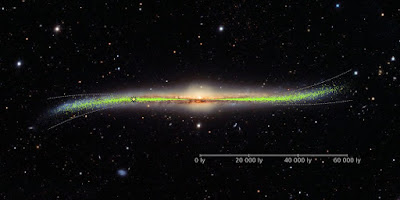
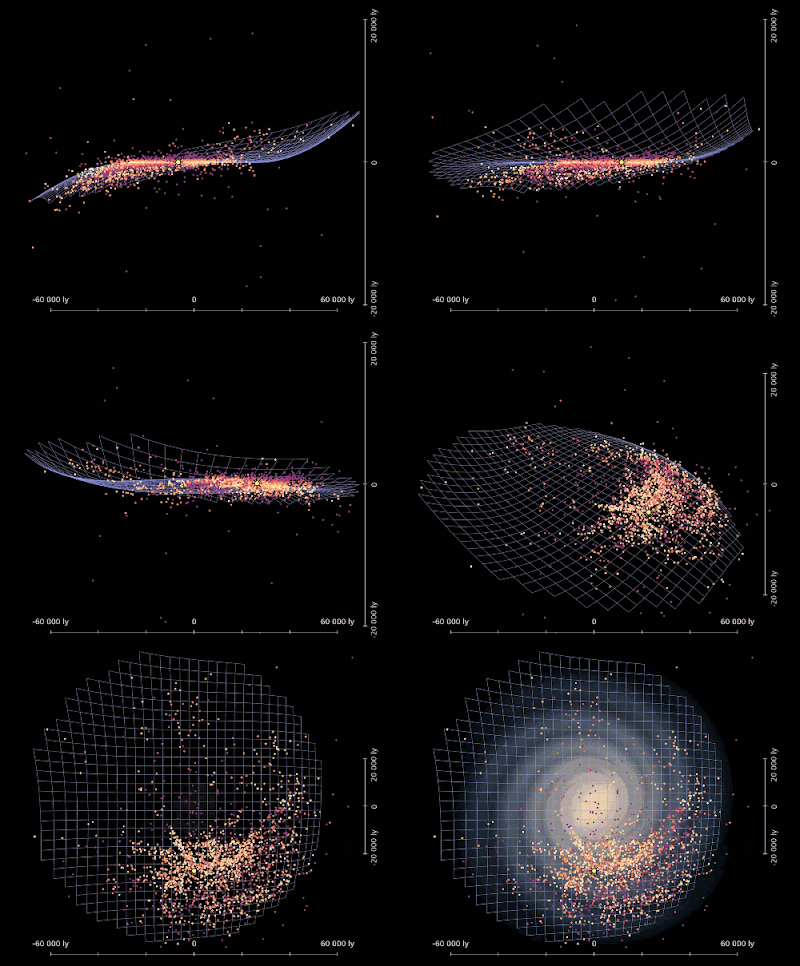
Researchers created a 3D map that shows the S-shaped structure of the Milky Way galaxy's combined star disc, our cosmic address, by calculating the distance from our Sun to hundreds of pulsating stars spread around our galaxy.

“Our map shows that the Milky Way disk is not flat. Instead, it is deformed and twisted in shape,” revealed study co-author Przemek Mróz of the University of Warsaw in Poland.“This is the first time we can use individual objects to display it in three dimensions,” he added.

Much of our present understanding of the spiral shape and structure of our galaxy is based on indirect observations of celestial objects and conclusions based on other distant galaxies in the Universe.


However, as scientists have discovered, the galactic map provided by these restricted observations is insufficient.


The classical Cepheids (giant stars that burn hundreds, if not thousands, of times brighter than our Sun) pulse frequently and are visible through the huge interstellar dust clouds that often cover less luminous interstellar objects, much like numerous distant lighthouses.


Distances to these stars may be estimated precisely owing to periodic fluctuations in brightness.


Dorota Skowron of Warsaw University, in collaboration with scientists from Ohio State University in the United States and the University of Warwick in the United Kingdom, traced the distance to over 2,400 cepheids along the Milky Way, the majority of which were discovered by the Optical Gravitational Lensing Experiment (OGLE), a project that helped double the number of known galactic classical cepheids.


The researchers were able to create an extremely precise three-dimensional model of the Milky Way by assigning coordinates to each distant pulsing star in reference to our Sun.


As a consequence, a beautiful, never-before-seen map of the Milky Way Galaxy has been created.


The findings of the study have helped astronomers better grasp our cosmic surroundings and precisely depict the form of the galaxy.


And it's not flat, but it does have an unusual form.


As noted by Space.com, “this new map helped reveal more details on distortions that astronomers had “previously detected in the shape of the Milky Way.”


The map took scientists six years to create, but as participating astronomers disclosed, "it was worth it."


At a distance of almost 25,000 light-years from the galactic core, we discovered that the galaxy's disc is not flat. It's twisted. This bending might have been generated by interactions between the galaxy and nearby galaxies, intergalactic gas, or even dark matter.


“Warping of the galactic disk has been detected before, but this is the first time we can use individual objects to trace its shape in three dimensions,” explained Mróz in a statement.


The quantity of 'warping' observed in our galaxy was shockingly pronounced, according to the researchers.


“It is not some statistical fact available only to a scientist’s understanding,” Mróz said. “It is apparent by eye.”


Reference(s): Science 

The Milky Way Is MOVING Through The Universe At 2.1 MILLION Kilometers Per Hour


Nothing is standing or stationary. As you are reading this, the Earth spins around its own axis; it revolves around the sun, the sun is moving through space at a stunning 792,000 km/h around the gigantic center, and our universe is moving at a mind-boggling 2.1 million kilometers per hour.


You may contemplate that as you are reading this, your body in a stationary position. But, everything inside the universe travels, from our planet (Earth) –which revolves on its axis at a speed of approximately 1700 km/h— to the solar system and even the Milky Way Galaxy.


All the planets in the solar system and their personal moons also travel through space. Actually, in order to retain a stable orbit, it is essential for Earth to move around 30 km/s. The innermost planets in our system, Mercury and Venus travel faster while planet Mars and the external planets of our solar system fly through space at a sluggish pace.


But think superior and bigger. Even yet the Sun is at the heart of our solar system, it is also travelling at an unbelievable speed through space. 


If we consider even bigger, we will understand that even our gigantic Milky Way galaxy is in motion, and all continuing things that make up the universe such as stars, gas clouds, planets, black holes and even the mighty dark matter travel within the universe.


Just as Earth revolve around the Sun and our Sun revolves the galactic center –which from our vantage point is situated around 2500 light-years away— in an elliptic trajectory. It finishes a revolution every 225 million years roughly. This is known as a Galactic year.


It is predicted that since the Sun and Earth came into being, 20 galactic years have passed, which means that we ended 20 successful revolutions orbiting the galactic center. However, if we relate detailed human history to our movement through the universe, we would understand we hardly moved in our galactic path.


But what about the Speed? In order to finish a successful revolution around the galactic center, the Star (Sun) has to travel at a stunning speed of 792,000 km/h. Including Earth and all other objects in our complete solar system follow the sun at this obsessive speed.


In comparison, light-travels at a mesmerizing speed of 1.09 BILLION km/h.


Though, not only do moons, planets, and in this particular case, our sun travels through space, the galaxy also moves through space, pushed by the gravitation of other enormous objects in the universe.


As it turns out, our Galaxy is now being thrown, by other huge galaxies and clusters in the surrounding area — near a certain point in the universe.


But wait a minute, related to WHAT is we actually calculating the movement through the universe? Well, when arguing our speed around the Milky Way Galaxy, researchers are capable to measure it relative to the HEART of the Milky Way Galaxy.


However, the Milky Way Galaxy isn’t motionless or stationary, and it also moves through the universe. So is there anything to which its motion can be compared?


For a long period time, astronomers and scientists were not able to answer any questions like this. We can compare our galaxy’s speed with other galaxies, but all the other galaxies travel through the universe just as the Milky Way Galaxy does.


In order to answer this mystery, astronomers and scientists point towards the CBR (Cosmic Background Radiation) and the Big Bang.


As stated by NASA, The Big Bang theory guesses that the early universe was an extremely hot place and that as it grows; the gas within it gets cooler. Therefore the universe should be packed with radiation that is exactly the remnant heat left from the Big Bang, called the “Cosmic Microwave Background,” or CMB. The Cosmic Microwave Background (CMB) radiation was produced 13.7 billion years ago.


Theoretically speaking, the CBR suggests experts with a frame of reference for the entire universe, compared to which we can determine and calculate our motion.


In order to get knowledge of how fast we’re travelling through the universe, astronomers need to take away the motion of planet Earth around the Sun and the Sun around the center of the Milky Way from the movement measured compared to the Cosmic Microwave Background (CBR).


This means that the Milky Way Galaxy is travelling through space at an amazing speed of 2.1 million km/h, in the direction of the constellations of Virgo and Leo; exactly where the so-called Great Attractor is situated.

An Object of Astronomical Proportions Just Started Punching Holes in Our Galaxy And Scientist Don’t Know What It Is


In our galaxy, there is a "dark object" that is causing massive holes.


It is intangible and may not be made of ordinary substance. It might be something that astronomers have never seen before. Despite the fact that we cannot see the massive object, astronomers have lately found its effects despite the fact that they have not seen the object itself.


Ana Bonaca, an astronomer at the Harvard-Smithsonian Center for Astrophysics, described the enigmatic item as "a thick bullet of something." Bonaca presented proof of the object's existence at an American Physical Society gathering in Denver.


Evidence of the object that is generating holes has been discovered in our galaxy's longest star stream, GD-1.


A stellar stream is a group of stars that circle a galaxy that was once a globular cluster or dwarf galaxy but has since been ripped apart and stretched along its orbit by tidal forces.


Evidence of the object that is generating holes has been discovered in our galaxy's longest star stream, GD-1.


A stellar stream is a group of stars that circle a galaxy that was once a globular cluster or dwarf galaxy but has since been ripped apart and stretched along its orbit by tidal forces.


The top image depicts how the G-1 appears. The bottom image depicts how it should appear. Image credit: Ana Bonaca/GAIA, New Astrophysical Probes of Dark Matter.


According to Bonaca, star streams are generally consistent and should resemble a single line that has been extended by the massive gravity of the galaxy.


This stellar stream may now include one or more gaps, which correspond to the initial globular cluster before its stars began moving in opposite directions.


What is unusual about GD-1 is that it features a second gap with an extremely jagged edge.


This area has been termed GD-1's "spur." Something massive seemed to have blasted into the star stream not long ago.


A comprehensive map of GD-1 is shown in one of Bonaca's presentations, depicting a second gap and spur. Image credit: Ana Bonaca/GAIA, New Astrophysical Probes of Dark Matter.


Whatever struck the stellar stream with such force drew the stars with it.


In other words, as Bonaca described it, the star stream appears to have been "struck" by a "unseen" bullet.


We're not sure what this bullet is.


However, it is quite enormous. It is quite effective. We are unable to perceive it. Did I mention it's huge?


“We can’t map [the impactor] to any luminous object that we have observed,” Bonaca explained to Live Science.

“It’s much more massive than a star… Something like a million times the mass of the sun. So there are just no stars of that mass. So we can rule that out. And if it were a black hole, it would be a supermassive black hole of the kind we find at the centre of our galaxy.”


Several hypotheses exist as to what the strange item may be. One theory suggests that we should blame a secondary supermassive black hole in our galaxy.


Obviously, we have no proof that another black hole exists in our galaxy, so we cannot be certain.


In addition to the hypothesis that GD-1 was affected by a Black Hole, Bonaca thinks that a large mass of dark matter may have collided with the star stream. Bonaca clarified that this does not imply that the object is composed completely of dark matter.


“It could be that it’s a luminous object that went away somewhere, and it’s hiding somewhere in the galaxy,” she added.


We are aware that whatever the thing is, its scale is enormous.


“We know that it’s 10 to 20 parsecs [30 to 65 light-years] across,” Bonaca revealed. “About the size of a globular cluster.”


Reference(s): APS Physics, LiveScience

BREAKING: The Far Side Of Our Galaxy Has Been "Seen" For The First Time


It's a frequent cliche to say that we can't see the forest for the trees, but we might just as easily say that we can't see the Milky Way for the stars. We now have a more exact understanding of where things are on the other side of the galaxy, according to recent research based on an old astronomy method, filling in critical details to the map of our own cosmic backyard.


As familiar as the night sky might be, sitting smack bang in the middle of our own galaxy makes it a little harder to get a complete picture of how it looks from the outside. The fact it's a flattened disc doesn't help matters much; the best we can do is find ways to measure the relative positions of stars and plot them on a 3D map.


But how do we know how far away a star is? Those twinkling nuclear furnaces come in all manner of sizes and luminosities, so astronomers can't use brightness to determine stellar distances. To make their record-breaking measurement, astronomers from the Max-Planck Institute for Radio Astronomy in Germany and the Harvard-Smithsonian Center for Astrophysics in the US used an astronomy technique that dates back nearly 180 years.


Stellar parallax was first used in 1838 by the German astronomer Friedrich Bessel to measure the distance to a star in the constellation Cygnus. His measurement of 10.3 light years was about a light year off; not bad for a guy with a simple telescope, keen eyes, and some sharp trigonometry skills.


The basics are fairly straightforward; hold up a forefinger close to your face and close one eye. Then open it, and close the other.


Stellar parallax was first used in 1838 by the German astronomer Friedrich Bessel to measure the distance to a star in the constellation Cygnus. His measurement of 10.3 light years was about a light year off; not bad for a guy with a simple telescope, keen eyes, and some sharp trigonometry skills.


The basics are fairly straightforward; hold up a forefinger close to your face and close one eye. Then open it, and close the other. 


Repeat this with your finger held at a distance. The apparent change in your finger's position as you look at it with each eye depends on how far away it is from your face. You'd need your eyes to be pretty far apart to detect the shifts in something as distant as a star.


Fortunately as the Earth orbits the Sun, we get just that. A dozen light years away is virtually just over the galactic back fence. To get to see more of the galaxy, we need a telescope with a much sharper focus.


Hubble's wide field camera manages a bit better, but even that can only manage to determine the relative shift in a star's position if it's within 10,000 light years. Our galaxy's diameter is estimated to be ten times that size.


In this latest analysis, the astronomers were able to measure the distance to a group of stars literally on the other side of the Milky Way, a mind-blowing 66,000 light years away from Earth. This nearly doubles the previous record of just over 36,000 light years achieved in 2013.


Both of these distances were measured using a piece of technology called the Very Long Baseline Array (VLBA). In simple terms, the VLBA consists of 10 large antennas separated out over thousands of kilometers between North America, Hawaii, and the Caribbean, making up one single, giant eye. That allows astronomers to detect a shift in a star's position equivalent to the diameter of a baseball on the surface of the Moon.


The observations were made several years ago, in 2014 and 2015, detecting light from a region in space where new stars were being born. Surrounding clouds of water and methanol molecules amplified their radiance across the incredible distance, helping them to shine through the thick fog of dust that blocks a lot of the light.


"Most of the stars and gas in our galaxy are within this newly-measured distance from the Sun. With the VLBA, we now have the capability to measure enough distances to accurately trace the galaxy's spiral arms and learn their true shapes," says researcher Alberto Sanna from the Max-Planck Institute for Radio Astronomy.

"This means that, using the VLBA, we now can accurately map the whole extent of our galaxy." We shouldn't hold our breath for an accurate Google Milky Way any time soon – the researchers estimate we're still a decade off having a fairly complete picture.

Still, a selfie the size of a galaxy should be well worth the wait. This research was published in Science.


Via Sciencealert

An Unknown Force Is Pulling The Milky Way And Other Galaxies Towards Itself At 12 Million Mph

We don't know why a hundred thousand galaxies, including our own, are being dragged into a region of space we can't see. Astronomers refer to this as a "Gravity Anomaly."


It's a vast region of space known as "The Great Attractor". Astronomers estimate its mass to be 100 billion Suns. More information can be found in the video below.

This X-Ray View of The Night Sky Reveals a Whole New Way of Seeing The Universe


Based on this recently released snapshot of the night sky captured by NASA's Neutron star Interior Composition Explorer (NICER), we can safely assume Superman gets no sleep at night. Just look at that thing.


The sparkling dots and tangled loops are the result of nearly two years of effort to study cosmic sources of X-rays from Earth's orbit.


As a piece of art, it's stunning. Check it out in all its glory below, complete with details identifying the relevant spots, or in high detail here on NASA's Goddard media page.


To fully appreciate its beauty, though, let's break down what this golden fireworks display actually describes.


On board the International Space Station (ISS) sits the workhorse of the NICER payload – a washing-machine sized cube called an X-ray Timing Instrument.


Roughly every hour and a half, after the Sun sets on the ISS orbit, the instrument scoops up high energy photons from up to eight locations per orbit in the night sky.


Every curved line is the path traced as the instrument's attention shifts from one source to the next. The smaller flecks and lines are energetic particles crashing into the sensors.


But the bigger 'sparkles' are of particular interest, their brightness the result of both the amount of time NICER spends focussed on that spot and their generous outpouring of X-ray radiation.


Many of the locations are home to dead suns called neutron stars; objects so dense, the only thing keeping them from collapsing into a black hole is a law that says their nuclei can't all pile into the same volume. Not without considerably more force, at least.


The problem is, we're still not entirely sure how that works, as the exact sizes of neutron stars aren't clear.


Knowing their precise radius can tell us more about the crazy physics going on inside their bodies. It's hoped this mission could determine their size to within a precision of just 5 percent.


Some of those neutron stars are quick spinners called pulsars. Nailing down the time of each sweep of their lighthouse-like X-ray beams can provide astronomers with a highly detailed set of coordinates.


An upgrade to NICER called the Station Explorer for X-ray Timing and Navigation Technology (SEXTANT) experiment will collect information that should not only help guide the future of the mission, but contribute to future space exploration as a whole.


It might look messy, but there's a lot of information in that bowl of cosmic spaghetti and meatballs.


"Even with minimal processing, this image reveals the Cygnus Loop, a supernova remnant about 90 light-years across and thought to be 5,000 to 8,000 years old," says principal investigator Keith Gendreau from NASA's Goddard Space Flight Center.

"We're gradually building up a new X-ray image of the whole sky, and it's possible NICER's night time sweeps will uncover previously unknown sources."


Even if none of that impresses you, at least you can look at it and imagine you're an astronomer with X-ray vision - casually star-gazing on Krypton.

For the first time EVER astronomers have found Planet in another Galaxy


A group of researchers claims to have found what may be the first exoplanet ever discovered in a different galaxy.


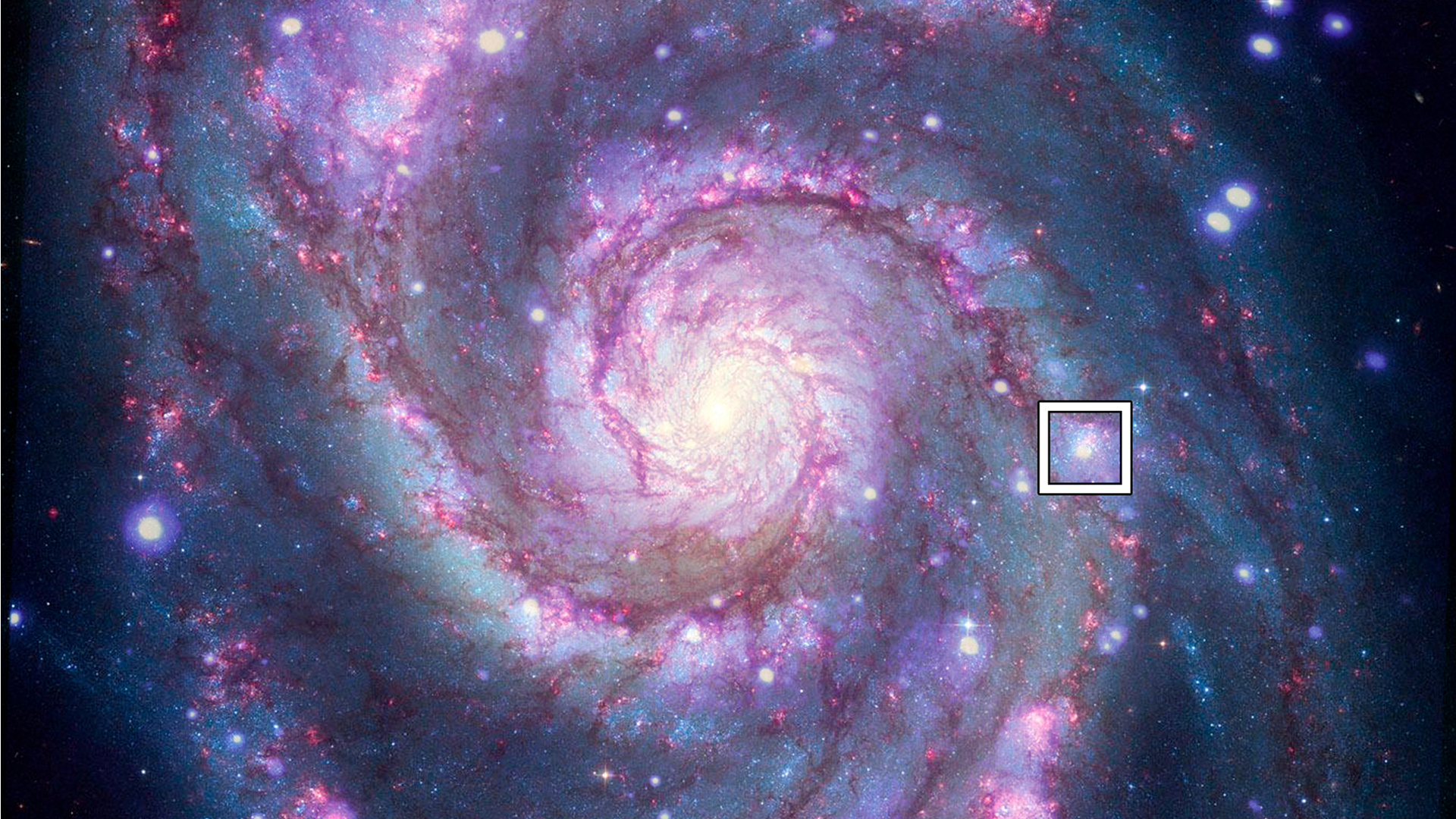
Although our galaxy may have billions of exoplanets, it is much more difficult to discover new planets even in the nearby galaxies. Now, according to a story in New Scientist, a team of Harvard-Smithsonian scientists may have finally overcome that limit thanks to evidence that a planet-sized object is orbiting a binary system in the Whirlpool galaxy.


Over the years, a few scientists found signs of exoplanets in other galaxies, but none have ever been confirmed. The same is true for this potential exoplanet, according to preprint research shared online last week. But still, scientists are cautiously optimistic.


“It’s exciting, but not unexpected,” Angelle Tanner, a Mississippi State University astronomer who didn’t work on the study, told New Scientist. “There’s absolutely no reason to think there wouldn’t be planets in other galaxies.”


Unfortunately, any confirmation could be entire decades away, New Scientist reports. The team found evidence that an object the size of Saturn — potentially a gas giant itself — passed in front of one of the stars in its binary system. But because it’s also orbiting at about the same distance as Saturn does our Sun, it might be decades before it does so again, at which point scientists could confirm the discovery.


“It could be something that just passed in front of this system, never returning again,” Tanner said.


READ MORE: Astronomers may have found the first planet in another galaxy [New Scientist]

The Milky Way Contains 36 Contactable Alien Civilizations, Scientists Estimate


Earth has supported a stunning array of lifeforms for hundreds of millions of years, including humans, the only species known to create cutting-edge technologies. What justification has the rest of the galaxy then? Is the Milky Way home to any advanced alien civilizations, and if so, how many?


The answer to that second question is 36, more or less, according to a study published in The Astrophysical Journal. This is only a statistical estimate, not an announcement that we have stumbled across three dozen civilizations in the galaxy, so there’s no need to pledge allegiance to any alien overlords yet.


But though its conclusions are speculative, the study incorporates new metrics and approaches in approximating how many alien societies within the Milky Way are capable of interstellar messaging (a group known as Communicating Extraterrestrial Intelligent civilizations, or CETI).


“One of the oldest questions that humans have asked is whether our existence—as an advanced intelligent species—is unique,” said authors Tom Westby and Christopher Conselice, who are astrophysicists at the University of Nottingham, in the study.


“Of course—from a statistical perspective—this is one of the most challenging problems in science, since all we can do is attempt to learn from a single known data point (ourselves), with no possible method of modelling the distribution of the potential population of civilizations across the Galaxy,” the team noted.


Westby and Conselice are far from the first scientists who have taken a shot at this challenging question by constraining the possible number of CETI worlds in the Milky Way. This tradition dates back to the Drake equation, pioneered by renowned astronomer Frank Drake in 1961. Drake’s probabilistic thought experiment outlines the conditions that might influence the galactic population of intelligent aliens, and factors in variables such as the galaxy’s star formation rate and the projected lifespan of a technologically advanced civilization.


Westby and Conselice present a revision of the Drake equation that loops in new findings from “a mixture of areas of contemporary astronomy,” according to the study. For instance, thousands of exoplanets have been detected in alien star systems over the past two decades, so Westby and Conselice included data about the odds that worlds orbit their stars within the habitable zone where liquid water can exist. The team also focused on the timescale of intelligent life’s emergence on Earth, a process that took about 4.5 billion years.


The pair’s results produced a range of possible CETI populations that currently exist in the Milky Way, with four at the low end, 211 as an upper limit, and 36 as the most likely figure based on the team’s assumptions.


These high numbers may sound like great news for alien enthusiasts, but Westby and Conselice caution that even if their estimate is correct, CETI worlds may be too far away from Earth to establish communication. If 36 contactable civilizations were scattered throughout the galaxy, they would be about 17,000 light years away from our planet on average, a distance that would require at least 34,000 years for a two-way conversation.


Some of these speculative civilizations may randomly end up closer to Earth, in which case it could be more feasible to strike up an interstellar chat. However, even if aliens were only 1,000 light years away, we would have to make sure that our own civilization survives another 2,000 years if we hope to exchange messages with it.


“If the average lifetime of civilizations is in fact less than 1,030 years, then their average separation becomes too great to allow any communication between neighbours before the species becomes extinct,” Westby and Conselice, citing their calculations.

“The lifetime of civilizations in our Galaxy is a big unknown within this and is by far the most important factor in the CETI equation we develop, as it was for the Drake equation,” they concluded.


In other words, if we humans truly hope to touch base with aliens some day, we should be as dedicated to maintaining Earth’s habitability for future generations as we are to seeking other inhabited worlds in the Milky Way.