Showing posts with label sun. Show all posts

A magnetic gateway will open, linking the Earth and the Sun in every 8 minutes

During the time you read this article, something will happen in the sky that many scientists didn’t believe would happen until recently. NASA says that a magnetic doorway will open that will connect the Earth and the Sun, which are 150 million kilometers apart.


Hundreds of thousands of high-energy particles will pass through this gap until it closes, which will happen about the time you reach the bottom of the page.


NASA’s Goddard Space Flight Center’s space physicist David Seebeck calls it a “flux transfer event” or “FTE.” “In 1998, I was sure they didn’t exist, but the proof is now clear.” In fact, David Seebeck proved their existence in 2008 at a plasma conference in Huntsville, Alabama, when he told a group of space physicists from all over the world about his research.


NASA has found that in the future, these openings between the Sun and the Earth will happen every 8 minutes.


Scientists have thought for a long time that the Earth and the Sun are linked. Through the solar wind, high-energy particles from the Sun get to the Earth’s magnetosphere, which is the magnetic bubble that surrounds our planet, and break through the magnetic shielding.


“We used to think that this connection was permanent and that the solar wind could get into space close to Earth at any time when it was active,” says Seebeck. “We were mistaken. The connections are not at all random, and flares and the speed at which solar particles move have no effect on them. These gates open every 8 minutes.”


Scientists talked about how these gateways are made. On the day side of the Earth, the Earth’s magnetic field is pushed against the Sun’s magnetic field.


Every eight minutes, these two fields briefly “reunite,” making a passageway through which particles can move. The shape of the portal is like a magnetic cylinder that goes all the way around the Earth. Four ESA Cluster spacecraft and five NASA THEMIS probes flew in and around these cylinders, measuring their diameters and keeping track of the particles that went through them.


Seebeck adds, “They are real.” Now that Cluster and THEMIS have looked at gateways in the real world, scientists can use these observations to make computer models of portals and predict how they will act. Jimmy Rader, a space physicist at the University of New Hampshire, talked about one of these ideas at a presentation.


He told his coworkers that cylindrical portals start above the equator and then pass through the Earth’s winter pole. In December, gateways between the Sun and the Earth go through the North Pole. In July, the openings between the Sun and the Earth pass over the South Pole.


Seebeck says, “I think there are two kinds of these portals: active and passive.” Active portals are magnetic cylinders that are large energy conductors for the Earth’s magnetosphere. They make it easy for particles to move through and let a lot of energy through.


Passive portals are magnetic cylinders that are more resistant to particles and fields. Their inner structure keeps particles and fields from passing through so easily (Active FTEs are formed at equatorial latitudes when the IMF is directed to the south; passive FTEs are formed at higher latitudes when the IMF is directed to the north). Seebeck has figured out what passive FTEs look like and told his colleagues to look in the THEMIS and Cluster data for clues.


“It’s possible that passive FTEs are important, but we won’t know for sure until we learn more about them.” Many questions remain unanswered: Why do portals show up every eight minutes? How do magnetic fields twist and curl inside a cylinder? Seebeck adds, “We’re giving it a lot of thought.”


At the same time, a new way to get to the sun is opening up high above you. How do you get and send data?

A magnetic gateway will open, linking the Earth and the Sun in every 8 minutes

During the time you read this article, something will happen in the sky that many scientists didn’t believe would happen until recently. NASA says that a magnetic doorway will open that will connect the Earth and the Sun, which are 150 million kilometers apart.


Hundreds of thousands of high-energy particles will pass through this gap until it closes, which will happen about the time you reach the bottom of the page.


NASA’s Goddard Space Flight Center’s space physicist David Seebeck calls it a “flux transfer event” or “FTE.” “In 1998, I was sure they didn’t exist, but the proof is now clear.” In fact, David Seebeck proved their existence in 2008 at a plasma conference in Huntsville, Alabama, when he told a group of space physicists from all over the world about his research.


NASA has found that in the future, these openings between the Sun and the Earth will happen every 8 minutes.


Scientists have thought for a long time that the Earth and the Sun are linked. Through the solar wind, high-energy particles from the Sun get to the Earth’s magnetosphere, which is the magnetic bubble that surrounds our planet, and break through the magnetic shielding.


“We used to think that this connection was permanent and that the solar wind could get into space close to Earth at any time when it was active,” says Seebeck. “We were mistaken. The connections are not at all random, and flares and the speed at which solar particles move have no effect on them. These gates open every 8 minutes.”


Scientists talked about how these gateways are made. On the day side of the Earth, the Earth’s magnetic field is pushed against the Sun’s magnetic field.


Every eight minutes, these two fields briefly “reunite,” making a passageway through which particles can move. The shape of the portal is like a magnetic cylinder that goes all the way around the Earth. Four ESA Cluster spacecraft and five NASA THEMIS probes flew in and around these cylinders, measuring their diameters and keeping track of the particles that went through them.


Seebeck adds, “They are real.” Now that Cluster and THEMIS have looked at gateways in the real world, scientists can use these observations to make computer models of portals and predict how they will act. Jimmy Rader, a space physicist at the University of New Hampshire, talked about one of these ideas at a presentation.


He told his coworkers that cylindrical portals start above the equator and then pass through the Earth’s winter pole. In December, gateways between the Sun and the Earth go through the North Pole. In July, the openings between the Sun and the Earth pass over the South Pole.


Seebeck says, “I think there are two kinds of these portals: active and passive.” Active portals are magnetic cylinders that are large energy conductors for the Earth’s magnetosphere. They make it easy for particles to move through and let a lot of energy through.


Passive portals are magnetic cylinders that are more resistant to particles and fields. Their inner structure keeps particles and fields from passing through so easily (Active FTEs are formed at equatorial latitudes when the IMF is directed to the south; passive FTEs are formed at higher latitudes when the IMF is directed to the north). Seebeck has figured out what passive FTEs look like and told his colleagues to look in the THEMIS and Cluster data for clues.


“It’s possible that passive FTEs are important, but we won’t know for sure until we learn more about them.” Many questions remain unanswered: Why do portals show up every eight minutes? How do magnetic fields twist and curl inside a cylinder? Seebeck adds, “We’re giving it a lot of thought.”


At the same time, a new way to get to the sun is opening up high above you. How do you get and send data?

The Sun has 8 billion years left, Earth has even less; As per data reveals by ESA

The sun will not last forever. Scientists can foresee the future of the star that gives energy to our solar system. However, we will not be alive to witness it.


The ESA's Star Mapping GAIA project now provides a glimpse into the Sun's future by detecting stars of similar mass and composition and forecasting how our Sun will evolve in the future. Despite the fact that the Earth has less time than the Sun, let us investigate what will happen in the future.


We already know that the Sun is powered by 'nuclear fusion.' Over the next few billion years, the Sun will continue to heat up, eventually depleting the hydrogen at its core. The core would then contract, bringing the hydrogen together to create the nucleus.


While the core is contracting, the Sun's outer atmosphere begins to expand significantly, consuming Earth and even engulfing Mars, transforming the Sun into a red giant.


When the Sun's core runs out of hydrogen and helium, it will eject all of its outer material, becoming a planetary nebula, while the core collapses into a white dwarf.


While this is based on how other stars have grown over time, it is crucial for Earth dwellers to have an idea about our planet's and the Sun's destiny.


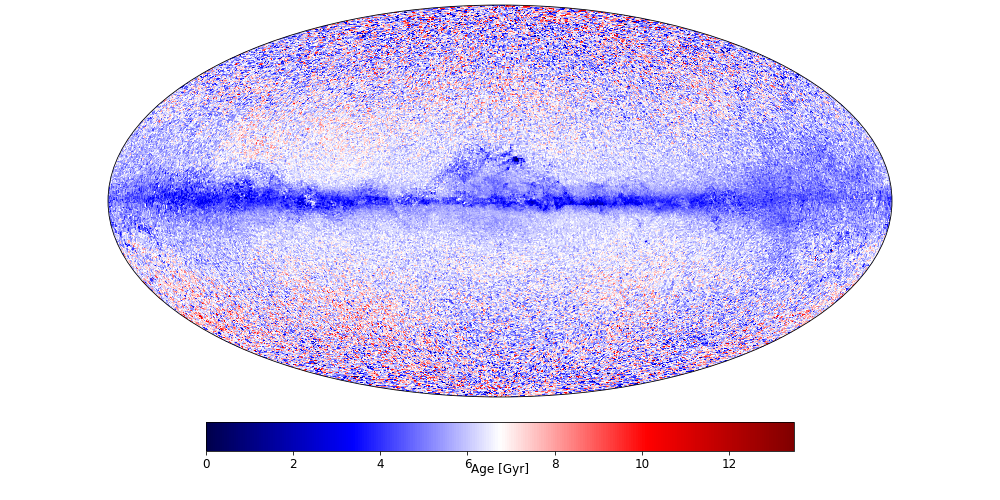
Figure 1. Sky map of stellar age obtained for Gaia Data Release 3, showing the average age of the stars in our Galaxy, with blue representing the younger stars and red representing the older stars. Most of the oldest stars are found outside the galactic disk. The age was derived with the Final Luminosity Age Mass Estimator (FLAME). Shown in this map is a random selection of 10 million stars from Gaia DR3. Credits: ESA/Gaia/DPAC - CC BY-SA 3.0 IGO. Acknowledgements: created by O.Creevey, M. Fouesneau, and the Gaia group at MPIA.


The third and most recent data release (DR3) from ESA's GAIA mission sheds light on the Sun's life cycle. "One of the key results of this release was a database of millions of stars' intrinsic attributes. These factors include their temperature, mass, and the amount of mass they contain."


Figure 2. Hertzsprung-Russell diagram with young massive star sample (OBA), intermediate mass sample (FGKM), low-mass ultra-cool dwarfs (UCD), evolved carbon-rich stars and solar analogues. Credits: ESA/Gaia/DPAC - CC BY-SA 3.0 IGO, based on Gaia Collaboration, Creevey, et al. 2022.


The GAIA mission takes precise readings of the star's apparent brightness and colour from Earth and plots them on a single diagram known as the Hertzsprung-Russell (H-R) diagram. 


An HR diagram plots a star's intrinsic brightness against its effective surface temperature. It reveals how stars change over their long life cycles in this way.

While the mass of a star changes very little over its lifetime, the temperature and size of the star change as it matures, due to the sorts of nuclear fusion events that occur in the core.


Our Sun is at its middle age and stationary condition at 4.57 billion years old. However, as the Sun ages, this stability will change. That's where the most recent GAIA mission data (DR3) comes in.

Orlagh Creevey of the Observatoire de la Côte d'Azur in France and colleagues from Gaia's Coordination Unit 8 analysed the data for the most precise stellar observations that the satellite could provide.


Figure 3: The Gaia DR3 RVS spectra of 1046 solar analogues. Outer grey contour includes 90% of the sample. Inner grey contour contains 68% of the sample. The most prominent absorption lines are marked with vertical dashed lines. Credits: ESA/Gaia/DPAC - CC BY-SA 3.0 IGO. The image is adapted from the one presented in Gaia Collaboration, Creevey et al. 2022. Acknowledgements: Rene Andrae, Andreas Korn, Orlagh Creevey, Georges Kordopatis, Rosanna Sordo.


They concentrated their attention on stars with surface temperatures ranging from 3000K to 10000K since they are similar to the Sun, which has a surface temperature of 6000K.


Furthermore, because these are the longest-living stars in the Milky Way, they can tell the Milky Way's history. They are also promising candidates for the discovery of exoplanets.


The scientists then filtered the results to display only stars with masses and chemical compositions similar to the Sun. The stars they chose traced a line in the H-R diagram that portrays our Sun's evolution from its past to its future because they allowed ages to vary. This implies that the Sun's temperature and brightness change as we age.


According to the findings, our Sun will reach its maximum temperature about 8 billion years old, then cool and expand in size, becoming a red giant star approximately 10-11 billion years old.


After this stage, the Sun will approach the end of its life and become a faint white dwarf.


How long will Earth be nearby?


While it is 8 billion years ahead of the Sun, Earth's duration of time is significantly shorter, at 1 billion years. This is due to the Sun's brightness and temperature growing by 10% per billion years; while 10% may seem insignificant, it would heat Earth sufficiently to make it livable for any form of life.


Orlag and his colleagues sought stars with similar temperatures, surface gravity, composition, mass, and radius to the Sun. He received 5863 stars that fit his criterion.


It also gives a ray of optimism to our way of existence, because there is always the possibility of discovering livable planets like Earth among these 5863 stars like our Sun.


We don't know if there is a planet that could support life right now, but we're looking.


Reference(s): ESA and GAIA Mission

The Sun has 8 billion years left, Earth has even less; As per data reveals by ESA

The sun will not last forever. Scientists can foresee the future of the star that gives energy to our solar system. However, we will not be alive to witness it.


The ESA's Star Mapping GAIA project now provides a glimpse into the Sun's future by detecting stars of similar mass and composition and forecasting how our Sun will evolve in the future. Despite the fact that the Earth has less time than the Sun, let us investigate what will happen in the future.


We already know that the Sun is powered by 'nuclear fusion.' Over the next few billion years, the Sun will continue to heat up, eventually depleting the hydrogen at its core. The core would then contract, bringing the hydrogen together to create the nucleus.


While the core is contracting, the Sun's outer atmosphere begins to expand significantly, consuming Earth and even engulfing Mars, transforming the Sun into a red giant.


When the Sun's core runs out of hydrogen and helium, it will eject all of its outer material, becoming a planetary nebula, while the core collapses into a white dwarf.


While this is based on how other stars have grown over time, it is crucial for Earth dwellers to have an idea about our planet's and the Sun's destiny.


Figure 1. Sky map of stellar age obtained for Gaia Data Release 3, showing the average age of the stars in our Galaxy, with blue representing the younger stars and red representing the older stars. Most of the oldest stars are found outside the galactic disk. The age was derived with the Final Luminosity Age Mass Estimator (FLAME). Shown in this map is a random selection of 10 million stars from Gaia DR3. Credits: ESA/Gaia/DPAC - CC BY-SA 3.0 IGO. Acknowledgements: created by O.Creevey, M. Fouesneau, and the Gaia group at MPIA.


The third and most recent data release (DR3) from ESA's GAIA mission sheds light on the Sun's life cycle. "One of the key results of this release was a database of millions of stars' intrinsic attributes. These factors include their temperature, mass, and the amount of mass they contain."


Figure 2. Hertzsprung-Russell diagram with young massive star sample (OBA), intermediate mass sample (FGKM), low-mass ultra-cool dwarfs (UCD), evolved carbon-rich stars and solar analogues. Credits: ESA/Gaia/DPAC - CC BY-SA 3.0 IGO, based on Gaia Collaboration, Creevey, et al. 2022.


The GAIA mission takes precise readings of the star's apparent brightness and colour from Earth and plots them on a single diagram known as the Hertzsprung-Russell (H-R) diagram. 


An HR diagram plots a star's intrinsic brightness against its effective surface temperature. It reveals how stars change over their long life cycles in this way.

While the mass of a star changes very little over its lifetime, the temperature and size of the star change as it matures, due to the sorts of nuclear fusion events that occur in the core.


Our Sun is at its middle age and stationary condition at 4.57 billion years old. However, as the Sun ages, this stability will change. That's where the most recent GAIA mission data (DR3) comes in.

Orlagh Creevey of the Observatoire de la Côte d'Azur in France and colleagues from Gaia's Coordination Unit 8 analysed the data for the most precise stellar observations that the satellite could provide.


Figure 3: The Gaia DR3 RVS spectra of 1046 solar analogues. Outer grey contour includes 90% of the sample. Inner grey contour contains 68% of the sample. The most prominent absorption lines are marked with vertical dashed lines. Credits: ESA/Gaia/DPAC - CC BY-SA 3.0 IGO. The image is adapted from the one presented in Gaia Collaboration, Creevey et al. 2022. Acknowledgements: Rene Andrae, Andreas Korn, Orlagh Creevey, Georges Kordopatis, Rosanna Sordo.


They concentrated their attention on stars with surface temperatures ranging from 3000K to 10000K since they are similar to the Sun, which has a surface temperature of 6000K.


Furthermore, because these are the longest-living stars in the Milky Way, they can tell the Milky Way's history. They are also promising candidates for the discovery of exoplanets.


The scientists then filtered the results to display only stars with masses and chemical compositions similar to the Sun. The stars they chose traced a line in the H-R diagram that portrays our Sun's evolution from its past to its future because they allowed ages to vary. This implies that the Sun's temperature and brightness change as we age.


According to the findings, our Sun will reach its maximum temperature about 8 billion years old, then cool and expand in size, becoming a red giant star approximately 10-11 billion years old.


After this stage, the Sun will approach the end of its life and become a faint white dwarf.


How long will Earth be nearby?


While it is 8 billion years ahead of the Sun, Earth's duration of time is significantly shorter, at 1 billion years. This is due to the Sun's brightness and temperature growing by 10% per billion years; while 10% may seem insignificant, it would heat Earth sufficiently to make it livable for any form of life.


Orlag and his colleagues sought stars with similar temperatures, surface gravity, composition, mass, and radius to the Sun. He received 5863 stars that fit his criterion.


It also gives a ray of optimism to our way of existence, because there is always the possibility of discovering livable planets like Earth among these 5863 stars like our Sun.


We don't know if there is a planet that could support life right now, but we're looking.


Reference(s): ESA and GAIA Mission

Huge Sunspot Pointed Straight at Earth Has Developed a Delta Magnetic Field


A massive sunspot may be set to erupt, unleashing the most intense form of solar flares that may last for days.


Sunspot AR3089, which is facing Earth, has now acquired a delta-class magnetic field, indicating that it has accumulated enough energy to produce X-class solar flares.


According to the National Oceanic and Atmospheric Administration (NOAA), the sunspot has a 5% chance of producing an X-class outburst. If that happens, the flare might cause a severe geomagnetic storm in the Earth's atmosphere, causing damage to infrastructure and electromagnetic communication systems.


Sunspots are black spots on the sun's surface caused by extremely powerful coronal magnetic fields. When these powerful magnetic fields realign, they can produce solar flares, which are bursts of electromagnetic radiation, as well as coronal mass ejections, which are massive plumes of solar plasma (CMEs).


Delta-class fields are frequently associated with higher levels of solar activity because they cause very large sunspots with reversed magnetic polarity, according to spaceweather.com.


Solar flares ejected from sunspots are classed according to the strength of their X-rays: C-class, M-class, and X-class. C-class flares are common and have few visible consequences on Earth, M-class flares are moderate in intensity and may create modest geomagnetic storms, and X-class flares are the most intense but rare. X-class flares are ten times stronger than M-class flares, and an X10 flare is ten times stronger than an X1 flare.


While the chances of an X-class flare occurring from sunspot AR3089 is low, if one were to occur, the resulting geomagnetic storms could have damaging effects on the Earth. According to NASA, X-class flares hitting Earth may result in damage to satellites, global transmission problems, worldwide radio blackouts, and potentially give airline passengers near the North and South poles small radiation doses.


GPS radio signals must pass through the Earth's ionosphere between the Earth receiver and the satellite in orbit, meaning that when a geomagnetic storm is in effect and the ionosphere is disturbed, the radio signal is distorted and the receivers cannot accurately get a position.


The largest and most powerful X-class flare to hit the Earth is thought to have caused the 1859 Carrington Event, which resulted in bright aurorae being seen around the world, and caused sparking and even fires in some telegraph stations. It's thought that if a storm of this magnitude occurred today, it would result in extended outages of the electrical power grid.


The sun's activity follows 11-year cycles, with its sunspot activity levels and subsequent number of solar flares and CMEs increasing as it approaches the solar maximum. The last solar minimum was in December 2019, and the next solar maximum is forecasted for 2025, however, the sun's activity is higher than previously predicted for its cycle stage.


Solar Cycle 25, the current cycle, is the 25th cycle that has occurred since we began recording sunspot activity in 1755, and according to spaceweather.com, "is on track to outperform" Solar Cycle 24.


Solar Cycle 24 was an average cycle in terms of sunspot activity, meaning that more frequent and more powerful solar flares and CMEs are to be expected in coming years compared to the previous decade.


Reference: Forbes