Showing posts with label Physics. Show all posts

Breaking: Researchers at CERN break “The Speed of Light”

Scientists said on Thursday they recorded particles travelling faster than light – a finding that could overturn one of Einstein’s fundamental laws of the universe. Antonio Ereditato, spokesman for the international group of researchers, saidthat measurements taken over three years showed neutrinos pumped from CERN near Geneva to Gran Sasso in Italy had arrived 60 nanoseconds quicker than light would have done.


“We have high confidence in our results. We have checked and rechecked for anything that could have distorted our measurements but we found nothing,” he said. “We now want colleagues to check them independently.”


If confirmed, the discovery would undermine Albert Einstein’s 1905 theory of special relativity, which says that the speed of light is a “cosmic constant” and that nothing in the universe can travel faster. That assertion, which has withstood over a century of testing, is one of the key elements of the so-called Standard Model of physics, which attempts to describe the way the universe and everything in it works. The totally unexpected finding emerged from research by a physicists working on an experiment dubbed OPERA run jointly by the CERN particle research center near Geneva and the Gran Sasso Laboratory in central Italy.

A total of 15,000 beams of neutrinos – tiny particles that pervade the cosmos – were fired over a period of three years from CERN towards Gran Sasso 730 (500 miles) km away, where they were picked up by giant detectors. Light would have covered the distance in around 2.4 thousandths of a second, but the neutrinos took 60 nanoseconds – or 60 billionths of a second – less than light beams would have taken.


“It is a tiny difference,” said Ereditato, who also works at Berne University in Switzerland, “but conceptually it is incredibly important. The finding is so startling that, for the moment, everybody should be very prudent.”


Ereditato declined to speculate on what it might mean if other physicists, who will be officially informed of the discovery at a meeting in CERN on Friday, found that OPERA’s measurements were correct.


“I just don’t want to think of the implications,” he said. “We are scientists and work with what we know.”


Much science-fiction literature is based on the idea that, if the light-speed barrier can be overcome, time travel might theoretically become possible. The existence of the neutrino, an elementary sub-atomic particle with a tiny amount of mass created in radioactive decay or in nuclear reactions such as those in the Sun, was first confirmed in 1934, but it still mystifies researchers.


It can pass through most matter undetected, even over long distances, and without being affected. Millions pass through the human body every day, scientists say. To reach Gran Sasso, the neutrinos pushed out from a special installation at CERN – also home to the Large Hadron Collider probing the origins of the universe – have to pass through water, air and rock.


The underground Italian laboratory, some 120 km (75 miles) to the south of Rome, is the largest of its type in the world for particle physics and cosmic research. Around 750 scientists from 22 different countries work there, attracted by the possibility of staging experiments in its three massive halls, protected from cosmic rays by some 1,400 meters (4,200 feet) of rock overhead.


What has happened at CERN? 


Scientists say they have clocked neutrinos – tiny particles smaller than atoms – travelling at 300,006 kilometers per second, slightly faster than the speed of light.


What does that mean? 


Einstein’s theory of special relativity says nothing can travel faster than the speed of light in a vacuum, because photons – light particles – have no mass. Proof that neutrinos, mysterious subatomic particles which have a tiny amount of mass, can travel faster would be inconsistent with Einstein’s theory.


What are the knock-on effects? 


Einstein’s theory is critical to the Standard Model of physics that helps explain everything we know about how the universe works, from black holes to the big bang. If it is shown to be flawed, virtually everything in modern physics and the fundamental laws of nature would have to be rethought.


Have the results been proven? The findings were such a shock that CERN’s scientists spent months checking their data before making their announcement. But they have asked American and Japanese teams to confirm the results before they are declared an actual discovery. The data will also be put online overnight so that it can be scrutinized by experts across the world.


Does this mean E does not equal MC squared? The theory of special relativity was used to spawn the theory that energy is equal to mass multiplied by the speed of light squared. It is premature to discount the most famous equation of all time, but the latest discovery suggests one key assumption it relies on – that nothing can accelerate faster than light – may not be wholly accurate.

Scientists Figured Out How to See the Beginning of Time

Princeton scientists believe they have the tools to peer back into the beginning of time itself. The researchers say they can use ripples in space-time, known as gravitational waves, to basically see the start of everything we know.


“We can’t see the early universe directly,” Deepen Garg, graduate student in the Princeton Program in Plasma Physics, says in a news release, “but maybe we can see it indirectly if we look at how gravitational waves from that time have affected matter and radiation that we can observe today.”

By using the same process for researching fusion energy, the scientists studied gravitational waves, which Albert Einstein first predicted in 1916 as a consequence of the theory of relativity. With the disturbances in space-time caused by the movement of dense object, new formulas “could theoretically lead gravitational waves to reveal hidden properties about celestial bodies, like stars that are many lightyears away.”


The hope is that physicists can analyze the characteristics of light to discover properties about a star millions of lightyears away, all while learning about a host of neutron stars, black holes, and star deaths along the way.


Why not shoot bigger and search for any little ripple that shows off a long-sought-after, Big Bang-type moment?


The scientists admit that they have formulas for looking into this concept, but “getting meaningful results will take more work,” they say. So our journey back to the beginning of time will have to wait just a bit longer to start.


Reference(s): Journal of Cosmology and Astroparticle Physics

German physicists got Nuclear Fusion reactor heated to nearly 54 million degrees Fahrenheit


We’re one step closer to a future of near-limitless clean energy. 


Physicists in Germany just found a way to minimize a major heat-loss problem plaguing a promising kind of nuclear fusion reactor called a “stellarator.”


The future of clean energy: Nuclear fusion occurs when the nuclei of two atoms merge into one. This releases an enormous amount of energy — it’s literally enough to power the sun and other stars.


If we could harness the power of nuclear fusion on Earth, it would be an absolute game changer in the battle against climate change.


Recreating fusion on Earth requires scientists to “put the sun in a box.”


Fusion doesn’t produce any carbon emissions (like the burning of fossil fuels) or long-lasting radioactive waste (like nuclear fission), and unlike solar and wind power, it isn’t dependent on the weather.


Designing a nuclear fusion reactor: Nuclear fusion can only happen under extreme heat and pressure — Nobel-winning physicist Pierre-Gilles de Gennes once said recreating it on Earth would require scientists to essentially put the “sun in a box.”


Scientists have designed a few different “boxes” — nuclear fusion reactors — that can create the conditions needed for fusion, but they require more energy than they produce, and until that changes, fusion won’t be a viable source of power.


Stellarators 101: A stellarator is a type of nuclear fusion reactor that looks like a massive donut that has been squished and twisted out of shape. A coil of magnets surrounds the stellarator, creating magnetic fields that control the flow of plasma within it.


By subjecting this plasma to extreme temperatures and pressure, a stellarator can force atoms within it to undergo fusion,  and compared to other fusion reactors, stellarators require less power and have more design flexibility.   


However, the device’s design makes it easier for the plasma to lose heat through a process called “neoclassical transport” — and without heat, you can’t have sustained fusion.


“It’s really exciting news for fusion that this design has been successful.”


NOVIMIR PABLANT


What’s new? Now, researchers have reduced heat loss in the world’s largest and most advanced stellarator — called the Wendelstein 7-X — by optimizing its magnetic coil.


In doing so, they were able to heat the interior of their nuclear fusion reactor to nearly 54 million degrees Fahrenheit — that’s more than twice as hot as the sun’s core — and testing confirmed that their design had specifically minimized heat loss due to neoclassical transport. 


“It’s really exciting news for fusion that this design has been successful,” physicist Novimir Pablant said. “It clearly shows that this kind of optimization can be done.”


And now, stellarators are one step closer to being a usable design for a nuclear fusion reactor.

This is the most accurate image of an atom

A mysterious quantum phenomenon reveals an image of an atom like never before. You can even see the difference between protons and neutrons.

The Relativistic Heavy Ion Accelerator (RHIC), from the Brookhaven Laboratory in the United States, is a sophisticated device capable of accelerating gold ions to a speed of up to 99.995% that of light. Thanks to him, it has recently been possible to verify, for example, Einstein's famous equation E=mc2.

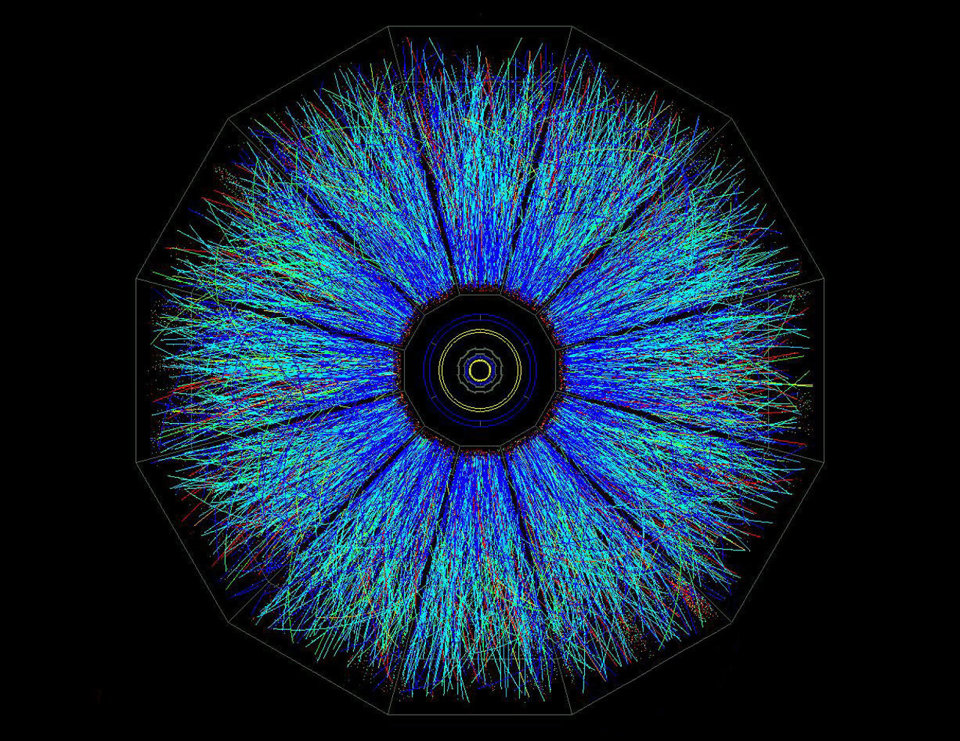
IMAGE: BROOKHAVEN LABORATORY. Final view of a gold atom particles colliding in the STAR detector of the Relativistic Heavy Ion Collider at Brookhaven National Laboratory. The beams travel in opposite directions at nearly the speed of light before colliding.

Now, researchers in this laboratory have shown how it is possible to obtain precise details about the arrangement of protons and neutrons in gold using a type of quantum interference never seen before in an experiment . The technique is reminiscent of the positron emission tomography (PET) scan that doctors use to peer into the brain and other anatomical parts.

BEYOND WHAT WAS SEEN BEFORE

No microscopic probe or X-ray machine is capable of peering into the innards of the atom, so physicists can only theorize what happens there based on the remains of high-speed collisions that take place in particle colliders , such as CERN 's LHC .

However, this new tool opens the possibility of making more precise inferences of protons and neutrons (which make up atomic nuclei) thanks to the quantum entanglement of particles produced when gold atoms rub against each other at high speed.

PHOTO: BROOKHAVEN LABORATORY, UNITED STATES.

The researchers   have shown how it is possible to obtain precise details about the arrangement of protons and neutrons in gold using a type of quantum interference never seen before in an experiment. 

At this scale, nothing can be observed directly because the very light used to carry out the observation interferes with the same observation. However, given enough energy, light waves can actually stir up pairs of particles that make up protons and neutrons, such as quarks and antiquarks . 

When two nuclei intersect within a few nuclear radii, a photon from one nucleus can interact through a virtual quark-antiquark pair with gluons from the other nucleus (gluons are mediators of the strong interaction, the force that binds nuclei). quarks inside protons and neutrons).

This allows for the equivalent of the first experimental observation of entanglement involving different particles, allowing images so precise that the difference between the place of neutrons and protons within the atomic nucleus can even begin to be appreciated.

BREAKING: The Physics Nobel Prize Winner of 2022 just Proved that the "Universe is actually not real"


The fact that the universe is not locally real is one of the more disquieting discoveries of the last half-century. "Real," which indicates that objects have defined attributes independent of observation—for example, an apple can be red even when no one is looking; "local," which means that objects can only be impacted by their surroundings, and that any effect cannot travel faster than light. Quantum physics researchers have discovered that these concepts cannot both be true. Instead, the evidence suggests that objects are not only influenced by their surroundings, and that they may lack distinct properties prior to measurement. "Do you honestly believe the moon isn't there when you're not gazing at it?" Albert Einstein famously asked a friend.


This is, of course, deeply contrary to our everyday experiences. To paraphrase Douglas Adams, the demise of local realism has made a lot of people very angry and been widely regarded as a bad move.


The accomplishment has now been attributed to three physicists: John Clauser, Alain Aspect, and Anton Zeilinger. They were awarded the Nobel Prize in Physics in 2022 in equal parts "for experiments with entangled photons, establishing the violation of Bell inequalities, and pioneering quantum information science." ("Bell inequalities" alludes to the early 1960s pioneering work of Northern Irish physicist John Stewart Bell, who established the groundwork for this year's Physics Nobel.) Colleagues felt that the trio deserved this punishment for upending reality as we know it. "This is wonderful news. "It had been a long time coming," Sandu Popescu, a quantum physicist at the University of Bristol, says. "There is no doubt that the award is well-deserved."

“The experiments beginning with the earliest one of Clauser and continuing along, show that this stuff isn’t just philosophical, it’s real—and like other real things, potentially useful,” says Charles Bennett, an eminent quantum researcher at IBM. 

“Each year I thought, ‘oh, maybe this is the year,’” says David Kaiser, a physicist and historian at the Massachusetts Institute of Technology. “This year, it really was. It was very emotional—and very thrilling.”


Quantum foundations’ journey from fringe to favor was a long one. From about 1940 until as late as 1990, the topic was often treated as philosophy at best and crackpottery at worst. Many scientific journals refused to publish papers in quantum foundations, and academic positions indulging such investigations were nearly impossible to come by. In 1985, Popescu’s advisor warned him against a Ph.D. in the subject. 


“He said ‘look, if you do that, you will have fun for five years, and then you will be jobless,’” Popescu says.


Today, quantum information science is among the most vibrant and impactful subfields in all of physics. It links Einstein’s general theory of relativity with quantum mechanics via the still-mysterious behavior of black holes. It dictates the design and function of quantum sensors, which are increasingly being used to study everything from earthquakes to dark matter. And it clarifies the often-confusing nature of quantum entanglement, a phenomenon that is pivotal to modern materials science and that lies at the heart of quantum computing.


“What even makes a quantum computer ‘quantum’?” Nicole Yunger Halpern, a National Institute of Standards and Technology physicist, asks rhetorically. “One of the most popular answers is entanglement, and the main reason why we understand entanglement is the grand work participated in by Bell and these Nobel Prize–winners. Without that understanding of entanglement, we probably wouldn’t be able to realize quantum computers.”


WHOM DOES THE BELL RING?


The trouble with quantum mechanics was never that it made the wrong predictions—in fact, the theory described the microscopic world splendidly well right from the start when physicists devised it in the opening decades of the 20th century.


What Einstein, Boris Podolsky and Nathan Rosen took issue with, laid out in their iconic 1935 paper, was the theory’s uncomfortable implications for reality. Their analysis, known by their initials EPR, centered on a thought experiment meant to illustrate the absurdity of quantum mechanics; to show how under certain conditions the theory can break—or at least deliver nonsensical results that conflict with everything else we know about reality. A simplified and modernized version of EPR goes something like this: Pairs of particles are sent off in different directions from a common source, targeted for two observers, Alice and Bob, each stationed at opposite ends of the solar system. Quantum mechanics dictates that it is impossible to know the spin, a quantum property of individual particles prior to measurement. When Alice measures one of her particles, she finds its spin to be either up or down. Her results are random, and yet, when she measures up, she instantly knows Bob’s corresponding particle must be down. At first glance, this is not so odd; perhaps the particles are like a pair of socks—if Alice gets the right sock, Bob must have the left.


But under quantum mechanics, particles are not like socks, and only when measured do they settle on a spin of up or down. This is EPR’s key conundrum: If Alice’s particles lack a spin until measurement, how then when they whiz past Neptune do they know what Bob’s particles will do as they fly out of the solar system in the other direction? Each time Alice measures, she effectively quizzes her particle on what Bob will get if he flips a coin: up, or down? The odds of correctly predicting this even 200 times in a row are 1 in 1060—a number greater than all the atoms in the solar system. Yet despite the billions of kilometers that separate the particle pairs, quantum mechanics says Alice’s particles can keep correctly predicting, as though they were telepathically connected to Bob’s particles.


Although intended to reveal the imperfections of quantum mechanics, when real-world versions of the EPR thought experiment are conducted the results instead reinforce the theory’s most mind-boggling tenets. Under quantum mechanics, nature is not locally real—particles lack properties such as spin up or spin down prior to measurement, and seemingly talk to one another no matter the distance.


Physicists skeptical of quantum mechanics proposed that there were “hidden variables,” factors that existed in some imperceptible level of reality beneath the subatomic realm that contained information about a particle’s future state. They hoped in hidden-variable theories, nature could recover the local realism denied to it by quantum mechanics.


“One would have thought that the arguments of Einstein, Podolsky and Rosen would produce a revolution at that moment, and everybody would have started working on hidden variables,” Popescu says.


Einstein’s “attack” on quantum mechanics, however, did not catch on among physicists, who by and large accepted quantum mechanics as is. This was often less a thoughtful embrace of nonlocal reality, and more a desire to not think too hard while doing physics—a head-in-the-sand sentiment later summarized by the physicist David Mermin as a demand to “shut up and calculate.”


The lack of interest was driven in part because John von Neumann, a highly regarded scientist, had in 1932 published a mathematical proof ruling out hidden-variable theories. (Von Neumann’s proof, it must be said, was refuted just three years later by a young female mathematician, Grete Hermann, but at the time no one seemed to notice.)


Quantum mechanics’ problem of nonlocal realism would languish in a complacent stupor for another three decades until being decisively shattered by Bell. From the start of his career, Bell was bothered by the quantum orthodoxy and sympathetic toward hidden variable theories. Inspiration struck him in 1952, when he learned of a viable nonlocal hidden-variable interpretation of quantum mechanics devised by fellow physicist David Bohm—something von Neumann had claimed was impossible. Bell mulled the ideas over for years, as a side project to his main job working as a particle physicist at CERN.


In 1964, Bell rediscovered the same flaws in von Neumann’s argument that Hermann had. And then, in a triumph of rigorous thinking, Bell concocted a theorem that dragged the question of hidden variables from its metaphysical quagmire onto the concrete ground of experiment.


Normally, hidden-variable theories and quantum mechanics predict indistinguishable experimental outcomes. What Bell realized is that under precise circumstances, an empirical discrepancy between the two can emerge. In the eponymous Bell test (an evolution of the EPR thought experiment), Alice and Bob receive the same paired particles, but now they each have two different detector settings—A and a, B and b. These detector settings allow Alice and Bob to ask the particles different questions; an additional trick to throw off their apparent telepathy. In local hidden-variable theories, where their state is preordained and nothing links them, particles cannot outsmart this extra step, and they cannot always achieve the perfect correlation where Alice measures spin down when Bob measures spin up (and vice versa). But in quantum mechanics, particles remain connected and far more correlated than they could ever be in local hidden-variable theories. They are, in a word, entangled.


Measuring the correlation multiple times for many particle pairs, therefore, could prove which theory was correct. If the correlation remained below a limit derived from Bell’s theorem, this would suggest hidden variables were real; if it exceeded Bell’s limit, then the mind-boggling tenets of quantum mechanics would reign supreme. And yet, in spite of its potential to help determine the very nature of reality, after being published in a relatively obscure journal Bell’s theorem languished unnoticed for years.


THE BELL IS RINGING FOR THEE


In 1967, John Clauser, then a graduate student at Columbia University, accidentally stumbled across a library copy of Bell’s paper and became enthralled by the possibility of proving hidden-variable theories correct. Clauser wrote to Bell two years later, asking if anyone had actually performed the test. Clauser’s letter was among the first feedback Bell had received.


With Bell’s encouragement, five years later Clauser and his graduate student Stuart Freedman performed the first Bell test. Clauser had secured permission from his supervisors, but little in the way of funds, so he became, as he said in a later interview, adept at “dumpster diving” to secure equipment—some of which he and Freedman then duct-taped together. In Clauser’s setup—a kayak-sized apparatus requiring careful tuning by hand—pairs of photons were sent in opposite directions toward detectors that could measure their state, or polarization.


Unfortunately for Clauser and his infatuation with hidden variables, once he and Freedman completed their analysis, they could not help but conclude that they had found strong evidence against them. Still, the result was hardly conclusive, because of various “loopholes” in the experiment that conceivably could allow the influence of hidden variables to slip through undetected. The most concerning of these was the locality loophole: if either the photon source or the detectors could have somehow shared information (a plausible feat within the confines of a kayak-sized object), the resulting measured correlations could still emerge from hidden variables. As Kaiser puts it pithily, if Alice tweets at Bob which detector setting she’s in, that interference makes ruling out hidden variables impossible.


Closing the locality loophole is easier said than done. The detector setting must be quickly changed while photons are on the fly—“quickly” meaning in a matter of mere nanoseconds. In 1976, a young French expert in optics, Alain Aspect, proposed a way for doing this ultra-speedy switch. His group’s experimental results, published in 1982, only bolstered Clauser’s results: local hidden variables looked extremely unlikely. 


“Perhaps Nature is not so queer as quantum mechanics,” Bell wrote in response to Aspect’s initial results. “But the experimental situation is not very encouraging from this point of view.”


Other loopholes, however, still remained—and, alas, Bell died in 1990 without witnessing their closure. Even Aspect’s experiment had not fully ruled out local effects because it took place over too small a distance. Similarly, as Clauser and others had realized, if Alice and Bob were not ensured to detect an unbiased representative sample of particles, they could reach the wrong conclusions.


No one pounced to close these loopholes with more gusto than Anton Zeilinger, an ambitious, gregarious Austrian physicist. In 1998, he and his team improved on Aspect’s earlier work by conducting a Bell test over a then-unprecedented distance of nearly half a kilometer. The era of divining reality’s nonlocality from kayak-sized experiments had drawn to a close. Finally, in 2013, Zeilinger’s group took the next logical step, tackling multiple loopholes at the same time.


“Before quantum mechanics, I actually was interested in engineering. I like building things with my hands,” says Marissa Giustina, a quantum researcher at Google who worked with Zeilinger.  “In retrospect, a loophole-free Bell experiment is a giant systems-engineering project.” 


One requirement for creating an experiment closing multiple loopholes was finding a perfectly straight, unoccupied 60-meter tunnel with access to fiber optic cables. As it turned out, the dungeon of Vienna’s Hofburg palace was an almost ideal setting—aside from being caked with a century’s worth of dust. Their results, published in 2015, coincided with similar tests from two other groups that also found quantum mechanics as flawless as ever.


BELL'S TEST GOES TO THE STARS


One great final loophole remained to be closed, or at least narrowed. Any prior physical connection between components, no matter how distant in the past, has the possibility of interfering with the validity of a Bell test’s results. If Alice shakes Bob’s hand prior to departing on a spaceship, they share a past. It is seemingly implausible that a local hidden-variable theory would exploit these loopholes, but still possible.


In 2017, a team including Kaiser and Zeilinger performed a cosmic Bell test. Using telescopes in the Canary Islands, the team sourced its random decisions for detector settings from stars sufficiently far apart in the sky that light from one would not reach the other for hundreds of years, ensuring a centuries-spanning gap in their shared cosmic past. Yet even then, quantum mechanics again proved triumphant.


One of the principal difficulties in explaining the importance of Bell tests to the public—as well as to skeptical physicists—is the perception that the veracity of quantum mechanics was a foregone conclusion. After all, researchers have measured many key aspects of quantum mechanics to a precision of greater than 10 parts in a billion. 


“I actually didn’t want to work on it. I thought, like, ‘Come on; this is old physics. We all know what’s going to happen,’” Giustina says. 


But the accuracy of quantum mechanics could not rule out the possibility of local hidden variables; only Bell tests could do that.


“What drew each of these Nobel recipients to the topic, and what drew John Bell himself, to the topic was indeed [the question], ‘Can the world work that way?’” Kaiser says. “And how do we really know with confidence?” What Bell tests allow physicists to do is remove the bias of anthropocentric aesthetic judgments from the equation; purging from their work the parts of human cognition that recoil at the possibility of eerily inexplicable entanglement, or that scoff at hidden-variable theories as just more debates over how many angels may dance on the head of a pin. The award honors Clauser, Aspect and Zeilinger, but it is testament to all the researchers who were unsatisfied with superficial explanations about quantum mechanics, and who asked their questions even when doing so was unpopular.

“Bell tests,” Giustina concludes, “are a very useful way of looking at reality.”


Image Description: John Stewart Bell (1928-1990), the Northern Irish physicist whose work sparked a quiet revolution in quantum physics. Credit: Peter Menzel/Science Source
Have we finally discovered the origin of time?

 Is time a dimension, a human invention, a linear arrow or a real aspect of entropy? 

To this day, science has not been able to reveal the secrets that are hidden behind this simple word. There are many theories and each one navigates the possible origin of time, but are we really prepared to discover it? 

Entropy could have the answer.

Have we finally discovered the origin of time?

Imagine a glass full of hot water , as time passes the heat escapes and there will undoubtedly come a time when the water is cold. The same thing happens if you add an ice cube to it, it will melt little by little until the water equals its temperature with that of the surroundings. 

Thanks to this we know that time passes and that it does so in a so-called 'arrow of time'. That is to say that it advances and it is impossible for it to go back. We couldn't add an ice cube to a glass of water and expect it to warm up, right?

From this simple example, thermodynamics is associated with time. Although they seem to be unrelated, they are actually closely linked. And this is where a more relevant term appears for understanding the origin of time: entropy.

Have we finally discovered the origin of time?

From disorder to more chaotic states

It is in the second law of thermodynamics where a concept widely used today appears, which is used to describe the processes of the universe and where the idea of ​​the "arrow of time" arose; entropy. This law states that as energy is transferred and transformed, some of it is dissipated (wasted). 

For this reason, a system always evolves towards a more chaotic state and never the other way around. We can understand this with a deck of cards, if we shuffle them the highest probability is that they will result in a state even more disordered than the initial one and not that they will find order by chance.

Thanks to Ludwig Boltzman, an Austrian physicist from the late 20th century, we are now more or less able to understand why time always passes from point A to point B and never the other way around. 

Boltzman introduced the concept of entropy and his great contribution to science is that according to his theory the future is different from the past simply because the entropy of the Universe has increased (the chaotic state).

Although it is clear that this is only the beginning of a series of obstacles to reach a small understanding of the origin of time. The Universe is not governed by thermodynamics, but more unknowns come into play in the equation, such as gravity that permeates everything out there. Here theories such as string theory appear that seek to get closer to understanding time and the Universe as a whole. 

Although this theory has certainly been losing strength little by little and in the meantime, we will continue looking for answers and perhaps at some point we will be able to better understand how time behaves.

Whoa! Light can travel back in time, scientists discover

A team of physicists claims to have moved light from one side of time to the other simultaneously ; that is, a kind of quantum trick to move a photon (particle of light) forward and backward in time.

The quantum experiment in which a particle of light has traveled back and forth in time at the same time has been demonstrated by two independent research groups. Can a photon exist in both states of time at the same time?

How have they achieved it?

The scientists involved in both experiments have achieved this thanks to a combination of two principles that are part of the strange world of quantum mechanics and using a special optical crystal: the convergence of quantum superposition and the symmetry of charge, parity and time reversal. (CPT), which describe the physical properties of atoms and subatomic particles.

Thanks to this effect, splitting a photon through a crystal produces a counterintuitive behavior or rule . The clearest example of quantum superposition we know from the hand of Schrödinger and the famous hypothetical cat that is considered both alive and dead due to the fact that its life is in the hands of a random subatomic event that takes place and has no place until observed. On the other hand, the second law, symmetry of charge, parity, and time reversal, states that any system containing particles will obey the same physical laws even if the charges, spatial coordinates, and motions through time of the particles are invest. This makes it possible for an overlapping particle to travel both forward and backward in time .

By measuring the polarization of the photons during the experiment, previously recombining the overlapping photons moving through another crystal, they found a quantum interference pattern: a pattern that could only and exclusively occur if the same photon moved in both directions. That's right: a photon that seemed to travel simultaneously along and backward on the arrow of time .


If confirmed, as the studies are pending peer review and available on the arXiv preprint server, placing a particle of light in an overlay to travel both forward and backward in time could prove useful for computation. quantum (and not so much to allow us time travel, which is surely what many readers are thinking). And it is that it would not have an immediate practical use, but perhaps it would have implications for quantum computers, even helping to develop a theory of quantum gravity. We will soon know if this exotic physics experiment leads to new paths in quantum physics.

Time travel would be possible, but only in parallel time lines

Reference: Experimental superposition of time directions

Teodor Strömberg, Peter Schiansky, Marco Túlio Quintino, Michael Antesberger, Lee Rozema, Iris Agresti, Časlav Brukner, Philip Walther Quantum Physics

https://doi.org/10.48550/arXiv.2211.01283

Experimental demonstration of input-output indefiniteness in a single quantum device

Yu Guo, Zixuan Liu, Hao Tang, Xiao-Min Hu, Bi-Heng Liu, Yun-Feng Huang, Chuan-Feng Li, Guang-Can Guo, Giulio Chiribella Quantum Physics

https://doi.org/10.48550/arXiv.2210.17046

'Immortality is my goal': 11-year-old boy gets bachelor’s degree in physics

Laurent Simons, a kid from the Belgian coastal town of Ostend, has just graduated from the University of Antwerp with a bachelor's degree in physics, making him the world's second-youngest graduate. 

Eleven-year-old Simons only took a year to complete his bachelor’s degree, which usually takes at least three years.

In a conversation with the Dutch daily De Telegraaf, Simons said that, "I don't really care if I'm the youngest." "It's all about getting knowledge for me."

"This is the first puzzle piece in my goal of replacing body parts with mechanical parts," Simons said.

"Immortality" is his goal, the child prodigy said.

"I want to be able to replace as many body parts as possible with mechanical parts.I’ve mapped out a path to get there. You can see it as a big puzzle. Quantum physics – the study of the smallest particles – is the first piece of the puzzle," he said.

To solve that puzzle, he said, "I want to work with the best professors in the world, look inside their brains, and find out how they think."

He finished high school in just 1.5 years and received his diploma when he was eight years old.

He grew interested in classical mechanics and quantum physics last year, and he became consumed with learning everything he could about them.

He subsequently put all of his other projects on hold to focus only on this.

A Woman Has Won the ‘Nobel Prize of Math’ for the First Time Ever

For the first time, one of the world's most prestigious mathematics prizes was given to a woman. 

Karen Uhlenbeck, an emeritus professor of mathematics at the University of Texas at Austin, is the first woman to receive the Abel Prize in mathematics.

According to the New York Times, the prize recognises "the basic importance of her work on analysis, geometry, and mathematical physics." 

It is granted by the King of Norway to excellent mathematicians who have profoundly influenced their area, and includes a monetary prize of Norwegian kroner worth approximately $700,000. Since 2003, the prize has been given out, however all past winners have been men.

Dr. Uhlenbeck is widely recognised for her contributions to geometric partial differential equations, gauge theory, and integrable systems. According to the Times, she helped pioneer a branch known as geometric analysis, and her theories of predictive mathematics, inspired by soap bubbles, were among her most notable achievements.

“She did things nobody thought about doing, and after she did, she laid the foundations of a branch of mathematics,” said Sun-Yung Alice Chang, a mathematician at Princeton University who served on the prize committee.

According to the Times, Dr. Uhlenbeck found out about her history-making award on Sunday morning, via text message, and said that she has yet to decide what to do with the cash prize that comes with it.

“When I came out of church, I noticed that I had a text message from Alice Chang that said, Would I please accept a call from Norway?” she said. “When I got home, I called Norway back and they told me.”

A big problem with fusion is solved leading us near to a perpetual energy source

As the dynamics inside a fusion reactor are very complex, the walls melt.

Image credit: Max Planck Institute of Plasma physics. Cutaway of a Fusion Reactor

A team of researchers from the Max Planck Institute for Plasma Physics (IPP) and the Vienna University of Technology (TU Wein) have discovered a way to control Type-I ELM plasma instabilities, that melt the walls of fusion devices. The study is published in the journal Physical Review Letters.

There is no doubt that the day will come when fusion power plants can provide sustainable energy and solve our persistent energy problems. It is the main reason why so many scientists around the world are working on this power source. Power generation in this way actually mimics the sun.


For the method to work, the plasmas must be heated to 100 million degrees Celsius inside the reactors. A Magnetic fields surrounds the plasma keep the walls of the reactor from melting. The shell that forms around the plasma can  work only because the outermost few centimeters of the edge of that shell, called the magnetically formed plasma edge, is very  well insulated.

However, there is a drawback to this method of keeping the plasma's solar-level heat within. In that edge region, which are plasma instabilities, exist there (ELMs). ELMs typically happen during fusion reactions. In the course of an ELM, intense plasma particles may strike the reactor's wall and cause possible damage.

The researchers returned to a technique of operation that had been previously abandoned, in a move that would remind anybody of presenting an original of anything after numerous trials of other approaches just to discover that the original is the correct one.

Instead of possibly harming the reactor's walls, very destructive instabilities. Numerous minor instabilities are possible, but none of them pose a threat to the walls of the reactor.

Elisabeth Wolfrum, research group head at IPP in Garching, Germany, and professor at TU Wien, states that "Our discovery marks a breakthrough in understanding the occurrence and prevention of massive Type I ELMs." The operating regime we provide is most likely the most optimistic case for fusion power plant plasmas in the future. Now, the findings have been released in the publication Physical Review Letters.

Toroidal tokamak fusion reactor is the name of the reactor. Extremely hot plasma particles travel quickly within this reactor. Strong magnetic coils make sure that the particles stay contained rather than destroying the reactor's walls by striking them.

How a fusion reactor works is complex, and the dynamics inside are also complex. The motion of the particles depends on the plasma density, temperature and magnetic field. The reactor's operation is determined by the selection of these parameters. When the smaller particles of plasma strike the walls or the reactor, instead of a round shape, the reactor takes on a triangular shape with rounded corners, however this shape is far less damaged than that caused by a big ELM. 


The primary author of the study, Georg Harrer, compares it to a cooking pot with a cover where water is beginning to boil. "If the pressure increases more, the lid will raise and shake violently as the steam escapes. However, if you tilt the lid just a little bit, steam may constantly escape while the top stays put and doesn't rattle."


The possibility for a continuous fusion process with enormous energy is greatly increased by this. A perpetual energy source.


Reference(s): Physical Review Letters

Conspiracy Theorists Claim The Large Hadron Collider Transferred Us Into A Parallel Universe In Latest Experiment

The largest particle accelerator in the world was restarted after three years of modifications and maintenance, and it quickly made its first observations of three exotic particles.

Now operational, the Large Hadron Collider (LHC) is shattering records for the highest energetic particle collisions ever carried out. The teams engaged are looking for evidence of dark matter as well as additional details on the so-called "god particle," the Higgs Boson.

Naturally, some conspiracy theorists are worried that the collider would create a portal to hell or a parallel universe from which there is no way back.

Conspiracy theories about CERN have long been widespread, ranging from the construction of black holes to human sacrifices on the property. The theories this year have all revolved around the opening of a doorway to another dimension, so it looks that the conspiracy theorists have been watching a bit too much Doctor Strange and the Multiverse of Madness.

Who has sensed a significant change is coming for some time now? One verified astrologer provided a classic example of a conspiracy theory on Twitter. 

"Now on july 5th we are quite literally gonna be switching timelines, when CERN is gonna turn on their machine thingy it’s opening a portal to go through also the unknown is coming in. Keep your positive vibes and energy up."

"I’ve looked into this," another added, look for 10x more Mandela effects.. because back in 2012 they did a record voltage level that caused these Mandela effects, whatever portal they’re opening, they shouldn’t."

Even though it's absurd to think that by vibbing, you can prevent getting sucked into a parallel realm produced by the "machine thingy," let's take the conspiracy theory seriously for a minute

If you were to be generous, you may speculate that the alternative dimension ideas are founded on the notion that the LHC might, in principle, find evidence of more dimensions.

"How could we test for extra dimensions? One option would be to find evidence of particles that can exist only if extra dimensions are real," CERN explains on their website.

According to theories that propose more dimensions, there would be heavier versions of common particles in those dimensions, much as atoms have a low-energy ground state and excited, high-energy states. 

These more massive versions of the particles, known as Kaluza-Klein states, would have all the same characteristics as normal particles and hence be detectable by our detectors.

The discovery of a Z- or W-like particle by CMS or ATLAS, with a mass 100 times greater, for example—the Z and W bosons serving as carriers of the electroweak force—might point to the existence of additional dimensions. 

Only at the high energies attained by the Large Hadron Collider (LHC) can such heavy particles be exposed.

Another possibility is that the LHC might create extraordinarily tiny, (extremely) transient black holes.

These tiny black holes' presence may provide information concerning the possibility of other dimensions. 

They would, however, collapse in on themselves in between 10 and 27 seconds and are not something that would engulf the world.

According to CERN, theories of miniature black holes at the LHC make reference to particles created in the collisions of proton pairs, each of which has an energy similar to that of a mosquito in flight.

Astronomical black holes are far heavier than anything the LHC could create.

So, you wonder, how did conspiracy theorists respond when the LHC started up and we didn't change dimensions? Faster than a proton being thrown around a particle accelerator, they altered the goalposts.

"A lot of people are discounting how serious the CERN Hadron Collider agenda truly is. It’s not like beings emerge from a portal and instantly kill everyone," one user wrote. "That’s not how Satanic rituals work. The ramifications of what happened yesterday will unfold in the coming months."

They had previously tweeted "in 8 hours the gates of ‘hell’ will be opened. The transdimensional reptilian beings are coming for you and your family. This is not a drill."

Scientists At CERN Have just Detected A New "Ghost Particle"

Scientists are trying to work out if a strange new particle, dubbed a “ghost particle”, has been detected at CERN’s Large Hadron Collider (LHC) in Switzerland.

Using the Compact Muon Solenoid (CMS) instrument on the particle accelerator, the team said they had seen a signal that could be a particle that’s twice the mass of a carbon atom. 

But as the particle does not fit known theories, it could cause a bit of a stir if it exists. Their findings, which have not yet been peer-reviewed, are available on arXiv.

“I’d say theorists are excited and experimentalists are very skeptical,” Alexandre Nikitenko, a theorist on the CMS team who worked on the data, told The Guardian. “As a physicist I must be very critical, but as the author of this analysis I must have some optimism too.”

The team were due to discuss their findings in a meeting today at CERN. Those findings suggest a build-up of muons, which are heavy electrons, in the CMS detector. This would correspond to a particle with a mass of 28GeV, which is about a quarter the mass of the Higgs boson at 125 GeV.

It may take another year to find out if this particle is real or not, but as Science Alert notes, even if it is real it’s not exactly physics-breaking. “But it is strange – a mass that has formed where no mass was expected,” they said.

This isn’t the only particle news we’ve had this year. In fact, this isn’t even the only “ghost particle” news we’ve had, because in July, astronomers announced the discovery of neutrinos coming from an energetic galaxy 4 billion light-years away – a slightly different discovery, for sure though.

Perhaps more relevant was the news from September this year, when scientists suggested they “broke the Standard Model” with the detection of ultra-high energy cosmic neutrinos using the Antarctic Impulsive Transient Antenna (ANITA).

In March, there was news of the weirdly named “skyrimon”, a particle with ball lightning-like properties. And also in September, results at CERN hinted at a particle that seemed to defy the Standard Model.

Will this latest discovery stand up to scrutiny? Time will tell. But it's certainly an exciting time for physics at the moment.

BREAKING: The Physics Nobel Prize Winner of 2022 just Proved that the "Universe is actually not real"

The fact that the universe is not locally real is one of the more disquieting discoveries of the last half-century. 

"Real," which indicates that objects have defined attributes independent of observation—for example, an apple can be red even when no one is looking; "local," which means that objects can only be impacted by their surroundings, and that any effect cannot travel faster than light. 

Quantum physics researchers have discovered that these concepts cannot both be true. Instead, the evidence suggests that objects are not only influenced by their surroundings, and that they may lack distinct properties prior to measurement. "Do you honestly believe the moon isn't there when you're not gazing at it?" Albert Einstein famously asked a friend.

This is, of course, deeply contrary to our everyday experiences. To paraphrase Douglas Adams, the demise of local realism has made a lot of people very angry and been widely regarded as a bad move.

The accomplishment has now been attributed to three physicists: John Clauser, Alain Aspect, and Anton Zeilinger. They were awarded the Nobel Prize in Physics in 2022 in equal parts "for experiments with entangled photons, establishing the violation of Bell inequalities, and pioneering quantum information science." ("Bell inequalities" alludes to the early 1960s pioneering work of Northern Irish physicist John Stewart Bell, who established the groundwork for this year's Physics Nobel.) Colleagues felt that the trio deserved this punishment for upending reality as we know it. "This is wonderful news. "It had been a long time coming," Sandu Popescu, a quantum physicist at the University of Bristol, says. "There is no doubt that the award is well-deserved."

“The experiments beginning with the earliest one of Clauser and continuing along, show that this stuff isn’t just philosophical, it’s real—and like other real things, potentially useful,” says Charles Bennett, an eminent quantum researcher at IBM. 

“Each year I thought, ‘oh, maybe this is the year,’” says David Kaiser, a physicist and historian at the Massachusetts Institute of Technology. “This year, it really was. It was very emotional—and very thrilling.”

Quantum foundations’ journey from fringe to favor was a long one. From about 1940 until as late as 1990, the topic was often treated as philosophy at best and crackpottery at worst. Many scientific journals refused to publish papers in quantum foundations, and academic positions indulging such investigations were nearly impossible to come by. In 1985, Popescu’s advisor warned him against a Ph.D. in the subject. 

“He said ‘look, if you do that, you will have fun for five years, and then you will be jobless,’” Popescu says.

Today, quantum information science is among the most vibrant and impactful subfields in all of physics. It links Einstein’s general theory of relativity with quantum mechanics via the still-mysterious behavior of black holes. It dictates the design and function of quantum sensors, which are increasingly being used to study everything from earthquakes to dark matter. And it clarifies the often-confusing nature of quantum entanglement, a phenomenon that is pivotal to modern materials science and that lies at the heart of quantum computing.

“What even makes a quantum computer ‘quantum’?” Nicole Yunger Halpern, a National Institute of Standards and Technology physicist, asks rhetorically. “One of the most popular answers is entanglement, and the main reason why we understand entanglement is the grand work participated in by Bell and these Nobel Prize–winners. Without that understanding of entanglement, we probably wouldn’t be able to realize quantum computers.”

WHOM DOES THE BELL RING?

The trouble with quantum mechanics was never that it made the wrong predictions—in fact, the theory described the microscopic world splendidly well right from the start when physicists devised it in the opening decades of the 20th century.

What Einstein, Boris Podolsky and Nathan Rosen took issue with, laid out in their iconic 1935 paper, was the theory’s uncomfortable implications for reality. Their analysis, known by their initials EPR, centered on a thought experiment meant to illustrate the absurdity of quantum mechanics; to show how under certain conditions the theory can break—or at least deliver nonsensical results that conflict with everything else we know about reality. 

A simplified and modernized version of EPR goes something like this: Pairs of particles are sent off in different directions from a common source, targeted for two observers, Alice and Bob, each stationed at opposite ends of the solar system. Quantum mechanics dictates that it is impossible to know the spin, a quantum property of individual particles prior to measurement. When Alice measures one of her particles, she finds its spin to be either up or down. Her results are random, and yet, when she measures up, she instantly knows Bob’s corresponding particle must be down. At first glance, this is not so odd; perhaps the particles are like a pair of socks—if Alice gets the right sock, Bob must have the left.

But under quantum mechanics, particles are not like socks, and only when measured do they settle on a spin of up or down. This is EPR’s key conundrum: If Alice’s particles lack a spin until measurement, how then when they whiz past Neptune do they know what Bob’s particles will do as they fly out of the solar system in the other direction? 

Each time Alice measures, she effectively quizzes her particle on what Bob will get if he flips a coin: up, or down? The odds of correctly predicting this even 200 times in a row are 1 in 1060—a number greater than all the atoms in the solar system. Yet despite the billions of kilometers that separate the particle pairs, quantum mechanics says Alice’s particles can keep correctly predicting, as though they were telepathically connected to Bob’s particles.

Although intended to reveal the imperfections of quantum mechanics, when real-world versions of the EPR thought experiment are conducted the results instead reinforce the theory’s most mind-boggling tenets. Under quantum mechanics, nature is not locally real—particles lack properties such as spin up or spin down prior to measurement, and seemingly talk to one another no matter the distance.

Physicists skeptical of quantum mechanics proposed that there were “hidden variables,” factors that existed in some imperceptible level of reality beneath the subatomic realm that contained information about a particle’s future state. They hoped in hidden-variable theories, nature could recover the local realism denied to it by quantum mechanics.

“One would have thought that the arguments of Einstein, Podolsky and Rosen would produce a revolution at that moment, and everybody would have started working on hidden variables,” Popescu says.

Einstein’s “attack” on quantum mechanics, however, did not catch on among physicists, who by and large accepted quantum mechanics as is. This was often less a thoughtful embrace of nonlocal reality, and more a desire to not think too hard while doing physics—a head-in-the-sand sentiment later summarized by the physicist David Mermin as a demand to “shut up and calculate.”

The lack of interest was driven in part because John von Neumann, a highly regarded scientist, had in 1932 published a mathematical proof ruling out hidden-variable theories. (Von Neumann’s proof, it must be said, was refuted just three years later by a young female mathematician, Grete Hermann, but at the time no one seemed to notice.)

Quantum mechanics’ problem of nonlocal realism would languish in a complacent stupor for another three decades until being decisively shattered by Bell. From the start of his career, Bell was bothered by the quantum orthodoxy and sympathetic toward hidden variable theories. 

Inspiration struck him in 1952, when he learned of a viable nonlocal hidden-variable interpretation of quantum mechanics devised by fellow physicist David Bohm—something von Neumann had claimed was impossible. Bell mulled the ideas over for years, as a side project to his main job working as a particle physicist at CERN.

In 1964, Bell rediscovered the same flaws in von Neumann’s argument that Hermann had. And then, in a triumph of rigorous thinking, Bell concocted a theorem that dragged the question of hidden variables from its metaphysical quagmire onto the concrete ground of experiment.

Normally, hidden-variable theories and quantum mechanics predict indistinguishable experimental outcomes. What Bell realized is that under precise circumstances, an empirical discrepancy between the two can emerge. In the eponymous Bell test (an evolution of the EPR thought experiment), Alice and Bob receive the same paired particles, but now they each have two different detector settings—A and a, B and b. 

These detector settings allow Alice and Bob to ask the particles different questions; an additional trick to throw off their apparent telepathy. In local hidden-variable theories, where their state is preordained and nothing links them, particles cannot outsmart this extra step, and they cannot always achieve the perfect correlation where Alice measures spin down when Bob measures spin up (and vice versa). But in quantum mechanics, particles remain connected and far more correlated than they could ever be in local hidden-variable theories. They are, in a word, entangled.

Measuring the correlation multiple times for many particle pairs, therefore, could prove which theory was correct. If the correlation remained below a limit derived from Bell’s theorem, this would suggest hidden variables were real; if it exceeded Bell’s limit, then the mind-boggling tenets of quantum mechanics would reign supreme. And yet, in spite of its potential to help determine the very nature of reality, after being published in a relatively obscure journal Bell’s theorem languished unnoticed for years.

THE BELL IS RINGING FOR THEE

In 1967, John Clauser, then a graduate student at Columbia University, accidentally stumbled across a library copy of Bell’s paper and became enthralled by the possibility of proving hidden-variable theories correct. Clauser wrote to Bell two years later, asking if anyone had actually performed the test. Clauser’s letter was among the first feedback Bell had received.

With Bell’s encouragement, five years later Clauser and his graduate student Stuart Freedman performed the first Bell test. Clauser had secured permission from his supervisors, but little in the way of funds, so he became, as he said in a later interview, adept at “dumpster diving” to secure equipment—some of which he and Freedman then duct-taped together. In Clauser’s setup—a kayak-sized apparatus requiring careful tuning by hand—pairs of photons were sent in opposite directions toward detectors that could measure their state, or polarization.

Unfortunately for Clauser and his infatuation with hidden variables, once he and Freedman completed their analysis, they could not help but conclude that they had found strong evidence against them. Still, the result was hardly conclusive, because of various “loopholes” in the experiment that conceivably could allow the influence of hidden variables to slip through undetected. 

The most concerning of these was the locality loophole: if either the photon source or the detectors could have somehow shared information (a plausible feat within the confines of a kayak-sized object), the resulting measured correlations could still emerge from hidden variables. As Kaiser puts it pithily, if Alice tweets at Bob which detector setting she’s in, that interference makes ruling out hidden variables impossible.

Closing the locality loophole is easier said than done. The detector setting must be quickly changed while photons are on the fly—“quickly” meaning in a matter of mere nanoseconds. In 1976, a young French expert in optics, Alain Aspect, proposed a way for doing this ultra-speedy switch. His group’s experimental results, published in 1982, only bolstered Clauser’s results: local hidden variables looked extremely unlikely. 

“Perhaps Nature is not so queer as quantum mechanics,” Bell wrote in response to Aspect’s initial results. “But the experimental situation is not very encouraging from this point of view.”

Other loopholes, however, still remained—and, alas, Bell died in 1990 without witnessing their closure. Even Aspect’s experiment had not fully ruled out local effects because it took place over too small a distance. Similarly, as Clauser and others had realized, if Alice and Bob were not ensured to detect an unbiased representative sample of particles, they could reach the wrong conclusions.

No one pounced to close these loopholes with more gusto than Anton Zeilinger, an ambitious, gregarious Austrian physicist. In 1998, he and his team improved on Aspect’s earlier work by conducting a Bell test over a then-unprecedented distance of nearly half a kilometer. 

The era of divining reality’s nonlocality from kayak-sized experiments had drawn to a close. Finally, in 2013, Zeilinger’s group took the next logical step, tackling multiple loopholes at the same time.

“Before quantum mechanics, I actually was interested in engineering. I like building things with my hands,” says Marissa Giustina, a quantum researcher at Google who worked with Zeilinger.  “In retrospect, a loophole-free Bell experiment is a giant systems-engineering project.” 

One requirement for creating an experiment closing multiple loopholes was finding a perfectly straight, unoccupied 60-meter tunnel with access to fiber optic cables. As it turned out, the dungeon of Vienna’s Hofburg palace was an almost ideal setting—aside from being caked with a century’s worth of dust. Their results, published in 2015, coincided with similar tests from two other groups that also found quantum mechanics as flawless as ever.

BELL'S TEST GOES TO THE STARS

One great final loophole remained to be closed, or at least narrowed. Any prior physical connection between components, no matter how distant in the past, has the possibility of interfering with the validity of a Bell test’s results. If Alice shakes Bob’s hand prior to departing on a spaceship, they share a past. It is seemingly implausible that a local hidden-variable theory would exploit these loopholes, but still possible.

In 2017, a team including Kaiser and Zeilinger performed a cosmic Bell test. Using telescopes in the Canary Islands, the team sourced its random decisions for detector settings from stars sufficiently far apart in the sky that light from one would not reach the other for hundreds of years, ensuring a centuries-spanning gap in their shared cosmic past. Yet even then, quantum mechanics again proved triumphant.

One of the principal difficulties in explaining the importance of Bell tests to the public—as well as to skeptical physicists—is the perception that the veracity of quantum mechanics was a foregone conclusion. After all, researchers have measured many key aspects of quantum mechanics to a precision of greater than 10 parts in a billion. 

“I actually didn’t want to work on it. I thought, like, ‘Come on; this is old physics. We all know what’s going to happen,’” Giustina says. 

But the accuracy of quantum mechanics could not rule out the possibility of local hidden variables; only Bell tests could do that.

“What drew each of these Nobel recipients to the topic, and what drew John Bell himself, to the topic was indeed [the question], ‘Can the world work that way?’” Kaiser says. “And how do we really know with confidence?” What Bell tests allow physicists to do is remove the bias of anthropocentric aesthetic judgments from the equation; purging from their work the parts of human cognition that recoil at the possibility of eerily inexplicable entanglement, or that scoff at hidden-variable theories as just more debates over how many angels may dance on the head of a pin. The award honors Clauser, Aspect and Zeilinger, but it is testament to all the researchers who were unsatisfied with superficial explanations about quantum mechanics, and who asked their questions even when doing so was unpopular.

“Bell tests,” Giustina concludes, “are a very useful way of looking at reality.”

Image Description: John Stewart Bell (1928-1990), the Northern Irish physicist whose work sparked a quiet revolution in quantum physics. Credit: Peter Menzel/Science Source

Physicists Have Finally Cracked Stephen Hawking's Famous Black Hole Paradox

At the heart of every black hole sits a problem. As they sizzle away into nothingness over the eons, they take with them a small piece of the Universe. Which, quite frankly, just isn't in the rule book.

It's a paradox the late Stephen Hawking left us with as a part of his revolutionary work on these monstrous objects, inspiring researchers to tinker with potential solutions for the better part of half a century.

Somewhere between the two greatest theories ever to be constructed in physics there's a tiny but significant flaw. Finding a solution would allow us to either model general relativity as a particle-like system or comprehend quantum physics against the rolling background of space and time. If not a combination of both.

One recent attempt at a new theory by physicists from the UK, the US, and Italy has certainly stirred some interest in the general media, though it will be some time before we know one way or another if it's the solution we so desperately seek.

Mathematically it's a clever new spin on an idea that's been kicked around a while – one that poses black holes are kind of 'hairy'.

To understand why a hairy black hole could be a useful one as far as paradoxes go, it's important to know why there's a paradox to begin with.

Black holes are masses of matter packed so tight, their gravity puckers space and time to the point that nothing can muster the velocity required to escape.

Ordinarily this wouldn't be a huge issue. But about half a century ago, Hawking came to the realization that black holes must 'shine' in a rather unique way. Their warping of the Universe would change the wave-like nature of surrounding quantum fields such that a form of heat radiation was produced.

To make the mathematics all balance, this means black holes would gradually radiate energy, shrink at an accelerating rate, and eventually pop out of existence.

Ordinarily, the information that falls into a radiating object like a star would be represented in the messy spectrum of colors that shoot from its surface. Or is left behind in its cold, dense husk after it dies.

Not so for black holes. If Hawking's radiation theory is correct, it would all just, well, go away. Which compromises the big rule in quantum physics which says the information that makes a particle a particle is conserved in the Universe from moment to moment.

A significant part of the debate over the nature of a black hole's information bank is the extent to which its contents' characteristics and behavior continue to affect their surroundings even after they've slipped over the edge.

There are solutions for black holes in general relativity that recognize their mass, angular momentum, and charge still push and pull on their local surroundings. Any remaining connections with the Universe are described as hair, with theories that presume their persistence as 'yes-hair theorems'.

Having a bit of fuzz would give black holes a path for their quantum information to remain stuck in the Universe, even if they do happen to fade away over time.

So theorists have been busy trying to find ways to make the laws that tell space and time how to curve mesh with the laws that tell particles how to share their information.

This new solution applies quantum thinking to gravity in the form of theoretical particles called gravitons. These aren't bona fide particles like electrons and quarks, as nobody has seen one in the flesh yet. They might not even exist at all.

That doesn't mean we can't figure out what they might look like if they did, or consider possible quantum states they might operate within.

Through a series of logical steps from the way gravitons could potentially behave under certain energy conditions, the team demonstrates a reasonable model for how information inside a black hole can remain connected with surrounding space across its line-of-no-return – as slight peturbances of the black hole's gravitational field (the hairs).

As a theory, it's an interesting one based on a solid framework. But there's a long way to go before we can stamp 'solved' on this paradox. 

Broadly speaking, there are two ways science progresses. One is to see something odd, and try to account for it. The other is to guess at something odd, and then try to find it.

Having a theoretical map like this is invaluable on our journey towards a solution to one of physics most perplexing paradoxes.

This research was published in Physical Review Letters.