Showing posts with label saturn. Show all posts

James Webb Telescope Watched Saturn's moon ejecting record-breaking water plume into space


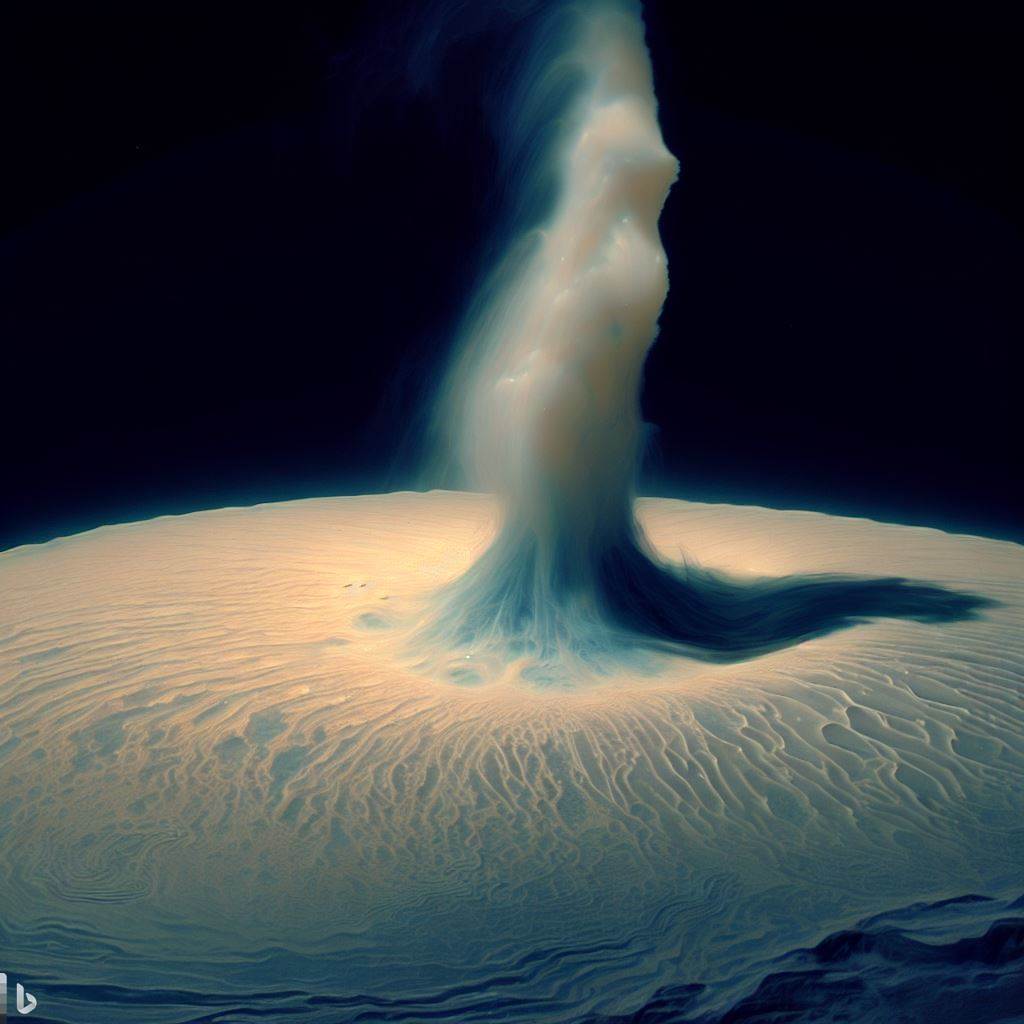
The James Webb Space Telescope (JWST) is a marvel of modern astronomy that has been observing the universe in infrared wavelengths since its launch in December 2021. One of its first targets was Saturn's moon Enceladus, a small icy world that harbors a global ocean beneath its frozen crust. Enceladus is also known for its spectacular geysers of water vapor and ice that erupt from cracks near its south pole, creating a huge plume that extends far into space.


Using its Near-Infrared Spectrograph (NIRSpec) instrument, JWST was able to map the properties of the plume and measure its composition, size, and speed. The results, published in Nature Astronomy, reveal that the plume is much larger and more powerful than previously thought, and that it contains traces of organic molecules that could be potential building blocks of life.


The plume spans about 9,600 km (6,000 miles), which is 20 times the diameter of Enceladus itself. It ejects water at a rate of about 360 liters (95 gallons) per second, enough to fill an Olympic-sized swimming pool in just a few hours. The water vapor reaches speeds of up to 2 km/s (4,500 mph), escaping the weak gravity of Enceladus and forming a torus-shaped cloud around Saturn's E-ring.


The NIRSpec instrument also detected signatures of methane, ammonia, carbon dioxide, and hydrogen in the plume, as well as more complex organic molecules that have not been identified yet. These molecules are likely produced by hydrothermal vents at the bottom of Enceladus' ocean, where water interacts with hot rocks and minerals. Some of these molecules could be precursors to amino acids, the building blocks of proteins.


The discovery of these organic molecules adds to the evidence that Enceladus is one of the most promising places in the solar system to look for signs of life. Previous observations by NASA's Cassini mission showed that the ocean of Enceladus is salty and alkaline, and that it contains hydrogen gas that could be used by microbes as a source of energy. Cassini also flew through the plume several times and sampled its composition directly, but it did not have the sensitivity or resolution of JWST.


The JWST observations also provide new insights into the origin and evolution of the plume. The researchers found that the plume varies in intensity depending on the position of Enceladus in its orbit around Saturn. When Enceladus is closer to Saturn, the tidal forces exerted by the planet squeeze and heat up the moon's interior, causing more water to escape through the cracks. When Enceladus is farther away from Saturn, the tidal forces relax and the plume becomes weaker.


The researchers also suggest that the plume has been active for a long time, possibly billions of years. This implies that Enceladus has maintained a stable source of heat and water for a long time, which is favorable for the emergence and persistence of life.


The JWST observations are only a glimpse of what this powerful telescope can do to explore the mysteries of Enceladus and other icy moons in our solar system. Future observations will aim to characterize the plume in more detail, identify more organic molecules, and look for possible variations over time. JWST will also complement other missions that are planned or proposed to visit these worlds, such as NASA's Europa Clipper and ESA's JUICE.


Enceladus is a fascinating example of how a small moon can have a big impact on its environment and on our understanding of life in the universe. Thanks to JWST, we can now see this impact more clearly than ever before.


Reference(s): NASA.

Hubble Just Captured a Breathtaking New Image of Saturn, And It Barely Looks Real


Hubble has captured a new image of Saturn that makes you wonder if it's even real. The image is so crisp it makes it look like Saturn is just floating in space. Which it is.


This image of the ringed-planet was captured when Saturn was at its closest to Earth, some 1.36 billion km away (845 million miles) on June 20th, 2019. The crisp image was captured with Hubble's Wide Field Camera 3 (WFC3.)


This is an artful image that wouldn't be out of place on a gallery wall. (As long as that gallery was cuted by a space nerd.) But it's more than just pretty: it's scientific.


The image is part of a program called Outer Planet Atmospheres Legacy (OPAL.) OPAL's goal is to accumulate long-baseline imagery of our Solar System's gas giant planets, to help us understand their atmospheres over time. This is the second yearly picture of Saturn as part of the OPAL program.


This is an older OPAL image of Saturn from 6 June 2018. (NASA/ESA/Amy Simon/OPAL Team/J. DePasquale/STScI) This is an older OPAL image of Saturn from 6 June 2018. (NASA/ESA/Amy Simon/OPAL Team/J. DePasquale/STScI)


Saturn always looks so placid. Stately, even. But closer inspection reveals a lot going on there. When we think of storms and gas giants, we usually think of Jupiter, with its prominent horizontal storm bands, and of course, the Great Red Spot. But Saturn is a very active, stormy planet as well.


Thanks to the OPAL program, we know that a large hexagonal storm in the planet's north polar region has disappeared. And smaller storms come and go frequently. There are also subtle changes in the planet's storm bands, which are largely ammonia ice at the top.


But some features have persisted.


Cassini spotted the hexagonal storm at Saturn's north pole, and that storm is still there. In fact, the Voyager 1 spacecraft was first to spot that feature back in 1981.

Saturn's northern polar vortex captured by Cassini. (NASA/JPL-Caltech/Space Science Institute.)


Mostly though, this new Hubble image of Saturn is just beautiful. Even if you knew nothing about Saturn, its beauty would draw you in.


Composite photo from 2018 showing six of Saturn's moons (NASA/ESA/ A. Simon/GSFC/OPAL/J. DePasquale/STScI)


NASA also released an annotated, more informational version of the Hubble image.


The latest image showing four of Saturn's moons. (NASA/ESA/A. Simon/Goddard Space Flight Center/M.H. Wong/OPAL Team)

NASA also released a time-lapse video of Hubble images of Saturn. It shows the moons, or at least a few of Saturn's 60+ moons, as they orbit around the gas giant. It's made up of 33 separate images taken on June 19th and 20th, 2019.


And this:


This article was originally published by Universe Today. Read the original article

It’s Official: NASA’s Sending a Mission to Titan, a Top Candidate For Alien Life

NASA's newest planetary scientific mission intends to land a flying robot on the surface of Saturn's moon Titan, a top target in the search for extraterrestrial life.

The Dragonfly project will be the first of its type. NASA's car-sized quadcopter, outfitted with instruments capable of recognising big organic compounds, is set to launch in 2026, land in 2034, and then fly to various places hundreds of miles apart.

"The science is compelling... and the mission is audacious," said NASA's associate administrator for science, Thomas Zurbuchen. "I am convinced that now is the moment to accomplish this."

What is Titan's significance?

Titan is larger than Mercury and has the same geographical diversity as Earth. This big, chilly moon has a thick, methane-rich atmosphere, ice mountains, and the only surface oceans in the solar system other than those found on Earth.

On Titan, however, the rivers and lakes are teeming with churning liquid hydrocarbons. If the moon does have water, scientists believe it is in an ocean beneath the frozen crust.

It's a world unlike ours, but "we know it has all of the ingredients that are necessary to help life form," said Lori Glaze, head of NASA's planetary research division.

Titan's intricate carbon rings and chains are essential to many basic biological activities and may mimic the building blocks from which life on Earth evolved.

Dragonfly will provide “the opportunity to discover the processes that were present on early Earth and possibly even the conditions that might harbour life today,” Glaze said.

New Frontiers

This is the fourth mission to be funded as part of NASA’s New Frontiers program, which supports medium-size planetary science projects that cost less than US$1 billion.

It follows in the footsteps of the New Horizons spacecraft, which flew past Pluto and the Kuiper belt object MU69; the asteroid-explorer OSIRIS-REx; and the Juno probe currently orbiting Jupiter.

It was one of two program proposals that have been under consideration since December 2017. The other finalist was the CAESAR mission, for Comet Astrobiology Exploration Sample Return, which would have circled to the comet 67P/Churyumov-Gerasimenko.

That craft would have rendezvoused with the huge space rock, sucked up a sample from its surface and returned it to Earth in November 2038.

Dragonfly will crash land near Titan's equator, among solid hydrocarbon snowflakes. It will be powered by heat generated by radioactive plutonium, similar to NASA's intrepid Mars rovers.

However, with eight rotors, it will be able to travel much further than any wheeled robot ever has - up to nine miles per hop.

"It's actually easier to fly on Titan," said Elizabeth Turtle, the mission's principle investigator and a researcher at the Johns Hopkins Applied Physics Laboratory, at a news conference on Thursday. The atmosphere of that world is thicker than Earth's, and its gravity is feeble.

However, the vessel must be able to manoeuvre on its own. Dragonfly is substantially more complicated than a regular drone since light signals from Earth take 43 minutes to reach Titan.

Scientists had to create a navigation system that would allow the spaceship to detect risks and fly and land on its own.

Dragonfly will land somewhere

It will sample Titan's hazy atmosphere and transmit aerial photographs of the area below while in flight. The ship, however, will spend the most of its time on the ground, searching for biologically relevant elements.

Selk Crater, the site of an old meteor impact where scientists discovered evidence of liquid water, organic molecules, and energy that could drive chemical reactions, is its final destination.

According to Zurbuchen, NASA asked two independent teams to analyse the mission concept and determine whether the project could be completed at the approved cost. Finally, the agency determined that the proposal was feasible.

“While this is a new way of exploring a different planet, this is actually technology that is very mature on Earth,” Turtle noted.

“Really what we’re doing with Dragonfly is innovation, not invention.”


NASA hasn’t seen the surface of Titan since 2005, when the Huygens probe dropped through its hazy orange clouds to reveal an outlandish panorama. Every Earth-like feature on this strange moon had a chemically alien twist.


“Instead of liquid water, Titan has liquid methane,” scientists reported in the journal Nature. “Instead of silicate rocks, Titan has frozen water ice. Instead of dirt, Titan has hydrocarbon particles settling out of the atmosphere.”


Its world is terribly cold at about 1 billion miles from the sun, with temperatures averaging minus 290 degrees Fahrenheit (-180 degrees Celsius) on a mild day. If there was more oxygen, those plentiful hydrocarbons (the major component of gasoline) would easily catch fire.


The presence of all that methane — a chemical that is normally destroyed by sunlight in a few million years — is what scientists are most interested in. Its persistence shows that some process is always replenishing Titan's supplies.


They currently assume that Titan has weather similar to Earth, except that its clouds are comprised of hydrocarbon gas and its precipitation falls as organic compound rain and snow.


Life as we currently know it


Turtle stated on Thursday that Titan is similar to the young Earth before life arose and irreversibly damaged the planet.


"Titan is simply a fantastic scientific laboratory for understanding the chemistry that occurred before chemistry progressed to biology," she explained.


Sarah Hörst, a planetary scientist at Johns Hopkins University and a member of Dragonfly's scientific and engineering team, has compared Titan to a cosmic kitchen where scientists have discovered all of the ingredients for life.


"But you weren't around when they got confused, so you have no idea what they got mixed up for." "You never know what happens when you bake it," she explained in 2017.


All of those ingredients could be for naught. Or they could be indicators of "life as we don't know it," a type of biology based on hydrocarbons rather than water, she speculated.


Scientists have discovered even more molecular riches in the years since Huygens' landing: negatively charged molecules associated with complex chemical reactions; rings of hydrogen, carbon, and nitrogen from which amino acids can be built; and molecules that can clump together to form a spherical envelope similar to the membranes that surround cells.


"We're quite sure Titan has everything in these broad, big-picture areas that life requires," Hörst said. "At some point, it just boils down to, should we not go check?"

The James Webb Telescope Is So Powerful It Can See The Clouds And Sea Of Saturn's Moon Titan

Let's see what the weather is on Titan today.... Will there be methane precipitation, or will it be clouded by ethane?

NASA 's James Webb Telescope continues to amaze astronomers. It is so powerful that it can see not only Saturn's moon Titan, but also its clouds and one of its seas.

It may surprise you that we use words like seas, rains, clouds, and even rivers and lakes, when we talk about the moon Titan. It is the only place in the Solar System, along with Earth, that has them. But they are not made of water, but of hydrocarbons: methane, ethane, etc. It is a toxic atmosphere for humans.

A group of astronomers headed by the Dutch professor Imke de Pater decided a few days ago to launch an experiment: Observe the moon Titan with the James Webb telescope, and only one day later with the Keck ground -based telescope in Hawaii.

The James Webb is so powerful, it can capture clouds, and even a Titan sea. Although it must be said that the Keck spotting scope can also do it. Here are the two photos, taken 30 hours apart:

The images are quite similar. You can see a couple of clouds that have moved slightly, and even a methane sea at the north pole.

But what makes the difference is that NASA 's James Webb is also an infrared telescope , and it can capture data that no other telescope can.

Here we can see, on the left, the infrared image from James Webb's NIRCam camera , and on the right the standard image, where two clouds can be seen, and the Kraken Sea:

What the James Webb contributes, which no other telescope can achieve, is that it shows data on the lower atmosphere and the height of the clouds, among others.

Combining all the data, astronomers have obtained the most detailed information about the moon Titan since the Cassini probe visited it in 2017.

They cannot be surpassed until the Dragonfly probe visits Titan in 2032. Meanwhile, the James Webb telescope will continue to fascinate us with its incredible images that are revolutionizing astronomy.

Hubble Just Captured a Breathtaking New Image of Saturn, And It Barely Looks Real

Hubble has captured a new image of Saturn that makes you wonder if it's even real. The image is so crisp it makes it look like Saturn is just floating in space. Which it is.

This image of the ringed-planet was captured when Saturn was at its closest to Earth, some 1.36 billion km away (845 million miles) on June 20th, 2019. The crisp image was captured with Hubble's Wide Field Camera 3 (WFC3.)

This is an artful image that wouldn't be out of place on a gallery wall. (As long as that gallery was cuted by a space nerd.) But it's more than just pretty: it's scientific.

The image is part of a program called Outer Planet Atmospheres Legacy (OPAL.) OPAL's goal is to accumulate long-baseline imagery of our Solar System's gas giant planets, to help us understand their atmospheres over time. This is the second yearly picture of Saturn as part of the OPAL program.


This is an older OPAL image of Saturn from 6 June 2018. (NASA/ESA/Amy Simon/OPAL Team/J. DePasquale/STScI) This is an older OPAL image of Saturn from 6 June 2018. (NASA/ESA/Amy Simon/OPAL Team/J. DePasquale/STScI)

Saturn always looks so placid. Stately, even. But closer inspection reveals a lot going on there. When we think of storms and gas giants, we usually think of Jupiter, with its prominent horizontal storm bands, and of course, the Great Red Spot. But Saturn is a very active, stormy planet as well.

Thanks to the OPAL program, we know that a large hexagonal storm in the planet's north polar region has disappeared. And smaller storms come and go frequently. There are also subtle changes in the planet's storm bands, which are largely ammonia ice at the top.

But some features have persisted.

Cassini spotted the hexagonal storm at Saturn's north pole, and that storm is still there. In fact, the Voyager 1 spacecraft was first to spot that feature back in 1981.

Saturn's northern polar vortex captured by Cassini. (NASA/JPL-Caltech/Space Science Institute.)


Mostly though, this new Hubble image of Saturn is just beautiful. Even if you knew nothing about Saturn, its beauty would draw you in.


Composite photo from 2018 showing six of Saturn's moons (NASA/ESA/ A. Simon/GSFC/OPAL/J. DePasquale/STScI)


NASA also released an annotated, more informational version of the Hubble image.


The latest image showing four of Saturn's moons. (NASA/ESA/A. Simon/Goddard Space Flight Center/M.H. Wong/OPAL Team)

NASA also released a time-lapse video of Hubble images of Saturn. It shows the moons, or at least a few of Saturn's 60+ moons, as they orbit around the gas giant. It's made up of 33 separate images taken on June 19th and 20th, 2019.


And this:


This article was originally published by Universe Today. Read the original article

Scientists just witnessed Titan's astonishing surface for the first time

The largest moon of Saturn is an unique habitat in our Solar System. It appears to be a world different from our own, with its methane-filled lakes, freezing volcanoes, and underground tunnels. 

However, Titan's first geomorphological map demonstrates that, while its landscape is spectacular and diverse, these elements actually make it surprisingly similar to Earth.

Titan is the only other body in the Solar System known to have stable liquid on its surface except Earth. Titan's lakes, rivers, and seas, on the other hand, are made of the liquid methane and ethane that rains down from its clouds. 

Titan is also the only moon with a considerable atmosphere and dense enough air to allow a person to walk over its harsh terrain without a spacesuit (though you'd have some additional problems to cope with, what with the methane rain and lakes...).

Titan's liquid is very exciting for another reason: the moon may harbour life in the layer of water that runs beneath its frozen surface.

This new map points out the countless lakes, dunes, craters, and plains. According to the report, these various traits may have arisen as a result of the same geological process that occurred on Earth.

Titan's lakes, dunes, and flat plains are depicted in unparalleled detail in the first geological depiction of the planet. NASA/JPL-Caltech/ASU

"Despite the differences in materials, temperatures, and gravity fields between Earth and Titan, many surface features are similar and can be interpreted as products of the same geologic processes," Rosaly Lopes, a planetary geologist at NASA's Jet Propulsion Laboratory in Pasadena, California, and lead author of the new study, said in a statement.

The map was built using data from NASA's Cassini spacecraft. Cassini was launched on October 15, 1997, to research Saturn and its moons, and it performed 120 flybys of Titan.

On September 15, 2017, the spacecraft crashed into Saturn's atmosphere, effectively terminating its 20-year mission.

Cassini employed radar imaging to peer through Titan's dense atmosphere of methane and nitrogen, as well as infrared equipment to see the planet's bigger geological formations.

“The Cassini mission revealed that Titan is a geologically active world, where hydrocarbons like methane and ethane take the role that water has on Earth,” David Williams, associate research professor at Arizona State University and a co-author on the study, said in a statement. “These hydrocarbons rain down on the surface, flow in streams and rivers, accumulate in lakes and seas, and evaporate into the atmosphere. It’s quite an astounding world!”

NASA thinks that by taking advantage of Titan's rich atmosphere and low gravity, its craft Dragonfly will be able to explore dozens of spots throughout the frozen globe – and maybe discover signs of life. NASA/JHU-APL

In the year 2026, NASA is planning an expedition to better investigate this unique world. The Dragonfly mission will collect and return samples from the frozen moon to Earth. It is also hoped that traces of life may be discovered, which could be the first indication that humans are not as cosmologically unique as we believe.

Reference(s): Nature Astronomy

Hubble Just Captured a Breathtaking New Image of Saturn, And It Barely Looks Real


Hubble has captured a new image of Saturn that makes you wonder if it's even real. The image is so crisp it makes it look like Saturn is just floating in space. Which it is.


This image of the ringed-planet was captured when Saturn was at its closest to Earth, some 1.36 billion km away (845 million miles) on June 20th, 2019. The crisp image was captured with Hubble's Wide Field Camera 3 (WFC3.)


This is an artful image that wouldn't be out of place on a gallery wall. (As long as that gallery was cuted by a space nerd.) But it's more than just pretty: it's scientific.


The image is part of a program called Outer Planet Atmospheres Legacy (OPAL.) OPAL's goal is to accumulate long-baseline imagery of our Solar System's gas giant planets, to help us understand their atmospheres over time. This is the second yearly picture of Saturn as part of the OPAL program.


This is an older OPAL image of Saturn from 6 June 2018. (NASA/ESA/Amy Simon/OPAL Team/J. DePasquale/STScI) This is an older OPAL image of Saturn from 6 June 2018. (NASA/ESA/Amy Simon/OPAL Team/J. DePasquale/STScI)


Saturn always looks so placid. Stately, even. But closer inspection reveals a lot going on there. When we think of storms and gas giants, we usually think of Jupiter, with its prominent horizontal storm bands, and of course, the Great Red Spot. But Saturn is a very active, stormy planet as well.


Thanks to the OPAL program, we know that a large hexagonal storm in the planet's north polar region has disappeared. And smaller storms come and go frequently. There are also subtle changes in the planet's storm bands, which are largely ammonia ice at the top.


But some features have persisted.


Cassini spotted the hexagonal storm at Saturn's north pole, and that storm is still there. In fact, the Voyager 1 spacecraft was first to spot that feature back in 1981.

Saturn's northern polar vortex captured by Cassini. (NASA/JPL-Caltech/Space Science Institute.)


Mostly though, this new Hubble image of Saturn is just beautiful. Even if you knew nothing about Saturn, its beauty would draw you in.


Composite photo from 2018 showing six of Saturn's moons (NASA/ESA/ A. Simon/GSFC/OPAL/J. DePasquale/STScI)


NASA also released an annotated, more informational version of the Hubble image.


The latest image showing four of Saturn's moons. (NASA/ESA/A. Simon/Goddard Space Flight Center/M.H. Wong/OPAL Team)

NASA also released a time-lapse video of Hubble images of Saturn. It shows the moons, or at least a few of Saturn's 60+ moons, as they orbit around the gas giant. It's made up of 33 separate images taken on June 19th and 20th, 2019.


And this:


This article was originally published by Universe Today. Read the original article

Hubble Just Captured a Breathtaking New Image of Saturn, And It Barely Looks Real


Hubble has captured a new image of Saturn that makes you wonder if it's even real. The image is so crisp it makes it look like Saturn is just floating in space. Which it is.


This image of the ringed-planet was captured when Saturn was at its closest to Earth, some 1.36 billion km away (845 million miles) on June 20th, 2019. The crisp image was captured with Hubble's Wide Field Camera 3 (WFC3.)


This is an artful image that wouldn't be out of place on a gallery wall. (As long as that gallery was cuted by a space nerd.) But it's more than just pretty: it's scientific.


The image is part of a program called Outer Planet Atmospheres Legacy (OPAL.) OPAL's goal is to accumulate long-baseline imagery of our Solar System's gas giant planets, to help us understand their atmospheres over time. This is the second yearly picture of Saturn as part of the OPAL program.


This is an older OPAL image of Saturn from 6 June 2018. (NASA/ESA/Amy Simon/OPAL Team/J. DePasquale/STScI) This is an older OPAL image of Saturn from 6 June 2018. (NASA/ESA/Amy Simon/OPAL Team/J. DePasquale/STScI)


Saturn always looks so placid. Stately, even. But closer inspection reveals a lot going on there. When we think of storms and gas giants, we usually think of Jupiter, with its prominent horizontal storm bands, and of course, the Great Red Spot. But Saturn is a very active, stormy planet as well.


Thanks to the OPAL program, we know that a large hexagonal storm in the planet's north polar region has disappeared. And smaller storms come and go frequently. There are also subtle changes in the planet's storm bands, which are largely ammonia ice at the top.


But some features have persisted.


Cassini spotted the hexagonal storm at Saturn's north pole, and that storm is still there. In fact, the Voyager 1 spacecraft was first to spot that feature back in 1981.

Saturn's northern polar vortex captured by Cassini. (NASA/JPL-Caltech/Space Science Institute.)


Mostly though, this new Hubble image of Saturn is just beautiful. Even if you knew nothing about Saturn, its beauty would draw you in.


Composite photo from 2018 showing six of Saturn's moons (NASA/ESA/ A. Simon/GSFC/OPAL/J. DePasquale/STScI)


NASA also released an annotated, more informational version of the Hubble image.


The latest image showing four of Saturn's moons. (NASA/ESA/A. Simon/Goddard Space Flight Center/M.H. Wong/OPAL Team)

NASA also released a time-lapse video of Hubble images of Saturn. It shows the moons, or at least a few of Saturn's 60+ moons, as they orbit around the gas giant. It's made up of 33 separate images taken on June 19th and 20th, 2019.


And this:


This article was originally published by Universe Today. Read the original article

It’s Official: NASA’s Sending a Mission to Titan, a Top Candidate For Alien Life


NASA's newest planetary scientific mission intends to land a flying robot on the surface of Saturn's moon Titan, a top target in the search for extraterrestrial life.


The Dragonfly project will be the first of its type. NASA's car-sized quadcopter, outfitted with instruments capable of recognising big organic compounds, is set to launch in 2026, land in 2034, and then fly to various places hundreds of miles apart.


"The science is compelling... and the mission is audacious," said NASA's associate administrator for science, Thomas Zurbuchen. "I am convinced that now is the moment to accomplish this."


What is Titan's significance?


Titan is larger than Mercury and has the same geographical diversity as Earth. This big, chilly moon has a thick, methane-rich atmosphere, ice mountains, and the only surface oceans in the solar system other than those found on Earth.


On Titan, however, the rivers and lakes are teeming with churning liquid hydrocarbons. If the moon does have water, scientists believe it is in an ocean beneath the frozen crust.


It's a world unlike ours, but "we know it has all of the ingredients that are necessary to help life form," said Lori Glaze, head of NASA's planetary research division.


Titan's intricate carbon rings and chains are essential to many basic biological activities and may mimic the building blocks from which life on Earth evolved.


Dragonfly will provide “the opportunity to discover the processes that were present on early Earth and possibly even the conditions that might harbour life today,” Glaze said.


New Frontiers


This is the fourth mission to be funded as part of NASA’s New Frontiers program, which supports medium-size planetary science projects that cost less than US$1 billion.


It follows in the footsteps of the New Horizons spacecraft, which flew past Pluto and the Kuiper belt object MU69; the asteroid-explorer OSIRIS-REx; and the Juno probe currently orbiting Jupiter.


It was one of two program proposals that have been under consideration since December 2017. The other finalist was the CAESAR mission, for Comet Astrobiology Exploration Sample Return, which would have circled to the comet 67P/Churyumov-Gerasimenko.


That craft would have rendezvoused with the huge space rock, sucked up a sample from its surface and returned it to Earth in November 2038.


Dragonfly will crash land near Titan's equator, among solid hydrocarbon snowflakes. It will be powered by heat generated by radioactive plutonium, similar to NASA's intrepid Mars rovers.


However, with eight rotors, it will be able to travel much further than any wheeled robot ever has - up to nine miles per hop.


"It's actually easier to fly on Titan," said Elizabeth Turtle, the mission's principle investigator and a researcher at the Johns Hopkins Applied Physics Laboratory, at a news conference on Thursday. The atmosphere of that world is thicker than Earth's, and its gravity is feeble.


However, the vessel must be able to manoeuvre on its own. Dragonfly is substantially more complicated than a regular drone since light signals from Earth take 43 minutes to reach Titan.


Scientists had to create a navigation system that would allow the spaceship to detect risks and fly and land on its own.


Dragonfly will land somewhere


It will sample Titan's hazy atmosphere and transmit aerial photographs of the area below while in flight. The ship, however, will spend the most of its time on the ground, searching for biologically relevant elements.


Selk Crater, the site of an old meteor impact where scientists discovered evidence of liquid water, organic molecules, and energy that could drive chemical reactions, is its final destination.


According to Zurbuchen, NASA asked two independent teams to analyse the mission concept and determine whether the project could be completed at the approved cost. Finally, the agency determined that the proposal was feasible.


“While this is a new way of exploring a different planet, this is actually technology that is very mature on Earth,” Turtle noted.

“Really what we’re doing with Dragonfly is innovation, not invention.”


NASA hasn’t seen the surface of Titan since 2005, when the Huygens probe dropped through its hazy orange clouds to reveal an outlandish panorama. Every Earth-like feature on this strange moon had a chemically alien twist.


“Instead of liquid water, Titan has liquid methane,” scientists reported in the journal Nature. “Instead of silicate rocks, Titan has frozen water ice. Instead of dirt, Titan has hydrocarbon particles settling out of the atmosphere.”


Its world is terribly cold at about 1 billion miles from the sun, with temperatures averaging minus 290 degrees Fahrenheit (-180 degrees Celsius) on a mild day. If there was more oxygen, those plentiful hydrocarbons (the major component of gasoline) would easily catch fire.


The presence of all that methane — a chemical that is normally destroyed by sunlight in a few million years — is what scientists are most interested in. Its persistence shows that some process is always replenishing Titan's supplies.


They currently assume that Titan has weather similar to Earth, except that its clouds are comprised of hydrocarbon gas and its precipitation falls as organic compound rain and snow.


Life as we currently know it


Turtle stated on Thursday that Titan is similar to the young Earth before life arose and irreversibly damaged the planet.


"Titan is simply a fantastic scientific laboratory for understanding the chemistry that occurred before chemistry progressed to biology," she explained.


Sarah Hörst, a planetary scientist at Johns Hopkins University and a member of Dragonfly's scientific and engineering team, has compared Titan to a cosmic kitchen where scientists have discovered all of the ingredients for life.


"But you weren't around when they got confused, so you have no idea what they got mixed up for." "You never know what happens when you bake it," she explained in 2017.


All of those ingredients could be for naught. Or they could be indicators of "life as we don't know it," a type of biology based on hydrocarbons rather than water, she speculated.


Scientists have discovered even more molecular riches in the years since Huygens' landing: negatively charged molecules associated with complex chemical reactions; rings of hydrogen, carbon, and nitrogen from which amino acids can be built; and molecules that can clump together to form a spherical envelope similar to the membranes that surround cells.


"We're quite sure Titan has everything in these broad, big-picture areas that life requires," Hörst said. "At some point, it just boils down to, should we not go check?"

This Planet has Rings 200 Times Larger than Saturn


J1407b, has the largest ring system yet seen – around 200 times larger than Jupiter's (the largest in our solar system). Its host planet is likewise massive: we don't know whether it's a gas giant or a brown dwarf. So far, it's been classified as a super-Jupiter stellar body.

If it resided in our solar system, the greatest planetary ring system we've discovered would dominate the sky.

To put this ring system into perspective, if Saturn possessed the same rings, they would be several times greater in diameter than the moon in the night sky. It would not only be visible with the naked eye, but it would completely dominate the view. Overall, the exoplanet has over 30 layers of rings.

Artistic rendering of the exoplanet and its impressive rings. Image via Wikimedia.

“It’d be huge. You’d see the rings and the gaps in the rings quite easily from Earth,” said Matthew Kenworthy of the Leiden Observatory in the Netherlands, one of the co-authors on the paper describing the findings, at the time. “It’d be several times the size of the full moon.”

Maybe the size of its rings helped too because J1407b was the first confirmed case of an exoplanet with a ring system. So far, it’s also the only exoplanet with rings that we’ve spotted.

Still, in cosmological terms, such lush manes of rings do not last for long. Researchers expect them to get progressively thinner and disappear in the next several million years as new moons form from the sheer quantity of material zipping and zapping through J1407b’s rings. Compared to planets in our solar system, J1407b is also very young, at only about 16 million years old. The Sun and Earth are 4.5 billion years old.

So it might be just youthful energy that makes large ring systems possible. Right now, we simply don’t know. The methods we use to spot exoplanets (planets outside our solar system) aren’t very good at all at picking up ring systems — they can do it, but there’s a lot of luck involved.

For now, our best knowledge of planetary ring systems come from our neighboring planets. There may well be larger rings than those boasted by J1407b out there, but until we can get a better view into deep space — or, even better, make our way there — they will likely remain undiscovered.