Showing posts with label NASA. Show all posts

New Nuclear Rocket Design to Send Missions to Mars in Just 45 Days

We live in an era of renewed space exploration, where multiple agencies are planning to send astronauts to the Moon in the coming years. This will be followed in the next decade with crewed missions to Mars by NASA and China, who may be joined by other nations before long. These and other missions that will take astronauts beyond Low Earth Orbit (LEO) and the Earth-Moon system require new technologies, ranging from life support and radiation shielding to power and propulsion. And when it comes to the latter, Nuclear Thermal and Nuclear Electric Propulsion (NTP/NEP) is a top contender!


NASA and the Soviet space program spent decades researching nuclear propulsion during the Space Race. A few years ago, NASA reignited its nuclear program for the purpose of developing bimodal nuclear propulsion – a two-part system consisting of an NTP and NEP element – that could enable transits to Mars in 100 days. As part of the NASA Innovative Advanced Concepts (NIAC) program for 2023, NASA selected a nuclear concept for Phase I development. This new class of bimodal nuclear propulsion system uses a “wave rotor topping cycle” and could reduce transit times to Mars to just 45 days.


The proposal, titled “Bimodal NTP/NEP with a Wave Rotor Topping Cycle,” was put forward by Prof. Ryan Gosse, the Hypersonics Program Area Lead at the University of Florida and a member of the Florida Applied Research in Engineering (FLARE) team. Gosse’s proposal is one of 14 selected by the NAIC this year for Phase I development, which includes a $12,500 grant to assist in maturing the technology and methods involved. Other proposals included innovative sensors, instruments, manufacturing techniques, power systems, and more.


Nuclear propulsion essentially comes down to two concepts, both of which rely on technologies that have been thoroughly tested and validated. For Nuclear-Thermal Propulsion (NTP), the cycle consists of a nuclear reactor heating liquid hydrogen (LH2) propellant, turning it into ionized hydrogen gas (plasma) that is then channeled through nozzles to generate thrust. Several attempts have been made to build a test this propulsion system, including Project Rover, a collaborative effort between the U.S. Air Force and the Atomic Energy Commission (AEC) that launched in 1955.


In 1959, NASA took over from the USAF, and the program entered a new phase dedicated to spaceflight applications. This eventually led to the Nuclear Engine for Rocket Vehicle Application (NERVA), a solid-core nuclear reactor that was successfully tested. With the closing of the Apollo Era in 1973, the program’s funding was drastically reduced, leading to its cancellation before any flight tests could be conducted. Meanwhile, the Soviets developed their own NTP concept (RD-0410) between 1965 and 1980 and conducted a single ground test before the program’s cancellation.


Nuclear-Electric Propulsion (NEP), on the other hand, relies on a nuclear reactor to provide electricity to a Hall-Effect thruster (ion engine), which generates an electromagnetic field that ionizes and accelerates an inert gas (like xenon) to create thrust. Attempts to develop this technology include NASA’s Nuclear Systems Initiative (NSI). Project Prometheus (2003 to 2005). Both systems have considerable advantages over conventional chemical propulsion, including a higher specific impulse (Isp) rating, fuel efficiency, and virtually unlimited energy density.


While NEP concepts are distinguished for providing more than 10,000 seconds of Isp, meaning they can maintain thrust for close to three hours, the thrust level is quite low compared to conventional rockets and NTP. The need for an electric power source, says Gosse, also raises the issue of heat rejection in space – where thermal energy conversion is 30-40% under ideal circumstances. And while NTP NERVA designs are the preferred method for crewed missions to Mars and beyond, this method also has issues providing adequate initial and final mass fractions for high delta-v missions.
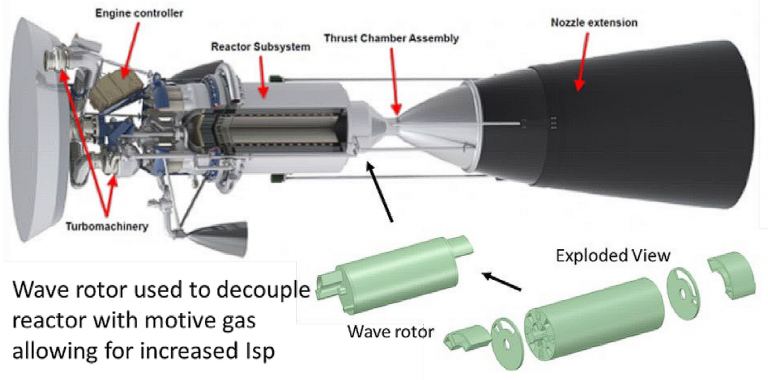


New Class of Bimodal NTP/NEP with a Wave Rotor Topping Cycle Enabling Fast Transit to Mars. Credit: Ryan Gosse


This is why proposals that include both propulsion methods (bimodal) are favored, as they would combine the advantages of both. Gosse’s proposal calls for a bimodal design based on a solid core NERVA reactor that would provide a specific impulse (Isp) of 900 seconds, twice the current performance of chemical rockets. Gosse proposed cycle also includes a pressure wave supercharger – or Wave Rotor (WR) – a technology used in internal combustion engines that harnesses the pressure waves produced by reactions to compress intake air.


When paired with an NTP engine, the WR would use pressure created by the reactor’s heating of the LH2 fuel to compress the reaction mass further. As Gosse promises, this will deliver thrust levels comparable to that of a NERVA-class NTP concept but with an Isp of 1400-2000 seconds. When paired with a NEP cycle, said Gosse, thrust levels are enhanced even further:


“Coupled with an NEP cycle, the duty cycle Isp can further be increased (1800-4000 seconds) with minimal addition of dry mass. This bimodal design enables the fast transit for manned missions (45 days to Mars) and revolutionizes the deep space exploration of our solar system.”


Based on conventional propulsion technology, a crewed mission to Mars could last up to three years. These missions would launch every 26 months when Earth and Mars are at their closest (aka. a Mars Opposition) and would spend a minimum of six to nine months in transit. A transit of 45 days (six and a half weeks) would reduce the overall mission time to months instead of years. This would significantly reduce the major risks associated with missions to Mars, including radiation exposure, the time spent in microgravity, and related health concerns.


Artist’s concept of a bimodal nuclear rocket making the journey to the Moon, Mars, and other destinations in the Solar System. Credit: NASA


In addition to propulsion, there are proposals for new reactor designs that would provide a steady power supply for long-duration surface missions where solar and wind power are not always available. 


Examples include NASA’s Kilopower Reactor Using Sterling Technology (KRUSTY) and the hybrid fission/fusion reactor selected for Phase I development by NASA’s NAIC 2023 selection. These and other nuclear applications could someday enable crewed missions to Mars and other locations in deep space, perhaps sooner than we think!


Further Reading: NASA

NASA Admits To Discovering 'Something Weird' Happening To Our Universe


The Hubble Space Telescope has reportedly reached a new milestone in its quest to measure the speed at which the universe is expanding, and it strongly suggests that something strange is going on in our cosmos.


Astronomers have recently utilised telescopes like Hubble to measure how quickly the cosmos is expanding.


However, as the data were refined, a peculiar finding was made. There is a considerable gap between evidence from the immediate aftermath of the Big Bang and the universe's current rate of expansion.


Scientists have been unable to explain the discrepancy. However, it shows that "something weird" is going on in our cosmos, which might be the product of undiscovered, new physics, according to NASA.


Hubble has spent the last 30 years collecting data on a set of "milepost markers" in space and time that can be used to trace the expansion rate of the cosmos as it moves away from us.


According to NASA, it has now calibrated more than 40 of the markers, allowing for even more precision than previously.


In a statement, Nobel Laureate Adam Riess of the Space Telescope Science Institute (STScI) and Johns Hopkins University in Baltimore, Maryland, stated, "You are getting the most precise measure of the expansion rate for the universe from the gold standard of telescopes and cosmic mile markers."


He is the leader of a group of scientists who have released a new research paper detailing the largest and most likely last significant update from the Hubble Space Telescope, tripling the previous set of mile markers and reanalysing existing data.


The hunt for a precise estimate of how quickly space was expanding began when American astronomer Edwin Hubble saw that galaxies beyond our own appeared to be moving away from us – and moving faster the further away they are. Since then, scientists have been working to gain a deeper understanding of that growth.


In honour of the astronomer's effort, both the rate of expansion and the space telescope that has been studying it are named Hubble.


When the space telescope began gathering data on the universe's expansion, it was discovered to be faster than models had expected. Astronomers anticipate that it should be approximately 67.5 kilometres per second per megaparsec, plus or minus 0.5, while measurements suggest that it is closer to 73.


Astronomers have a one in a million probability of getting it incorrect. Instead, it implies that the universe's growth and expansion are more intricate than we previously thought, and that there is still much to discover about how the cosmos is changing.


The newly launched James Webb Space Telescope, which will soon send back its first observations, will be used by scientists to delve deeper into this difficulty. They should be able to see more recent, far-off, and detailed mileposts as a result.


Reference(s): NASA

NASA Releases Stunning 4K Video of Apollo 13 Views of the Moon, Ending All Conspiracy Theories

NASA has developed a stunning view of the Moon using data from the Lunar Reconnaissance Orbiter (LRO) and combined with the views recorded by Apollo 13 astronauts during their risky trek around the far side in 1970.


NASA’s Lunar Reconnaissance Orbiter (LRO) is now in an eccentric polar mapping orbit around the Moon. NASA will use the data obtained by the spacecraft to plan future robotic and manned missions to the lunar surface. For nearly 12 years, the LRO has been studying and photographing the moon. On June 18, 2009, the mission was launched. It is one of NASA’s most successful lunar missions, and the spacecraft has enough fuel to last for another seven years as of 2019.

The film displays a 4K view of the lunar surface, with the sun setting and rising, and ends with Apollo 13 reestablishing radio communication with Mission Control on Earth. The movie also shows the course of the Apollo 13 astronauts’ free return flight around the moon, as well as a continuous view of the moon throughout the journey.

Apollo 13 was the seventh crewed mission of NASA’s Apollo space program. Data collected in the last decade aligns with views recorded by NASA’s astronauts in 1970. Getting this sort of data back in 1970 was impossible and now modern technology has once again proved that humans did go to Moon and not just go there but astronauts aboard the Six Apollo missions landed there as well.

There are so many arguments and literal facts along with actual evidence that prove the notion of humans not going to the moon is not just wrong but it’s plain stupidity in today’s modern world. Now this new video from NASA adds to that evidence. New data provides the same view NASA recorded back in 1970. So how did NASA know what the moon will look like up close back in 1970 if they didn't go to the Moon in the first place? Unless they went there and recorded videos of it. These videos are turning out to be the same as what today’s satellites are recording orbiting Moon.

So if you are already familiar with the satellites being in Space, and know for a fact that they are real but had some doubts regarding humans going to Moon back in the 1960s and 1970s then this should clear up your doubts. If someone still doubts it then they probably are just walking around with no brain(Pun intended).

Meet Jonny Kim: A Harvard doctor, Navy Seal Sniper, and A NASA Astronaut

When you were a kid, do you remember all the fun things you wanted to do and the adventures you wanted to go on? 

Jonny Kim achieved his aspirations of becoming a doctor, NASA astronaut, and sniper for Navy. And he finished it all by the time he was 37.

We can hear you wondering, “But… how?” Kim enlisted at the age of 16 and eventually became a Navy Seal rather than enrolling in college. In an interview with NBC San Diego, Kim claimed that his decision to enlist caused his mother to sob in disappointment. She didn’t like it very much, he continued. 

At least 20 years ago, when I was going through this process, I believe that many Asian Americans weren’t really comfortable with it.

History of Jonny Kim:

Jonny Kim, a Lieutenant Commander (LCDR), has been chosen by NASA to be a member of the 2017 Astronaut Candidate Class. In August 2017, he reported for service; in 2021 he was the Increment Lead for Expedition 65 of the International Space Station.

The Silver Star and Bronze Star with Combat “V” have been awarded to Kim, a U.S. Navy SEAL who has completed over 100 combat missions. Kim graduated from the University of San Diego with a degree in mathematics and the Harvard Medical School with a doctorate in medicine before being commissioned as a naval officer through an enlisted-to-officer program.

Personal information:

Jonny Kim is a Korean American immigrant who was born and raised in Los Angeles, California. Enjoys spending time with his family, being outdoors, mentoring students and professionals, lifting weights, and continuing his education. Holds Advanced SCUBA certifications.

Santa Monica High School, Santa Monica, California, 2002; education 2012:

Jonny Kim and his mother at Harvard Medical School graduation./ Source: nbcsandiego.com


The University of San Diego, summa cum laud, mathematics bachelor’s degree. Harvard Medical School awarded me a doctorate in medicine in 2016. 2017 Boston, Massachusetts, Massachusetts General Hospital and Brigham and Women’s Hospital medical internship, Harvard Affiliated Emergency Medicine Residency.


Experience:


After graduating high school in 2002, Kim joined the Navy as a Seaman recruit. He reported to Coronado, California’s Basic Underwater Demolition/SEAL (BUD/S) training after finishing Hospital Corpsman “A” school training. Kim reported to the John F. Kennedy Special Warfare Center and School in Fort Bragg, North Carolina for the Special Operations Combat Medic Course after finishing his training at Naval Special Warfare.


Jonny Kim obtained various certifications, including those for Combatant Diver (closed circuit rebreather), Naval Special Warfare Special Reconnaissance Scout and Sniper, and Advanced Special Operations Techniques before being assigned as a Special Warfare Operator to SEAL Team Three Charlie Platoon in San Diego, California.


NASA


Over the course of two deployments to the Middle East, including Ramadi and Sadr City, Iraq, Kim participated in more than 100 combat missions as a Special Operations Combat Medic, sniper, navigator, and point person. After graduating from the University of San Diego in 2012, he was appointed as a naval officer through the Navy’s Seaman to Admiral-21 enlisted-to-officer commissioning program.


Kim did his internship with the Harvard Affiliated Emergency Medicine Residency at Brigham and Women’s Hospital and Massachusetts General Hospital before earning his medical degree from Harvard Medical School.


He stated, in an interview with Harvard Gazette:

 “He got a pretty nasty wound to the face,” One of the worst helplessness’s I’ve ever experienced. I could only focus on positioning him correctly and ensuring that his blood wasn’t impeding his airway. He required a doctor. I eventually managed to get him to a doctor, but that feeling of powerlessness was intense for me.


He went on to say,

“The loss of many excellent friends inspired me, and many of my surviving colleagues made sure we lived lives that were meaningful. I continue to reflect on all the decent people who didn’t get the chance to return home every day, even today. I make an effort to make up for the lives and worthwhile effects they may have had if they had lived.”


Experience with NASA:


Kim completed two years of training as an astronaut candidate before reporting for duty in August 2017. Physiological training, expeditionary training, field geology, robotics, technical and operational education in International Space Station systems, water and wilderness survival training, and Russian language competence training were all included in the program.


Kim started working as a Capsule Communicator (Capcom) in Mission Control Center Houston in 2020 to assist the operations of the International Space Station. Kim was chosen to lead Expedition 65’s increment on the International Space Station in April 2021.


Honors:


Combat “V” on the Bronze Star Medal, Combat Action Ribbon, Navy and Marine Corps Commendation Medal, Silver Star Medal, and several campaign and service awards. HM “A” School, Navy Hospital Corpsman, Distinguished Honor Graduate. Commandant’s List, Joint Special Operations Medical Training Center, Special Operations Combat Medic Course (JSOMTC). Special Operations Medical Association’s Naval Special Warfare Medic of the Year award.


Pat Tillman Foundation Tillman Scholar Scholarship from the University of San Diego’s trustees. The University of San Diego’s Summa cum laude (Naval Reserve Officers Training Corps). the honor society Phi Beta Kappa. the honor society Kappa Gamma Pi. Society of Mortar Board Honor.


A successful and unconventional professional path:


After finishing his training at Naval Special Warfare at Coronado, Kim joined the elite Navy SEAL unit and was subsequently assigned to SEAL Team 3. Kim served as a Special Operation Combat Medic, a navigator, and a sniper during his two deployments, and throughout his military career, he performed over 100 combat operations.


As if that weren’t enough, he was also given the Silver and Bronze Stars for bravery. Kim enlisted after high school, delaying his plans for college, but in 2012, Later, Kim understood that his time spent in combat had inspired him to pursue a career in medicine.


He pursued his desire, attended Harvard Medical School, and earned his medical degree in 2016. Despite all his achievements, his desire to help humanity was not met. That is when he made the decision to aim high. Kim applied for astronaut candidacy in 2017 and was chosen by NASA to become the first Korean American astronaut. after an already distinguished military career, he returned to complete his bachelor’s degree in mathematics at the University of San Diego.

Here's What NASA Saw When it Landed on Saturn's Largest Moon

When NASA landed on Saturn's largest moon, Titan, it became the farthest space landing in history. Here are the actual images from that landing.

NASA Admits Alcubierre Drive Initiative: Faster Than The Speed Of Light

In order to explore the prospect of travelling faster than the speed of light, NASA is now developing the first real-world test.

The Alcubierre Drive, developed by Harold White and his NASA team, revolutionised the perception that travelling faster than light was only possible in science fiction. 

Even if special relativity may be valid, we might not require a vehicle that can move at the speed of light in order to travel faster or at that speed. The answer might lie in putting a craft inside a space that is travelling faster than light! 

As a result, the craft itself does not need a propulsion system that can propel it at the speed of light.

It’s easier to think about if you think in terms of a flat escalator in an airport. The escalator moves faster than you are walking! 

In this case, the space encompassing the ship would be moving faster than the ship could fly, keeping all the matter of the ship intact. Therefore, we can move faster than light, in a massless cloud of space-time.

What is the Alcubierre Drive? It’s actually based on Einstein's field equations, it suggests that a spacecraft could achieve faster-than-light travel. 

Rather than exceed the speed of light alone in a craft, a spacecraft would leap long distances by contracting space in front of it and expanding space behind it. 

This would result in faster than light travel (1). Physicist Miguel Alcubierre was the first that we know to identify this possibility. He described it as remaining still on a flat piece of space-time inside a warp bubble that was made to move at “superluminal” (faster than light) velocity. 

We must not forget that space-time can be warped and distorted, it can be moved. But what about  moving sections of space-time that’s created by expanding space-time behind the ship, and by contracting space-time in front of the ship?

This type of concept was also recently illustrated by Mathematician James Hill and Barry Cox at the University of Adelaide. They published a paper in the journal proceedings of the Royal Society A: Mathematical and Physical Sciences (3).

It was once believed that Einstein's theory of special relativity means that faster than light travel is just not possible. This is a misconception, special relativity simply states that the distance you travel depends on how fast you move, for how long you’re moving for. 

So if you are driving at 70 mph you will have covered 70 miles in one hour. The confusing part is that, no matter how fast you are moving you will always see the speed of light as being the same. It’s similar to sound, if you close your eyes and imagine that the only sense you have is hearing, you will identify things by how they sound. 

So if a car is driving at a rapid speed and honks its horn, we know that the horn is always tooting the same tone, it’s just the car’s motion that made it appear to change.

Special relativity also showed us that the atoms and molecules that make up matter are connected by electromagnetic fields, the same stuff light is made up of. The object that would break the light speed barrier is made up of the same stuff as the barrier itself. How can an object travel faster than that which links it’s atoms? This was the barrier.

The only problem with our modern day science is that creating distortions in space-time require energy densities that are not yet possible for humans, or so they say. NASA scientists are currently working on tweaking Alcubierre’s model.

Faster-than-light travel, also known as hyper space or “warp” drive from what the masses know for sure is currently at the level of speculation. Although there is already a lot of evidence that shows it is possible  and has already been accomplished, mainstream science is still catching up.  We are at the point right now where faster-than-light travel is still theoretical, but possible.

At the same time, we have to look at other factors that are now coming to light. As former NASA Astronaut and Princeton Physics Professor Dr, Brian O’leary Illustrates. 

This topic has recently had another media explosion and congress recently discussed and looked at evidence for Earth like planets recently found by Kepler Telescopes. Three “super-Earths” to be exact that are most probably teeming with life (4). 

Furthermore, former congressmen and women recently participated in a citizens hearing on the subject of UFOs a few weeks ago. You can read more about that here. I’ve used this video in many articles before, but it’s just a great clip from when Dr O’leary was still with us.

UFOs and the technology behind it should not be subject to speculation. Odds are we have retrieved some of that technology, or manufactured some ourselves. Some of our science may not be so theoretical after all.

“We now have the technology to take ET home” – Ben Rich

Sources:

http://ntrs.nasa.gov/archive/nasa/casi.ntrs.nasa.gov/20110015936_2011016932.pdf

http://www.technewsdaily.com/18051-star-trek-warp-drive-possible.html

(1)http://www.nasa.gov/centers/glenn/technology/warp/warpstat_prt.html

(2)http://www.livescience.com/23789-einstein-relativity-faster-than-light-travel.html

(3)http://www.space.com/17951-einstein-relativity-faster-than-light-travel.html

http://www.nasa.gov/centers/glenn/technology/warp/warpstat_prt.html

http://techland.time.com/2012/09/19/nasa-actually-working-on-faster-than-light-warp-drive/

(4)http://www.space.com/21030-alien-earth-search-congress-hearing.html

NASA’s Future Spaceships Will Travel At 1 Million Miles Per Hour

Two highly promising concepts are being funded by the NASA Institute for Advanced Concepts (NIAC). 

In terms of ISP and power levels, the new ion drives could have been five times better. The development of multi-megawatt ion engines and antimatter propulsion is ongoing.

Propulsion and Speed in Space

What is the fastest spacecraft we have made?

Voyager 1 is travelling at a speed of 38,000 mph (61,000 km/h). Both a gravitational slingshot and a chemical rocket were mostly used to accomplish this. 

Using gravitational boosts, the Juno, Helios I, and Helios II spacecraft attained speeds in the 150,000 mph range. The Sun's gravity will let the recently launched Parker Solar Probe travel at 430,000 miles per hour.

Gravitational acceleration can increase the speed of a spacecraft by many times. However, using the gravity of Jupiter and the Sun to get more speed waste a lot of time. The spacecraft take many months to go around the Sun and get speed before starting the real mission.

Best Chemical Rocket Speeds and Times

Refueling a large rocket like the SpaceX BFR can produce surprisingly good trip times to Mars. Multiple orbital refueling of the SpaceX BFR at a high orbit can maximize the speed of the BFR. 

A fully fueled SpaceX BFR would shorten the one-way trip to Mars to as little as 40 days. A parabolic orbit would be used instead of a Hohmann transfer.

Space Missions to Mars have been small spacecraft. The entire mission was launched from Earth. This means most of the fuel was used to get the system off of the Earth. The final stage is tiny and slow. 

By refueling the SpaceX BFR in orbit, it is possible for a large chemically powered space mission with up to 10.0 kilometer per second Delta-V. This is about 100 hundred times larger than prior Earth to Mars missions and three times faster.


Advanced Propulsion: Multi-megawatt Lithium-ion Drives

JPL (Jet Propulsion Lab) will be testing a 50000 ISP lithium ion thruster within 4 months. This is part of a NASA NIAC phase 2 study to use lasers to beam 10 megawatts of power to new ion drives. Many people are not aware of the recent progress with more powerful lasers. 

The US military is developing arrays of lasers that can produce 100 kilowatts within the next 2 years. The military should have megawatt laser arrays by around 2025. 

Laser beam-powered lithium-ion drives ten times faster than any previous ion drive. A spacecraft with this system would take less than a year to get to Pluto.

JPL is building and proving the various components of this system. The sail and the ion drives are coming together. The hard part is the phased array lasers. 

They are boosting the testing voltage up to 6000 volts so the lithium-ion drives can be directly driven. Direct drive eliminates the need for a lot of heavy electronics which would kill the performance.

The power density will be one hundred times more than sun-based solar power. They will reduce system size by using a laser wavelength of 300 nanometers instead of 1063 nanometers. The multi-megawatt lithium-ion drive has technical challenges. However, a well-funded project can be successful before 2040.


Advanced Propulsion: Positron Dynamics – Positron Catalyzed Fusion Drive

Positron Dynamics has given updates to NIAC and Brian Wang has interviewed Positron Dynamics CEO Ryan Weed. The problems to create and store antimatter are avoided. Krypton isotopes are used to generate hot positrons. More isotopes can be made using neutron-producing reactors. This avoids the problem of creating antimatter.

Antimatter is not stored, which is great because we do not know how to store antimatter. Positrons are created and then directed into a process that produces fusion propulsion. This also solves the problem of using antimatter to generate propulsion.

Positron Dynamics slow the positrons that are generated. They have a small moderator device. It uses several layers of silicon carbide film to extract individual positrons. An electric field causes the particles to drift to the surface of each layer where they can cool. The positrons catalyze fusion reactions in a dense block of deuterium. This produces propulsion.


Rose Ferreira: the astrophysicist who went from living on the street to studying the stars

Anyone looking at Rose Ferreira, an astronomy student at Arizona State University and a NASA intern, cannot imagine the road she has taken.

As a child, the young woman grew up in the Dominican Republic and did not have access to education. She eventually relocated to New York, where she encountered an even harsher reality: she visited violent areas, had limited access to school, and was homeless in one of the major cities in the United States.

But there was always something that piqued her interest: what could explain space? The doubts stem from her childhood, when she endured blackouts in her hometown. She was obliged to survive solely by the light of the moon throughout those times.

“The Moon was a lot of what I used to see and I was always curious about it,” he said, in NASA news website interview. "That obsession is what made me start asking questions."

It was the many unanswered questions that helped her through the storm. Before arriving at university, Rose worked as a home health assistant and studied through EJA (Youth and Adult Education). She still needed to recover from a hit-and-run and cancer treatment.

It was only after that that she was finally able to enroll in college. In July of this year, she received the email of her life: she was going to be an intern at NASA.

Dream of being an astronaut

If as a child Rose Ferreira didn't even know what NASA was, today she wants to become an astronaut for the US space agency. She says that she felt the greatest emotion of her life when she saw for the first time the image of a field of galaxies in the James Webb telescope, in July.

“I went into the bathroom and cried a little,” he recalls, now laughing. “Being able to contribute in some way to the efforts of the NASA team felt like such a strong thing to me. After that, I was in shock for a week.”

In his internship, Ferreira advised the teams that launched the largest space science telescope of all time at the Goddard Space Center in Greenbelt, Maryland.

She also supported live interviews on James Webb's first released images and other multimedia assignments for NASA's Spanish-language communications program. Now, her short-term goal is to earn a doctoral degree. And, then, who knows how to fulfill the dream of being an astronaut.

“Discover what you love”

Rose Ferreira left a piece of advice for young people who also want to follow space science. “Coming from a person who had a little more trouble getting there, I think, first, find out if it's really what you love,” she advises.

"And if it's really what you love," then literally find a way to do it, no matter who says what."

She says the process, while difficult, was worth it. Her interest now lies in the Artemis mission, which will explore the Moon, her longtime “friend”.

“Even when I lived on the streets, the moon used to be the thing I looked to to calm myself down. It’s my sense of comfort even today when I’m overwhelmed with things,” she said. "It's my driving force."

NASA’s Future Spaceships Will Travel At 1 Million Miles Per Hour


Two highly promising concepts are being funded by the NASA Institute for Advanced Concepts (NIAC). In terms of ISP and power levels, the new ion drives could have been five times better. The development of multi-megawatt ion engines and antimatter propulsion is ongoing.


Propulsion and Speed in Space


What is the fastest spacecraft we have made?


Voyager 1 is travelling at a speed of 38,000 mph (61,000 km/h). Both a gravitational slingshot and a chemical rocket were mostly used to accomplish this. Using gravitational boosts, the Juno, Helios I, and Helios II spacecraft attained speeds in the 150,000 mph range. The Sun's gravity will let the recently launched Parker Solar Probe travel at 430,000 miles per hour.


Gravitational acceleration can increase the speed of a spacecraft by many times. However, using the gravity of Jupiter and the Sun to get more speed waste a lot of time. The spacecraft take many months to go around the Sun and get speed before starting the real mission.


Best Chemical Rocket Speeds and Times


Refueling a large rocket like the SpaceX BFR can produce surprisingly good trip times to Mars. Multiple orbital refueling of the SpaceX BFR at a high orbit can maximize the speed of the BFR. A fully fueled SpaceX BFR would shorten the one-way trip to Mars to as little as 40 days. A parabolic orbit would be used instead of a Hohmann transfer.


Space Missions to Mars have been small spacecraft. The entire mission was launched from Earth. This means most of the fuel was used to get the system off of the Earth. The final stage is tiny and slow. By refueling the SpaceX BFR in orbit, it is possible for a large chemically powered space mission with up to 10.0 kilometer per second Delta-V. This is about 100 hundred times larger than prior Earth to Mars missions and three times faster.


Advanced Propulsion: Multi-megawatt Lithium-ion Drives


JPL (Jet Propulsion Lab) will be testing a 50000 ISP lithium ion thruster within 4 months. This is part of a NASA NIAC phase 2 study to use lasers to beam 10 megawatts of power to new ion drives. Many people are not aware of the recent progress with more powerful lasers. The US military is developing arrays of lasers that can produce 100 kilowatts within the next 2 years. The military should have megawatt laser arrays by around 2025. Laser beam-powered lithium-ion drives ten times faster than any previous ion drive. A spacecraft with this system would take less than a year to get to Pluto.


JPL is building and proving the various components of this system. The sail and the ion drives are coming together. The hard part is the phased array lasers. They are boosting the testing voltage up to 6000 volts so the lithium-ion drives can be directly driven. Direct drive eliminates the need for a lot of heavy electronics which would kill the performance.


The power density will be one hundred times more than sun-based solar power. They will reduce system size by using a laser wavelength of 300 nanometers instead of 1063 nanometers. The multi-megawatt lithium-ion drive has technical challenges. However, a well-funded project can be successful before 2040.


Advanced Propulsion: Positron Dynamics – Positron Catalyzed Fusion Drive


Positron Dynamics has given updates to NIAC and Brian Wang has interviewed Positron Dynamics CEO Ryan Weed. The problems to create and store antimatter are avoided. Krypton isotopes are used to generate hot positrons. More isotopes can be made using neutron-producing reactors. This avoids the problem of creating antimatter.


Antimatter is not stored, which is great because we do not know how to store antimatter. Positrons are created and then directed into a process that produces fusion propulsion. This also solves the problem of using antimatter to generate propulsion.


Positron Dynamics slow the positrons that are generated. They have a small moderator device. It uses several layers of silicon carbide film to extract individual positrons. An electric field causes the particles to drift to the surface of each layer where they can cool. The positrons catalyze fusion reactions in a dense block of deuterium. This produces propulsion.


This NASA Probe Just Sent Us A Message That Something Big Was Seen Entering Our Solar System

Scientists just received word from this NASA spacecraft that a large object has been seen approaching our solar system. Today, we examine the solar system observations made by this NASA mission.

NASA also comes out each year and documents new planets, galaxies, exoplanets, and several other mysteries. Scientists are continually discovering new discoveries in space.

A large object entered our Solar System on December 1st a few years ago, as seen by NASA's stereo spacecraft, which noted that it sent off a vast wave of electrically charged particles.

NASA just made Oxygen On Mars So Reliably That It Will Sustain Human Exploration


NASA claimed a few months ago that it had successfully created oxygen on Mars for the first time. The Mars Oxygen In-Situ Resource Utilization Experiment (MOXIE) can now manufacture oxygen dependably, according to comprehensive results from the experiment, which was tested seven times in diverse settings, night and day, and across two Martian seasons.


According to Science Advances, the experiment was able to give 6 grammes (0.2 ounces) of oxygen every hour, which is around the rate of a tiny tree on Earth. This may appear minor, but it demonstrated that the technology is capable of tackling the challenging task ahead.


“This is the first demonstration of actually using resources on the surface of another planetary body, and transforming them chemically into something that would be useful for a human mission,” MOXIE deputy principal investigator Jeffrey Hoffman, from the Massachusetts Institute of Technology, said in a statement. “It’s historic in that sense.


MOXIE is one of several instruments on Perseverance, hence it cannot operate indefinitely like a full-scale version. It takes hours to warm up before starting work. Martian air is purified before being compressed. The air is then sent through the SOXE, which separates it into carbon monoxide and oxygen. This process lasts an hour.


“The atmosphere of Mars is far more variable than Earth,” Hoffman noted. “The density of the air can vary by a factor of two through the year, and the temperature can vary by 100 degrees. One objective is to show we can run in all seasons.”


MOXIE has been shown to create oxygen under restricted conditions, during the fall and winter months, and at various times of day and night. The team plans to put it to the test in the spring, when the weather changes swiftly.


“The only thing we have not demonstrated is running at dawn or dusk, when the temperature is changing substantially,” added Michael Hecht, principal investigator of the MOXIE mission at MIT’s Haystack Observatory. “We do have an ace up our sleeve that will let us do that, and once we test that in the lab, we can reach that last milestone to show we can really run any time.”


The goal is to generate enough oxygen to not only sustain multiple astronauts, but also to provide fuel for the Mars Ascent Vehicle, which will transport the astronauts back to orbit and ultimately to Earth.


A scaled-up version of MOXIE would provide enough oxygen for a crew of six arriving 26 months later, producing around 2 to 3 kilogrammes (4.5 to 6.5 pounds) every hour. A highly plausible situation that supports the viability of this strategy.


“To support a human mission to Mars, we have to bring a lot of stuff from Earth, like computers, spacesuits, and habitats,” Hoffman said. “But dumb old oxygen? If you can make it there, go for it – you’re way ahead of the game.”


The team is excited to put MOXIE to the test in the spring. They intend to push the device to its limits with higher air density to discover how much oxygen it can produce.


Reference(s): Science Advances

BREAKING: James Webb Space Telescope Just Detected Direct Evidence Carbon Dioxide On An Alien Planet


The James Webb Space Telescope (JWST), a cooperation between NASA, the European Space Agency, and the Canadian Space Agency, has caught definitive evidence of carbon dioxide in the atmosphere of a gas giant planet circling a Sun-like star 700 light years away.


The result, which has been accepted for publication in Nature, provides important insights into exoplanet composition and formation and is indicative of Webb’s ability to detect and measure carbon dioxide in the thinner atmospheres of smaller rocky planets. And furthermore, a better understanding of such exoplanets could lead to the discovery of worlds that could harbor extraterrestrial life.


The team that made the discovery was granted time on the telescope through the Early Science Publication Program, which was selected to collect some of Webb’s first data after its science operations began in late June Led by Natalie Batala of the University of California, Santa Cruz, the team includes astronomers from around the world, including Björn Benneke of the Université de Montréal, who is also a member of the Institute for Exoplanet Research (iREx).


The target of the monitoring program, WASP-39 b, is a hot gas giant with a mass roughly a quarter that of Jupiter (about the same as Saturn) and a diameter 1.3 times that of Jupiter. Its exceptional puffiness is due in part to the high temperature (about 900°C). 


Unlike the cooler, more compact gas giants in our Solar System, WASP-39 b orbits very close to its star – only about one-eighth the distance between the Sun and Mercury – completing one orbit in just over four Earth days . 

The discovery of the planet, reported in 2011, was based on ground-based detections of the subtle, periodic dimming of light from its host star as the planet transits, or passes in front of, the star.


During transit, some of the starlight is completely blocked by the planet (causing total dimming) and some passes through the planet’s atmosphere. Because different gases absorb different combinations of colors, researchers can analyze small differences in the brightness of transmitted light across a spectrum of wavelengths to determine exactly what the atmosphere is made of.


With its combination of inflated atmosphere and frequent transits, WASP-39 b is an ideal target for transmission spectroscopy. The team used Webb’s (NIRSpec) to make this discovery.


First clear detection of CO2A transmission spectrum of the hot-gas exoplanet WASP-39 b, imaged by Webb’s (NIRSpec) on July 10, 2022, reveals the first definitive evidence of carbon dioxide on a planet outside the Solar System. 


What the discovery team saw was extremely impressive. A significant signal—an absorption feature—was detected at wavelengths between 4.1 and 4.6 microns in the infrared range. This is the first clear, detailed and indisputable evidence of carbon dioxide ever found on a planet outside the solar system.


“I was absolutely blown away,” said Benecke, a UdeM physics professor and member of the Transiting Exoplanet Team who worked on the concept of the observing program and the analysis of the NIRSpec data with UdeM graduate students Louis-Philippe Coulomb, Caroline Piolet, Michael Radica and Pierre-Alexis Roy and postdoctoral fellow Jake Taylor.


“We were analysing the data here in Montreal and we saw this huge carbon dioxide signature: 26 times stronger than any noise in the data. Before JWST, we often dug into the noise, but here we had a perfectly solid signature. It’s like seeing something clearly with your own eyes.”


Björn Benneke, a professor at Université de Montréal and iREx, is a key member of the team that discovered the first definitive signature of carbon dioxide in an exoplanet atmosphere.


No observatory has ever measured such subtle differences in the brightness of so many individual infrared colors in the exoplanet transmission spectrum before. 


Access to this part of the spectrum, from 3 to 5.5 microns, is critical for measuring abundant gases such as water and methane, as well as carbon dioxide, that are believed to exist in many different types of exoplanets.


“Finding such a clear carbon dioxide signal on WASP-39 b bodes well for the discovery of atmospheres on smaller Earth-sized planets,” said Batala, the program’s principal investigator.


“On Earth,” Beneke added, “carbon dioxide plays such an important role in our climate, and we’re used to seeing its spectroscopic signatures here. Now we see that signature on a distant world. It really drives home the message that these exoplanets are real worlds: as real as Earth and the planets in our solar system.”


The James Webb Space Telescope is the world’s leading space science observatory. Webb will solve mysteries in our solar system, look beyond distant worlds around other stars, and explore the mysterious structures and origins of our universe and our place in it. Webb is an international program led by NASA with its partners ESA (European Space Agency) and the Canadian Space Agency.


Reference(s): NASA

17-Year-Old Student Discovers A New Planet On The Third Day Of Internship At NASA


On his third day of work at NASA's Goddard Space Flight Center in Greenbelt, Maryland, Wolf Cukier, a high school student interning there, found a new planet. His main responsibility when he first joined in the summer of 2019, at the age of 17, was to examine changes in star brightness recorded by NASA's Transiting Exoplanet Survey Satellite, or TESS. However, while doing so, he discovered a brand-new planet 1,300 light-years from Earth in an extraordinary star-system.


Image credits: NASA Goddard


“I was looking through the data for everything the volunteers had flagged as an eclipsing binary, a system where two stars circle around each other and, from our view, eclipse each other every orbit,” said Wolf Cukier . “About three days into my internship, I saw a signal from a system called TOI 1338b. At first, I thought it was a stellar


The new planet, TOI 1388b, is TESS's first circumbinary planet, meaning it orbits two stars rather than one. One is 10% more massive than our Sun, while the other is cooler, darker, and barely one-third the mass of the Sun.


Image credits: NASA Goddard


The planet is around 6.9 times the size of Earth, falling somewhere between Neptune and Saturn. Some generated photos of the TOI 1388b planet have been made public. and took the internet by storm The hues of this planet appear to be captivating pastels in these photographs, with bubblegum pink, soft purple, lavender, and light green tints.


(Updated version of the previous article.)


These photos were generated by a bot and do not represent the planet in any way. We still lack telescopes capable of resolving all of the planets in our solar system, let alone exoplanets from other star systems.


Reference(s): CNBC

A Mission To Alpha Centauri Within A Human Lifetime Has Just Become A Reality


Even the closest stars will take hundreds of years for humanity's fastest spacecraft to approach.


In order to potentially allow the scientists who launch the mission to live to witness the results, the Breakthrough Initiatives have been looking at the prospect of cutting this to decades. In a recent work published in the Journal of the Optical Society of America B, the authors agree that other challenges still need to be addressed, but they demonstrate how one of the fundamental challenges for such a project may be overcome using current technology.


The difficulty of accelerating an object increases with its mass, especially as one approaches the speed of light, which poses a significant challenge for any spaceship carrying its own fuel.


The closest star and planetary system to Earth is Alpha Centauri, which is 4.37 light-years away. However, using present technology, it would take a person around 6,000 years to travel there.


“To cover the vast distances between Alpha Centauri and our own Solar System, we must think outside the box and forge a new way for interstellar space travel,”  Dr Chathura Bandutunga of the Australian National University said in a statement. Lightweight missions could be given an immensely powerful push and left to voyage on alone.


The idea of using lasers to provide this push has been around for decades but is now being explored more seriously as part of Breakthrough Starshot. There are many challenges to making this work, but Bandutunga argues the atmosphere needn’t be one of them.


The twinkling of the stars reminds us how much the atmosphere affects incoming light. The same distortions affect laser light sent upwards, potentially preventing lasers from applying the force necessary to push a spacecraft on its way. Some proponents of the idea have suggested locating the launch system on the Moon, but the cost would be, well, astronomical.


Bandutunga is the first author of the paper, which argues the adaptive optics used by telescopes to compensate for atmospheric distortion can be used in reverse. A small satellite-mounted laser pointed down to Earth can be used to measure atmospheric effects in real-time, allowing the vastly more powerful lasers located on the ground to adjust, keeping their focus securely on the space probe.


Vastly more powerful” is no exaggeration. Previous research identified the power requirements for these lasers to transmit to the craft as 100GW. The entire United States uses an average of 450 GW of electricity at any one time.


Bandutunga and co-author Dr Paul Sibley are undaunted. “It only needs to operate for 10 minutes at full power,” they told IFLScience. “So we imagine a battery or super capacitors that can store energy built up over several days and release it suddenly.” The power would be delivered from 100 million lasers distributed over an area of a square kilometer.


All this power would be directed at an object no more than 10 meters (33 feet) across; by the time the lasers switched off, it would be traveling at about 20 percent of the speed of light. Slowed only insignificantly by the Sun’s gravity and the interstellar medium, the craft could reach Alpha Centauri in around 22 years, although its transmissions would take another four years to reach us.


Not melting the probe is “Definitely one of the remaining big challenges,” Bandutunga and Sibley acknowledged to IFLScience. To avoid this it needs to be a mirror so nearly perfect it would reflect 99.99 percent of the light falling on it, doubling the momentum transfer and reducing heat.


A probe would zip through the Alpha Centauri system in a few days, probably never getting very close to a planet. However, the beauty of the idea is that, once the launch system is built, sending additional probes becomes relatively cheap. A fleet of probes could flood nearby star systems, maximizing the chance one will get a close, if brief, look at any Earthlike planets.


Reference(s): Press Release, Peer-Reviewed Research


Source