Showing posts with label Dark Matter. Show all posts

Astronomers have discovered a massive "Ghost Galaxy" made up of 99.99% dark matter

Astronomers have found a nearby galaxy that's roughly the same mass as the Milky Way, but somehow contains less than 1 percent of its stars.

The galaxy is so dim, it's evaded detention for decades, and now the team behind its discovery has figured out how its lack of stars hasn't ripped it apart - it's made from 99.99 percent dark matter.

Dark matter is estimated to make up around 27 percent of all the mass and energy in the observable Universe, and while we can detect its gravitational force, it doesn't appear to emit any form of light or radiation that we can observe.
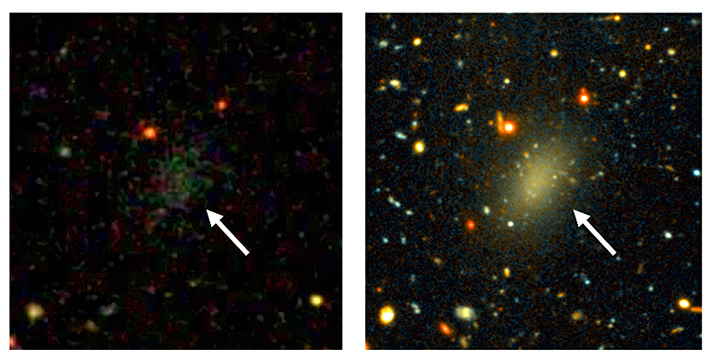

Despite years of searching, we have no idea what dark matter actually is, but this invisible matter is crucial to the stability of the Universe. 

Pieter van Dokkum, Roberto Abraham, Gemini, Sloan Digital Sky Survey


Galaxies rotate at such speeds, they'd rip themselves apart if the only thing trying to hold them together was their own gravitational force. Something else has to be holding them and the rest of the Universe together, and physicists think the answer is a whole lot of dark matter. 


In fact, the standard model of cosmology suggests that there's so much dark matter in the Universe, for every 1 gram of atoms in existence, there's at least five times more dark matter.


Now scientists have found a galaxy that's almost entirely made up of the stuff. 


Named Dragonfly 44, the galaxy was discovered back in 2014, when a team using the WM Keck Observatory and the Gemini North Telescope in Manuakea, Hawaii, located a whole bunch of 'fluffy galaxies' in a region called the Coma Cluster, some 320 million light-years away.


"If the Milky Way is a sea of stars, then these newly discovered galaxies are like wisps of clouds," one of the researchers, Pieter van Dokkum from Yale University, said at the time.

"We are beginning to form some ideas about how they were born, and it's remarkable they have survived at all," he added. 


"They are found in a dense, violent region of space filled with dark matter and galaxies whizzing around, so we think they must be cloaked in their own invisible dark matter 'shields' that are protecting them from this intergalactic assault."


Now van Dokkum and his team have had a chance to test out their hypothesis, and by figuring out the mass of Dragonfly 44, they say they have enough evidence to suggest that dark matter truly is the glue holding this whole thing together. 


The researchers measured the velocities of stars in Dragonfly 44 for 33.5 hours over a period of six nights, and used this information to calculate the mass of the galaxy as a whole.


An increase in the velocity of an object will increase its kinetic energy and therefore its mass, which means the faster these stars are going will equate to a more massive galaxy. 


Having measured the speed of Dragonfly 44's stars as around 47 kilometres per second, the team calculated that it's around 1 trillion times more massive than our Sun - far too heavy to be held together by its stars alone.


"Motions of the stars tell you how much matter there is," van Dokkum told Avery Thompson at Popular Mechanics. "They don't care what form the matter is, they just tell you that it's there. Using the Keck Observatory, we found many times more mass indicated by the motions of the stars than there is mass in the stars themselves."


Having estimated that the galaxy needs to be made up of 99.99 percent of dark matter to remain intact, the team has officially found the darkest known galaxy in the Universe. 


A similarly dark galaxy in the Virgo cluster was identified earlier this year, but its 99.96 percent dark matter just got beat.


As cool as this discovery is, it's thrown up a whole lot more questions than answers. Right now, every potential candidate for dark matter has failed to yield enough evidence to explain what it's made from, and until recently, the only dark matter galaxies we've known about have been tiny.


Dragonfly 44 is huge, and no one can figure out how it got so big - and stayed so big - with so little visible matter. But at least now we've now got an entire galaxy full of dark matter to study, right?


"It's hard to argue with the observations, yet the conclusion from this paper runs counter to my understanding of how galaxies are formed," one of the team, astronomer Marla Geha from Yale University, who wasn't involved in the research, told New Scientist.

"I'm hoping these objects are rather rare and/or only form in special environments such as a dense galaxy cluster. Otherwise we may need to rewrite galaxy formation."


The research has been published in Astrophysical Journal Letters.

Astronomers have discovered a massive "Ghost Galaxy" made up of 99.99% dark matter

Astronomers have found a nearby galaxy that's roughly the same mass as the Milky Way, but somehow contains less than 1 percent of its stars.


The galaxy is so dim, it's evaded detention for decades, and now the team behind its discovery has figured out how its lack of stars hasn't ripped it apart - it's made from 99.99 percent dark matter.


Dark matter is estimated to make up around 27 percent of all the mass and energy in the observable Universe, and while we can detect its gravitational force, it doesn't appear to emit any form of light or radiation that we can observe.


Despite years of searching, we have no idea what dark matter actually is, but this invisible matter is crucial to the stability of the Universe. 

Pieter van Dokkum, Roberto Abraham, Gemini, Sloan Digital Sky Survey


Galaxies rotate at such speeds, they'd rip themselves apart if the only thing trying to hold them together was their own gravitational force. Something else has to be holding them and the rest of the Universe together, and physicists think the answer is a whole lot of dark matter. 


In fact, the standard model of cosmology suggests that there's so much dark matter in the Universe, for every 1 gram of atoms in existence, there's at least five times more dark matter.


Now scientists have found a galaxy that's almost entirely made up of the stuff. 


Named Dragonfly 44, the galaxy was discovered back in 2014, when a team using the WM Keck Observatory and the Gemini North Telescope in Manuakea, Hawaii, located a whole bunch of 'fluffy galaxies' in a region called the Coma Cluster, some 320 million light-years away.


"If the Milky Way is a sea of stars, then these newly discovered galaxies are like wisps of clouds," one of the researchers, Pieter van Dokkum from Yale University, said at the time.

"We are beginning to form some ideas about how they were born, and it's remarkable they have survived at all," he added. 


"They are found in a dense, violent region of space filled with dark matter and galaxies whizzing around, so we think they must be cloaked in their own invisible dark matter 'shields' that are protecting them from this intergalactic assault."


Now van Dokkum and his team have had a chance to test out their hypothesis, and by figuring out the mass of Dragonfly 44, they say they have enough evidence to suggest that dark matter truly is the glue holding this whole thing together. 


The researchers measured the velocities of stars in Dragonfly 44 for 33.5 hours over a period of six nights, and used this information to calculate the mass of the galaxy as a whole.


An increase in the velocity of an object will increase its kinetic energy and therefore its mass, which means the faster these stars are going will equate to a more massive galaxy. 


Having measured the speed of Dragonfly 44's stars as around 47 kilometres per second, the team calculated that it's around 1 trillion times more massive than our Sun - far too heavy to be held together by its stars alone.


"Motions of the stars tell you how much matter there is," van Dokkum told Avery Thompson at Popular Mechanics. "They don't care what form the matter is, they just tell you that it's there. Using the Keck Observatory, we found many times more mass indicated by the motions of the stars than there is mass in the stars themselves."


Having estimated that the galaxy needs to be made up of 99.99 percent of dark matter to remain intact, the team has officially found the darkest known galaxy in the Universe. 


A similarly dark galaxy in the Virgo cluster was identified earlier this year, but its 99.96 percent dark matter just got beat.


As cool as this discovery is, it's thrown up a whole lot more questions than answers. Right now, every potential candidate for dark matter has failed to yield enough evidence to explain what it's made from, and until recently, the only dark matter galaxies we've known about have been tiny.


Dragonfly 44 is huge, and no one can figure out how it got so big - and stayed so big - with so little visible matter. But at least now we've now got an entire galaxy full of dark matter to study, right?


"It's hard to argue with the observations, yet the conclusion from this paper runs counter to my understanding of how galaxies are formed," one of the team, astronomer Marla Geha from Yale University, who wasn't involved in the research, told New Scientist.

"I'm hoping these objects are rather rare and/or only form in special environments such as a dense galaxy cluster. Otherwise we may need to rewrite galaxy formation."


The research has been published in Astrophysical Journal Letters.
Earth Is Passing Through A Dark Matter "Hurricane" Right Now


Scientists believe a dark matter "storm" is making its way past the Sun and could be detected here on Earth.


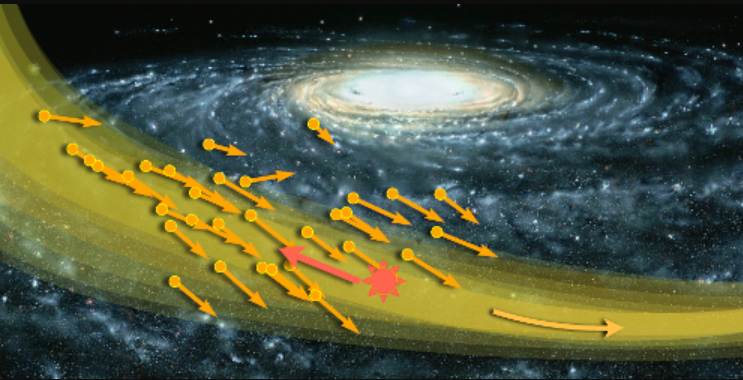
The study, conducted by Ciaran O'Hare of the University of Zaragoza in Spain, was published in Physical Review D and looked at the S1 stream, a cluster of neighbouring stars travelling in the same direction. According to APS Physics, these are "believed to be the remnants of a dwarf galaxy that was eaten by the Milky Way billions of years ago."


The ESA's Gaia spacecraft, which is mapping a billion stars in our galaxy, discovered the S1 stream of 30,000 stars last year. In our galaxy, some 30 such streams have been discovered, each one the result of a previous collision.


S1 is particularly intriguing because it is currently "blowing" by us at approximately 500 kilometres (310 miles) per second. According to the experts, this could have an impact on the dark matter surrounding us.


"Current detectors probing for weakly interacting massive particles (WIMPs), a widely discussed form of dark matter, are unlikely to see any effect from S1," the statement said, "but future WIMP detectors may."


All galaxies are assumed to have originated within a vast halo of dark matter, which is invisible to us and does not interact with normal matter. However, the researchers discovered that approximately 10 billion solar masses of dark matter originating in the initial dwarf galaxy was migrating down S1.


A star stream passing past our Sun is depicted. Jon Lomberg/NASA/C. O'Hare


“As the S1 stream ‘hits the Solar System slap in the face’, the authors write, its counter-rotating structure will dramatically increase the amount of dark matter appearing to come from the same patch of sky as the standard dark matter wind,” reports Cosmos Magazine.

"Indeed, it should generate a ring-like structure around this wind, which directed dark matter detectors... may easily detect in the future."


ScienceAlert also reported that axions, theorised particles 500 million times lighter than an electron that could represent dark matter, could be detected in the stream. "[T]hese ultralight particles, which humans cannot see, could be transformed to visible photons in the presence of a strong magnetic field," they said.


Despite repeated efforts, no direct discovery of dark matter has ever been made. However, this "storm" may present an exciting opportunity to do so.


Reference(s):  Physical Review D, Cosmos Mag and ScieneAlert

We Are About To Witness Jupiter's Poles For The First Time Ever

Juno flying over Jupiter.


Get ready for the next year or so, because you are going to be hearing a lot more new stuff about Jupiter. NASA’s Juno spacecraft will do its first science flyby of the gas giant. And in the process, Juno will sight its poles like never before.


Juno entered the orbit around Jupiter in this July. It is the first spacecraft to do so since NASA’s Galileo in year 1995. To keep itself harmless from Jupiter’s radiation, though, Juno is in a wide extensive orbit around the planet. At it is furthest; it is up to 3 million km (2 million miles) away. Two days ago, it has flied just 4,200 km (2,500 miles) above the clouds of Jupiter. It is the closest approach to Jupiter so far. When Juno first entered the orbit, its eight science equipments were shut down. But this time around, all eight equipments will be on, as well as JunoCam. This camera will take high-resolution images of Jupiter and, for the first time, will get complete images of Jupiter’s north and south poles. We have already seen Jupiter’s polar region before, thanks to the Cassini spacecraft, but those sights were somewhat obscured because Cassini observed the pole from an angle.

Steve Levin, Juno project researcher from NASA's Jet Propulsion Laboratory in Pasadena, California,said in a statement"No other spacecraft has ever orbited Jupiter this closely, or over the poles in this fashion. This is our first opportunity and there are bound to be surprises. We need to take our time to make sure our conclusions are correct."

The flyby is taken place around 8.51am EDT (1.51pm BST) this Saturday, although images will not be sent home straight away. A NASA spokesman told IFLScience we could expect the first images to be on the loose on Thursday, September 1. This is the first of 36 flybys of Jupiter scheduled for Juno up till the end of its mission in February 2018, and it is just the foundation for some of the interesting science we can imagine from Jupiter.

Scott Bolton, principal investigator of Juno from the Southwest Research Institute in San Antonio, Texas, US, said in the statement "This is our first opportunity to really take a close-up look at the king of our solar system and begin to figure out how he works."