If you go to the Innovation Center for US Dairy's website, their top frequently asked question is: "Does chocolate milk come from brown cows?". They answer it clearly and politely:
"Actually, chocolate milk – or any flavored milk for that matter – is white cow’s milk with added flavoring and sweeteners".
Unfortunately, this message does not appear to be sinking in with the American public, as a survey commissioned by the Center has found that a whopping 7 percent of Americans still think that chocolate milk comes directly out of a brown cow. If you multiply that, that's 16.4 million people nationwide who think that chocolate milkshake could potentially be drunk directly from a cow's udder, Food and Wine reports.
The nationally representative survey gets more alarming. Forty-eight percent of respondents admitted they weren't sure where chocolate milk comes from. If this is true across the nation generally, that would be an astounding 154,272,000 potential voters who aren't confident enough to guess "cows?".
Unfortunately, this isn't an isolated case of Americans being uninformed about where food comes from. A study in the early '90s found that 20 percent of adults didn't know that hamburgers are made of meat from cows.
Strangely, Innovation Center for US Dairy's study also found that 37 percent of people secretly drank milk straight out of the container in the fridge, in extremely poor milk/fridge etiquette. Another 29 percent use their children as an excuse to buy chocolate milk, so that they can drink it themselves.
The survey of over 1,000 adults also reports that 95 percent of Americans have some kind of cheese in their fridge. We are hoping they will conduct a follow-up study to look into whether Americans think blue cheese comes from blue cows.
Stilton does not come from blue cows, by the way. Pexels/IFLS
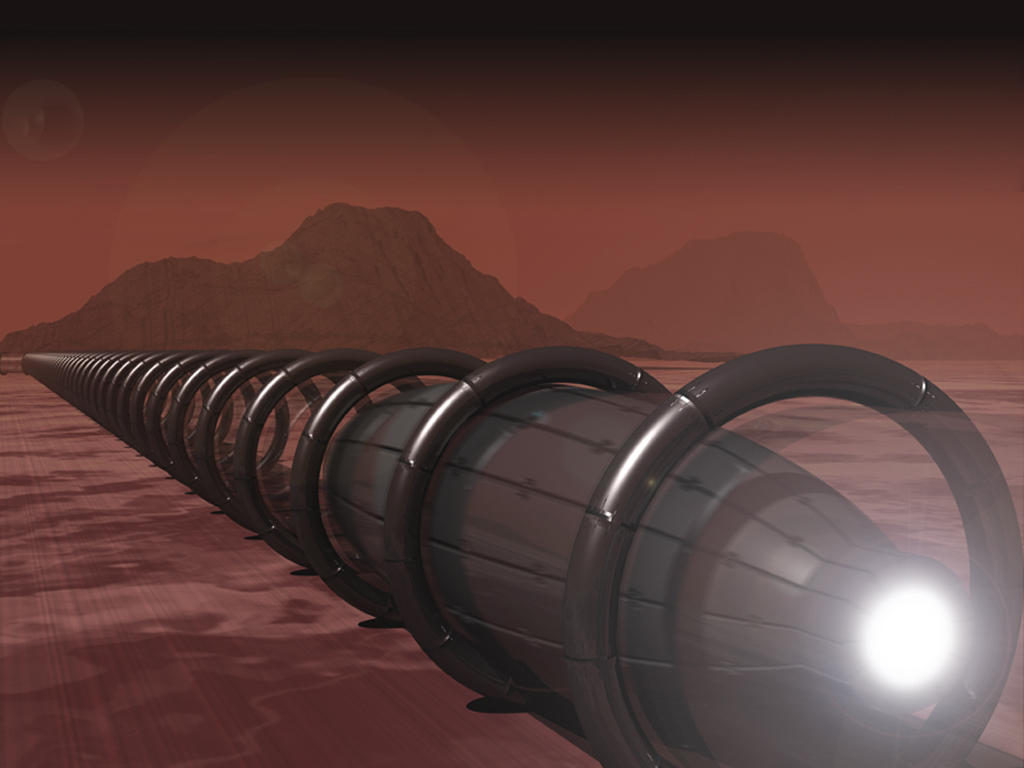
Charles Bombardier, is a Montreal-based innovator, has uncovered an idea for a hypothetical space train called Solar Express that can take passengers and freights between planets faster than any present systems. If ever a reality, Charles Bombardier and his team visualize Solar Express travelling at roughly 1% the speed of light, about 3,000 km per second (1,864 miles per second), dropping the travel time between Earth and Mars to less than two Earth days.
Bombardier said on Solar Express site, "In space, the most costly portions of travel are the acceleration and deceleration phases. The energy required for those portions is terrific, particularly for something as heavy as a space train. In addition, if you were to start shipping cargo, it would become very expensive.
"However, once the train reached its travelling speed, its energy consumption would be nominal. That’s the idea behind the Solar Express model. It would never stop; instead, space wagons/capsules would rendezvous with it."
While it is necessarily important to keep in mind that this is just a theoretical idea and not a project in fact being implemented in reality (yet, besides), the team is looking at outside-of-the-box answers to humanity’s space travel problems. So, how would it work? Well, according to the team, Solar Express would contain of a series of allied cylinders almost of 50 meters (164 feet) in length. Six of these cylinders, which you can consider as train cars, would be connected together in a straight line and hurtle through space.
To launch, one of the most expensive features of space travel, Solar Express would use rocket boosters, keeping a low amount of fuel on standby to regulate course. Then, the train would slingshot around astronomic bodies to gain speed without requiring more fuel. Charles Bombardier describes, "Huge solar groups located along the train’s path could be used to capture solar energy and transfer it by laser to super-capacitors. Water gathered from comets or small moons would be used for humans living on the train and transported to other places."The gathered water could also be used to create hydrogen and propellant, but the central propulsion system should take the form of an ion thruster."
After in motion, the train would never stop. Instead, smaller crafts would join up with the train when it orbits a planet to collect supplies and drop the passengers. The capacity to keep going forever would cut expenditures, though the up-front manufacture cost would be huge. There are also many technical questions that the team is still figure out, such as how to control such a fast ship, how the space shuttles would discharge goods from the moving craft, and how to get it to such great speed.
Bombardier said,"Clearly, there is a lot to consider starting with dimensions, speed, masses, energy, etc. How do you control such a multipart vehicle? The Solar Express is a basic idea and we would like to know how we could advance it."
If you can take the imaginative dive, though, the opportunities of a working Solar Express would be senseless. According to Kritin Tablang from Forbes, a tour from Earth to the Moon would take only 2.13 minutes, although a trip to Mars would take about 37 hours. A trip to Neptune, the utmost planet from Earth, would take almost 18 days. To put that into perception, it acquired Voyager 2 about 12years to get to Neptune, and NASA says it takes approximately 260 days to get Mars by using current technology. Since the time constraint for space travel within our own Solar System is one of the many restrictive issues for us humans, throwing around ideas to circumvent the old-style approach is always a good thing, no matter how doubtful they are to ever come to achievement. Optimistically, scientists will have some answers to Bombardier’s remaining questions about Solar Express. Till then, we have to just imagine it.