Showing posts with label galaxies. Show all posts

Amateur astronomers have discovered an enormous, never-before-seen nebula near the Andromeda Galaxy


he vast emission feature lies right next to the Andromeda Galaxy, though researchers aren't yet sure if they're physically related.


The OIII emission nebula Strottner-Drechsler-Sainty Object 1 appears next to M31 as a banded teal arc in this HOLRGB image.Marcel Drechsler/Xavier Strottner/Yann Sainty


Despite being one of the most venerable and prominent objects in the night sky, the Andromeda Galaxy (M31) still has surprises. And a group of amateur astronomers have uncovered the latest: a previously unknown emission nebula lying just southeast of Andromeda and spanning half the width of the galaxy itself.


The feature was discovered in images taken last year with an Oxygen-III (OIII) filter by French astroimager Yann Sainty, who worked with Marcel Drechsler and Xavier Strottner to process and analzye the data. They have designated the feature Strottner-Drechsler-Sainty Object 1.


They then worked with a team of professional astronomers and other astroimagers to confirm the find. The team published their results in Research Notes of the AAS last month — as well as a stunning, highly-processed image on the astroimaging site Astrobin (reproduced above).


A side project


The observations of Andromeda began as a side project for the trio, who had originally teamed up for another reason: Drechsler and Strottner maintain a catalog of planetary nebulae, and had asked Sainty to capture several known and candidate objects. 


Sainty traveled all across France in search of the darkest sites he could find for his mobile observing setup, which includes a 4.2-inch Takahashi refractor and a CMOS astronomical camera from ZWO. After concluding this months-long project, Sainty “decided to focus on a relaxing and easy project — the Andromeda Galaxy,” Drechsler said in a statement shared with media, including Astronomy and ZWO.

“While working on the Andromeda project, Yann Sainty did something that few astrophotographers before him have done — he used an OIII filter to better bring out the faint HII regions,” said Drechsler. “Since an OIII filter is relatively new territory in astrophotography, Yann sent the data to [me] and Xavier for review. Yann’s secret hope, perhaps, was to have a previously unknown planetary nebula or supernova remnant in the data.”

When Drechsler and Strottner looked at the OIII images, they noticed “an extremely faint nebulosity … at the edge of the image that seemed to continue outside the photo.” At first, the team considered whether it was an artifact, like a gradient introduced through a faulty flat-field calibration image. But Drechsler “urged Sainty to collect more OIII data, thinking he spotted finer sub-structures in the barely-visible nebula.”

Sainty collected more images through the fall of 2022, eventually totaling 111 hours of exposure. As he did, the team began increasingly sure they had found something real — and previously unreported.


Confirming observations


The team reached out to professional astronomers to aid in verifying their discovery, including Robert Fesen of Dartmouth College in Hanover, New Hampshire. In an interview with Astronomy at last month’s meeting of the American Astronomical Society (AAS) in Seattle, Fesen pointed to the arc in an image and summed up his initial reaction: “What the hell is that?”

“When they sent it to me, I said, ‘There’s something wrong with your camera, and go fix it and leave me alone,’” he quipped. “[Dreschler] came back a couple of weeks later: ‘Rob, it’s real.’ And I said, ‘Look, you haven’t tried hard enough to kill it.’”

To confirm it, other astroimagers joined the hunt: Bray Falls working with two remote telescopes in California, Christophe Vergnes and Nicolas Martino in France, and Sean Walker (associate editor at Sky and Telescope magazine) observing with a remote telescope in New Mexico. Their results convinced Fesen: “Five different telescopes see stuff there? At different levels of resolution, but it’s in the same spot of the sky off M31? I decided it’s real.”


Remarkably, the nebula had been missed by previous OIII surveys of M31 on professional-grade telescopes, including one by the 3.6-meter Canada-France-Hawaii Telescope (CFHT) on Mauna Kea. That’s because many instruments designed for research simply aren’t well-suited to spot such a faint and extended nebula. 


CFHT’s MegaCam instrument has a field of view of 1° — wide by professional standards, but still not wide enough to capture the full extent of the new object, which spans 1.5°. The MegaCam survey of M31 also used a filter that allowed a relatively wide range of wavelengths to pass through — over 10 nanometers. Sainty used an off-the-shelf Antlia filter with a bandwidth of just 3 nm, which better isolated the OIII signal from background noise.


Here or there?


The find has set the astronomical community ablaze with speculation about the object’s nature, including whether it is physically next to Andromeda, which is 2.5 million light-years away. It is entirely possible that the newfound object is part of the Milky Way and simply lies along our line of sight to our galactic neighbor.

One possibility that the team considered was that the feature is caused by Andromeda beginning to interact with the Milky Way. But, they wrote, “the arc seems much too close to M31 to fit that picture. More likely, it lies within M31’s halo and is related to the numerous stellar streams, especially the Giant Stellar Stream whose eastern edge lies close to the OIII arc.”

However, Fesen tells Astronomy that since then, “I have started to think it less likely to be a feature of M31, but, instead, a Milky Way nebula much closer. But who knows.”


To settle the issue, Fesen and his colleagues hope to obtain a spectrum with a professional-grade observatory. From this, they can measure any Doppler shift in the light caused by motion toward or away from the Milky Way — and whether it matches the motion of Andromeda itself.


Whether or not the arc is ultimately associated with Andromeda, the discovery highlights the role that amateur astronomers and imagers with widely available high-quality narrowband filters are playing in discovering faint, extended emission nebulae.


Fesen expressed admiration for the imagers, who, he notes, are taking data that totals exposures of “fractions of a day or more.” He pointed to one of the confirmation images: “That one picture’s 86 hours. Are you kidding me? [Sainty’s image] was taken over 22 nights over three months of clear weather. This is insane.”

Astronomers capture radio signal from ancient galaxy at record-breaking distance

The detection of the special radio wavelength from the most distant galaxy means astronomers may be ready to investigate how the earliest stars form.


Top image Credits: The Giant Metrewave Radio Telescope in Pune, India. (Image credit: National Centre for Radio Astrophysics)


Astronomers have detected a radio signal from the most distant galaxy yet. 


The signal was detected at a special and significant wavelength known as the "21-centimeter line" or the "hydrogen line," which is emitted by neutral hydrogen atoms. The detection of the hydrogen line from such a galaxy so far away   —  and therefore so early in the universe  —  by the Giant Metrewave Radio Telescope in India could mean astronomers are ready to begin investigating the formation of the earliest stars and galaxies.


The signal from the star-forming galaxy SDSSJ0826+5630 was emitted when our 13.8 billion-year-old galaxy was just 4.9 billion years old. The signal allowed the astronomers to measure the galaxy's gas content and find that its mass is double that of the early galaxy's visible stars. 


Galaxies emit electromagnetic radiation, or light, across a wide range of radio wavelengths, but thus far 21-cm-wavelength radio waves have only been seen from nearby and thus more recent galactic sources.


"It's the equivalent to a look-back in time of 8.8 billion years," lead author and McGill University Department of Physics Post-Doctoral cosmologist Arnab Chakraborty, said of the breakthrough in a statement. "A galaxy emits different kinds of radio signals. Until now, it's only been possible to capture this particular signal from a galaxy nearby, limiting our knowledge to those galaxies closer to Earth."


The difficulty in spotting these wavelengths from more distant galaxies is due to the fact that as electromagnetic radiation from early galaxies travels vast distances to Earth, the expansion of the universe stretches its wavelength and causes its energy to reduce. That means telescopes here on Earth need a natural boost to see long-wavelength, low-energy radio waves like the hydrogen line signal.


However, the team was able to make the record-breaking detection using a phenomenon predicted as part of the theory of general relativity, Einstein's geometric theory of gravity, first suggested in 1915.


Gravity as a window to the early universe


General relativity suggests that objects with mass warp spacetime similar to how a ball placed on a stretched rubber sheet would weigh it down in the center, and just like in that analogy, the greater the mass, the more extreme the curvature.


That means a tremendously massive object like a black hole or galaxy causes extreme curvature in spacetime just as a bowling ball would cause the extreme curvature of the rubber sheet in the analogy. 


An illustration showing the detection of radiowaves from galaxies at different distances. (Image credit: Swadha Pardesi)


This curving of spacetime causes light to bend as well as it passes by objects of tremendous mass. A phenomenon known as gravitational lensing occurs when a foreground or lensing object of tremendous mass sits between an observer and a background source, causing the light from the background object to curve and take different paths through and around the lensing object. This can not only make a single object appear at multiple points in the sky, but it can also have the effect of magnifying this light.


The Hubble Space Telescope image known as the "Einstein Cross" shows the light from a distant quasar after it has been bent by a nearby galaxy acting as a gravitational lens.  (Image credit: NASA/ESA/STSci)


In the case of SDSSJ0826+5630, the radio wave signal was magnified by another galaxy between the early galaxy acting as a lensing body. "This effectively results in the magnification of the signal by a factor of 30, allowing the telescope to pick it up," co-author and Associate Professor in the Department of Physics at the Indian Institute of Science, Nirupam Roy, said.


The team of astronomers believes that the detection of the hydrogen line signal from this early galaxy demonstrates that it is feasible to observe radio signals from other distant galaxies during the early epoch of the universe. 


This could in turn open up a new way of using long-wavelength radio telescopes to probe the evolution of stars and galaxies and how the early universe evolved into the cosmos we see around us in its current era. 


The team's research is detailed in a paper published in the Monthly Notices of the Royal Astronomical Society.

Scientists See Giant Structure “Hidden” Behind Our Galaxy

An uncharted region of space known as the "zone of avoidance" lurks behind the Milky Way's center – and astronomers just found an enormous, multi-galaxy structure there.


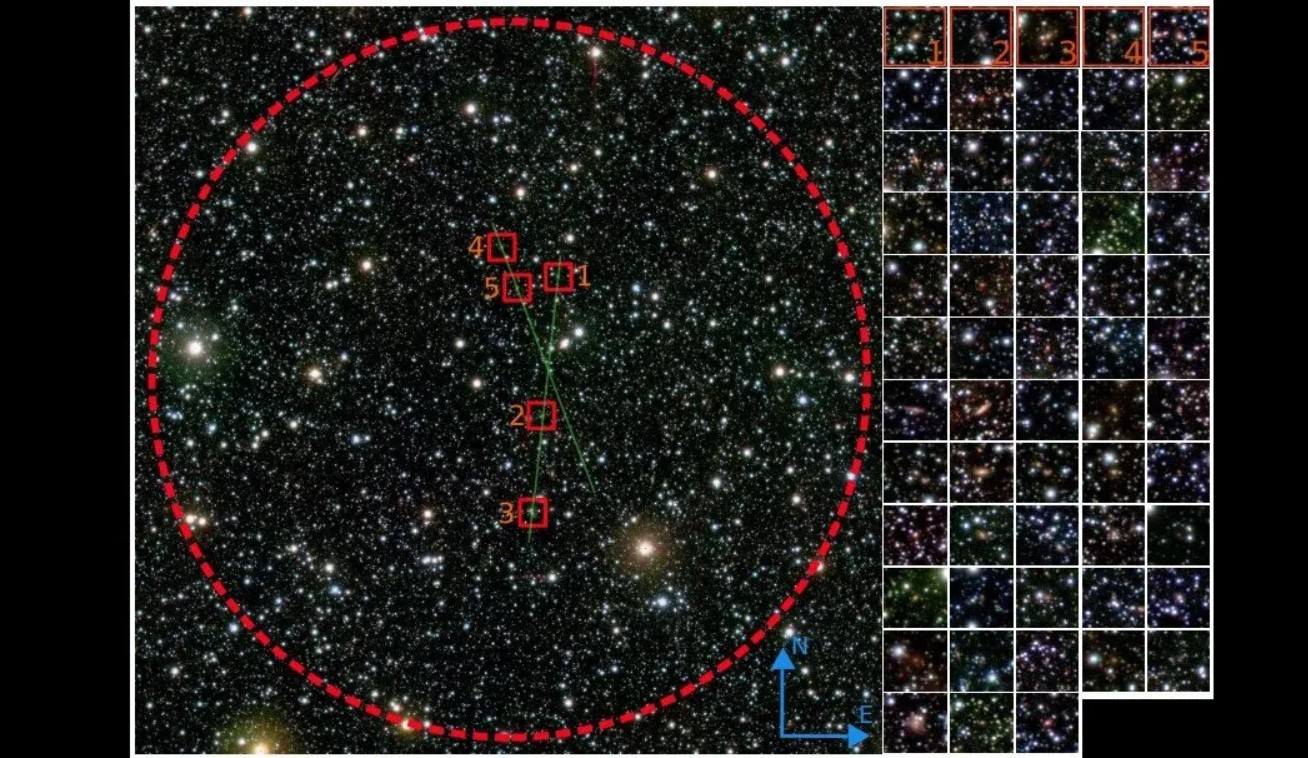
A composite image showing the 58 galaxies clustered together in the "zone of avoidance" behind the Milky Way. (Image credit: Galdeano et al. / ESO)


Astronomers have detected an enormous extragalactic structure hiding in an uncharted region of space far beyond the Milky Way's center.


This phantom region, known as the zone of avoidance, is a blank spot on our map of the universe, comprising somewhere between 10% and 20% of the night sky. The reason we can't see it — at least with standard visible light telescopes — is because the Milky Way's bulging center blocks our view of it; the center of our galaxy is so dense with stars, dust and other matter that light from the zone of avoidance gets scattered or absorbed before reaching Earth's telescopes.


However, researchers have had better luck uncovering the zone's secrets with telescopes that can detect infrared radiation — a type of energy that's invisible to human eyes, but powerful enough to shine through dense clouds of gas and dust. Infrared surveys of the zone of avoidance have found evidence of thousands of individual galaxies shining through the cosmic fog, though little is known about the large-scale structures that lurk there. 


Now, researchers have combined data from several of those infrared surveys to reveal the most colossal structure ever detected in the zone of avoidance, according to a study published Oct. 28 on the preprint database arXiv.org. (This study has not yet been peer reviewed, though it has been submitted for review to the journal Astronomy and Astrophysics).


Located approximately 3 billion light-years from Earth, the mysterious structure appears to be a large cluster of galaxies drawn together by a shared center of gravity. Using observations from the VVV Survey — a survey that studies the Milky Way's central bulge at infrared wavelengths using the Visible and Infrared Survey Telescope for Astronomy in Chile — the study authors found evidence of at least 58 galaxies bundled together in a small plot of the zone of avoidance.


Galaxy clusters are the largest gravitationally-bound objects in the universe; the largest known clusters contain hundreds of thousands of galaxies bunched together. Unfortunately, it's impossible to tell just how wide or massive the newly discovered cluster is, given the vast distances and myriad obstructions sitting between the cluster's stars and Earth. 


However, the mere detection of this colossal object shows that the zone of avoidance may not be as inscrutable as was once thought. Future infrared studies — including potential observations by the James Webb Space Telescope, which has already used its infrared camera to take the deepest image of the universe to date — should further help scientists unlock the hidden secrets beyond the Milky Way's bulge.

Scientists See Giant Structure “Hidden” Behind Our Galaxy

An uncharted region of space known as the "zone of avoidance" lurks behind the Milky Way's center – and astronomers just found an enormous, multi-galaxy structure there.


A composite image showing the 58 galaxies clustered together in the "zone of avoidance" behind the Milky Way. (Image credit: Galdeano et al. / ESO)


Astronomers have detected an enormous extragalactic structure hiding in an uncharted region of space far beyond the Milky Way's center.


This phantom region, known as the zone of avoidance, is a blank spot on our map of the universe, comprising somewhere between 10% and 20% of the night sky. The reason we can't see it — at least with standard visible light telescopes — is because the Milky Way's bulging center blocks our view of it; the center of our galaxy is so dense with stars, dust and other matter that light from the zone of avoidance gets scattered or absorbed before reaching Earth's telescopes.


However, researchers have had better luck uncovering the zone's secrets with telescopes that can detect infrared radiation — a type of energy that's invisible to human eyes, but powerful enough to shine through dense clouds of gas and dust. Infrared surveys of the zone of avoidance have found evidence of thousands of individual galaxies shining through the cosmic fog, though little is known about the large-scale structures that lurk there. 


Now, researchers have combined data from several of those infrared surveys to reveal the most colossal structure ever detected in the zone of avoidance, according to a study published Oct. 28 on the preprint database arXiv.org. (This study has not yet been peer reviewed, though it has been submitted for review to the journal Astronomy and Astrophysics).


Located approximately 3 billion light-years from Earth, the mysterious structure appears to be a large cluster of galaxies drawn together by a shared center of gravity. Using observations from the VVV Survey — a survey that studies the Milky Way's central bulge at infrared wavelengths using the Visible and Infrared Survey Telescope for Astronomy in Chile — the study authors found evidence of at least 58 galaxies bundled together in a small plot of the zone of avoidance.


Galaxy clusters are the largest gravitationally-bound objects in the universe; the largest known clusters contain hundreds of thousands of galaxies bunched together. Unfortunately, it's impossible to tell just how wide or massive the newly discovered cluster is, given the vast distances and myriad obstructions sitting between the cluster's stars and Earth. 


However, the mere detection of this colossal object shows that the zone of avoidance may not be as inscrutable as was once thought. Future infrared studies — including potential observations by the James Webb Space Telescope, which has already used its infrared camera to take the deepest image of the universe to date — should further help scientists unlock the hidden secrets beyond the Milky Way's bulge.

Astronomers find hidden galaxies at the edge of space and time

A team of researchers unintentionally discovered two hidden galaxies at the frontier of space and time.


A group of scientists discovered and has now identified two hidden galaxies at the frontier of space and time.


Yoshinobu Fudamoto, an astronomer from Waseda University's Research Institute for Science and Engineering and the National Astronomical Observatory of Japan (NAOJ), led the team that made the discovery using the Atacama Large Millimeter/submillimeter Array (ALMA) in Chile. ALMA is an astronomical interferometer made up of 66 radio telescopes that can see through dusty conditions and over extremely long distances.


The scientists discovered the two new galaxies while watching two target galaxies called REBELS-12 and REBELS-29. The scientists discovered strong emissions hundreds of light-years away from the target galaxies. This discovery prompted the researchers to conduct additional observations, which resulted in the identification of two galaxies known as REBELS-12-2 and REBELS-29-2. These galaxies are obscured by a cloud of cosmic dust and are not visible in ultraviolet or optical light.


Researchers believe the newly discovered galaxies developed only 800 million years after the universe's inception 13.8 billion years ago.

Astronomers discover the most distant galaxy yet

 A galaxy named HD1 has been crowned the new farthest object in the cosmos. 

Astronomers may have discovered the most distant galaxy, HD1. Harikane et al.

Located some 13.5 billion light-years away, HD1 existed only about 330 million years after the Big Bang. And the far-flung galaxy may be harboring another surprise, too — either Population III stars, the first stars born in the cosmos, or the earliest supermassive black hole ever found.


The findings are presented in two papers, released today (April 7) in The Astrophysical Journal and the Monthly Notices of the Royal Astronomical Society Letters (MNRAS).


HD1's age compared to the farthest galaxy confirmed to date. Harikane et al., NASA, EST and P. Oesch/Yale.


HD1 is extremely bright in ultraviolet light, which is normally evidence that a galaxy is producing stars at a high rate. But researchers quickly realized that even if HD1 was a starburst galaxy, it would be creating over 100 stars a year. 


“This is at least 10 times higher than what we expect for these galaxies,” said Fabio Pacucci, lead author of the MNRAS study, co-author in the discovery paper in The Astrophysical Journal, in a news release


So the team turned to other possibilities that might explain HD1’s surplus of ultraviolet light.


Population III stars float in primordial gas in this artist's concept of the early universe. NASA/WMAP Science Team


The first stars


One possible explanation for HD1's ultraviolet radiance is that the stars the galaxy is producing are different from the mundane stars produced in modern galaxies. Today, stars are made from recycled material ejected from previous generations of stars. So, every star has some heavier elements, even if just a sprinkle. 


But in the very early universe, after the Big Bang, primordial gas consisted entirely of hydrogen, helium, and a sampling of lithium and beryllium. From these elements, the first stars were born. Known as Population III stars, they were more massive, more luminous, and hotter than today’s stars. They also perfected the mantra of live fast, die young, burning out within only a few million years. 


The only problem: Population III stars are hypothetical as their quick lives means no direct evidence of them has ever been spotted. But the recent discovery of the earliest star, Earendel, may prove fruitful for Population III hunters — if follow-up studies find the star’s composition to be entirely hydrogen and helium. 


In the meantime, while Population III stars would easily explain HD1’s brightness in the ultraviolet wavelength, they aren’t the only possibility.


An artist's concept of a galaxy in the early universe. The bright center is a quasar — highly luminous objects powered by supermassive black holes.  ESO/M. Kornmesser


Earliest cosmic monster 


Alternatively, a supermassive black hole might explain the galaxy's ultraviolet brightness. If that's the case, the supermassive black hole would become the earliest known, breaking the previous record by some 500 million years. 


Supermassive black holes are believed to reside in the hearts of most galaxies, but understanding how these monsters grew so big so quickly in the early universe remains a conundrum for scientists. Physics tells us that black holes need time to gobble up enough material to grow to supermassive proportions, meaning that scientists didn’t expect to see them so early in the cosmic timeline. 


But in 2017, astronomers began finding these monsters within the universe’s earliest galaxies. Disks of material surrounded the black holes, and the infalling matter shone so brightly the galaxies, despite their extreme distances, can still be seen today.


It is the high-energy photons from that infalling material, which gets violently swirled around the black hole, that might be causing HD1’s ultraviolet brightness. 


“Forming a few hundred million years after the Big Bang, a black hole in HD1 must have grown out of a massive seed at an unprecedented rate,” explains MNRAS co-author Avi Loeb. Such an early black hole may not answer the question of how these objects grew so big so quickly, but it would narrow down how soon they appeared in the early universe. 


JWST up to bat 


To make this distant discovery, the team spent more than 1,200 hours observing with the Subaru Telescope, VISTA Telescope, UK Infrared Telescope, and Spitzer Space Telescope. To verify HD1's distance, the team plans to observe the galaxy again, this time with NASA’s powerful James Webb Space Telescope. 


Capable of peering back to the first luminous glows that emerged after the Big Bang, JWST will also be able to settle which theory explains HD1's ultraviolet shine. And, perhaps, find even more distant galaxies in the earliest moments of the cosmos.

A Giant Galaxy Orbiting Our Own Just Appeared Out of Nowhere

Astronomers watching the sky recently got a big surprise. They discovered a big galaxy in an undiscovered region of our galaxy. It appeared seemingly out of nowhere.

So, how did the galaxy, called Crater 2, achieve this feat, much like a deer leaping from intergalactic bushes to peer down our collective headlights? While Crater 2's appearance may appear sudden, he has been present the entire time. We simply ignored it.

However, now that we know it exists, astronomers have discovered a few more humiliating qualities. To begin, we cannot attribute the galaxy's relative obscurity to its size. Crater 2 is so massive that it has already been designated as the fourth largest galaxy in our galaxy's orbit. We can't blame its distance either. The orbit of Crater 2 around the Milky Way places it immediately overhead.

With that stated, how did we manage to miss it? Researchers at the University of Cambridge have an answer for us in a recent publication published in Monthly Notices of the Royal Astronomical Society. 

Despite its size and proximity, Crater 2 is likewise a rather dark galaxy. Indeed, it is one of the faintest galaxies ever discovered. This, together with several considerably brighter neighbours, allowed the galaxy dubbed “the feeble giant” to remain undetected until today.

However, now that we've seen Crater 2, the discovery raises questions about what more might exist. Researchers are already talking about starting a search for such massive, black galaxies in our neighbourhood. It serves as a fantastic reminder that there is still a lot about space that we don't comprehend.

Reference(s): Peer-Reviewed Research Paper

The Hubble telescope captures a black hole that forms stars instead of absorbing them

Astronomers in charge of the Hubble Space Telescope have discovered a black hole in the heart of a dwarf galaxy that, rather than absorbing stars, generates them. 

This revelation challenges the commonly held belief that black holes are matter destroyers.

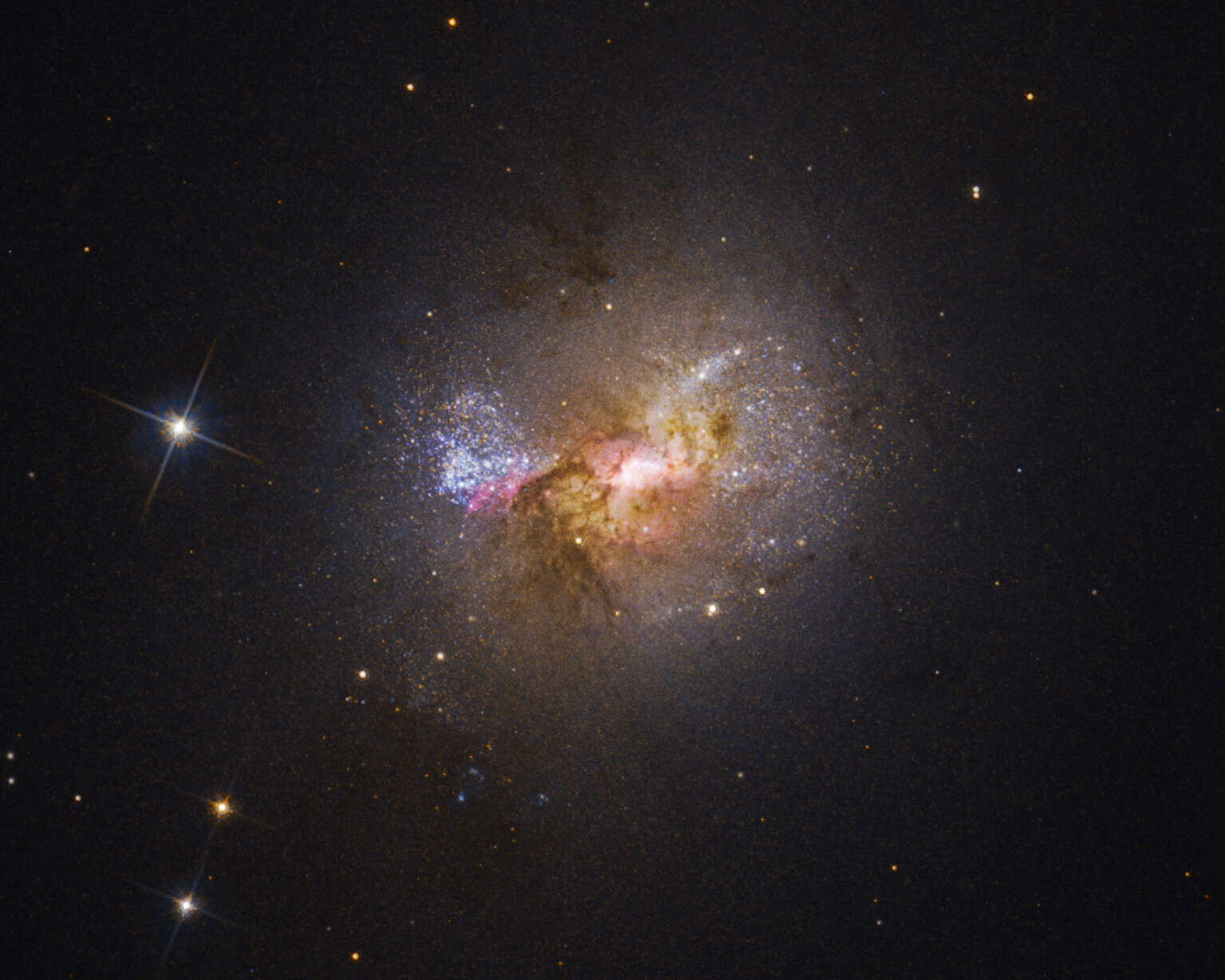
Henize 2-10 | Image credit: NASA, ESA, Zachary Schutte (XGI), Amy Reines (XGI); Image processing: Alyssa Pagan (STScI).

The process by which these stars form is peculiar and differs from what is found in larger galaxies. Gas may be observed circling about the black hole known as Henize 2-10 before merging with a dense core of gas within the galaxy, according to the astronomers.

“Hubble's spectroscopy shows that the outflow was moving at a million miles per hour, hitting the dense gas like a garden hose hitting a mound of dirt. Clusters of newborn stars dot the path of the outflow propagation,” explains NASA .

Next, a video in which you can observe this curious phenomenon:

BREAKING: The Far Side Of Our Galaxy Has Been "Seen" For The First Time

It's a frequent cliche to say that we can't see the forest for the trees, but we might just as easily say that we can't see the Milky Way for the stars. 


We now have a more exact understanding of where things are on the other side of the galaxy, according to recent research based on an old astronomy method, filling in critical details to the map of our own cosmic backyard.

As familiar as the night sky might be, sitting smack bang in the middle of our own galaxy makes it a little harder to get a complete picture of how it looks from the outside. The fact it's a flattened disc doesn't help matters much; the best we can do is find ways to measure the relative positions of stars and plot them on a 3D map.

But how do we know how far away a star is? Those twinkling nuclear furnaces come in all manner of sizes and luminosities, so astronomers can't use brightness to determine stellar distances. To make their record-breaking measurement, astronomers from the Max-Planck Institute for Radio Astronomy in Germany and the Harvard-Smithsonian Center for Astrophysics in the US used an astronomy technique that dates back nearly 180 years.

Stellar parallax was first used in 1838 by the German astronomer Friedrich Bessel to measure the distance to a star in the constellation Cygnus. His measurement of 10.3 light years was about a light year off; not bad for a guy with a simple telescope, keen eyes, and some sharp trigonometry skills.

The basics are fairly straightforward; hold up a forefinger close to your face and close one eye. Then open it, and close the other.


Stellar parallax was first used in 1838 by the German astronomer Friedrich Bessel to measure the distance to a star in the constellation Cygnus. His measurement of 10.3 light years was about a light year off; not bad for a guy with a simple telescope, keen eyes, and some sharp trigonometry skills.

The basics are fairly straightforward; hold up a forefinger close to your face and close one eye. Then open it, and close the other. 

Repeat this with your finger held at a distance. The apparent change in your finger's position as you look at it with each eye depends on how far away it is from your face. You'd need your eyes to be pretty far apart to detect the shifts in something as distant as a star.

Fortunately as the Earth orbits the Sun, we get just that. A dozen light years away is virtually just over the galactic back fence. To get to see more of the galaxy, we need a telescope with a much sharper focus.

Hubble's wide field camera manages a bit better, but even that can only manage to determine the relative shift in a star's position if it's within 10,000 light years. Our galaxy's diameter is estimated to be ten times that size.

In this latest analysis, the astronomers were able to measure the distance to a group of stars literally on the other side of the Milky Way, a mind-blowing 66,000 light years away from Earth. This nearly doubles the previous record of just over 36,000 light years achieved in 2013.

Both of these distances were measured using a piece of technology called the Very Long Baseline Array (VLBA). In simple terms, the VLBA consists of 10 large antennas separated out over thousands of kilometers between North America, Hawaii, and the Caribbean, making up one single, giant eye. That allows astronomers to detect a shift in a star's position equivalent to the diameter of a baseball on the surface of the Moon.

The observations were made several years ago, in 2014 and 2015, detecting light from a region in space where new stars were being born. Surrounding clouds of water and methanol molecules amplified their radiance across the incredible distance, helping them to shine through the thick fog of dust that blocks a lot of the light.

"Most of the stars and gas in our galaxy are within this newly-measured distance from the Sun. With the VLBA, we now have the capability to measure enough distances to accurately trace the galaxy's spiral arms and learn their true shapes," says researcher Alberto Sanna from the Max-Planck Institute for Radio Astronomy.

"This means that, using the VLBA, we now can accurately map the whole extent of our galaxy." We shouldn't hold our breath for an accurate Google Milky Way any time soon – the researchers estimate we're still a decade off having a fairly complete picture.

Still, a selfie the size of a galaxy should be well worth the wait. This research was published in Science.

Via Sciencealert

Astronomers just found 1 million new galaxies, previously unknown to astronomy, in just 300 hours

 In under 300 hours, the world-renowned CSIRO telescope in Australia surveyed the whole southern sky in amazing detail and record time, discovering 3 million previously unseen galaxies.


The feat, announced on December 1 by Australia's national science organisation CSIRO, has swiftly made headlines throughout the world for developing a new atlas of the universe.

According to the researchers, as many as 1 million of these distant galaxies may be previously unknown to astronomy, and this is likely just the beginning. Because of the success of this first study, CSIRO scientists are already planning additional in-depth observations in the future years.

Previous telescopic all-sky surveys of the galaxy took years and tens of thousands of photographs to complete.

The telescope, known as the Australian Square Kilometre Array Pathfinder (ASKAP), is a cluster of 36 radio dish antennae stretched out over 4,000 square metres in the Western Outback that work together to stitch together high-resolution images to create panoramic views of the universe.

According to CSIRO, the final 903 photos used to generate the new atlas are made up of 70 billion pixels totaling 26 terabytes of data, which is different than the resolution of your iPhone. This massive load, which began as 13.5 "exabytes," was processed by the Pawsey Supercomputing Center's "Galaxy" supercomputer.

“ASKAP is applying the very latest in science and technology to age-old questions about the mysteries of the Universe and equipping astronomers around the world with new breakthroughs to solve their challenges,” says CSIRO Chief Executive Dr. Larry Marshall.

3 million new galaxies is a lot of ground to cover, so ASKAP is probably only getting started.

“This census of the Universe will be used by astronomers around the world to explore the unknown and study everything from star formation to how galaxies and their supermassive black holes evolve and interact,” lead author and CSIRO astronomer Dr. David McConnell said in a statement.

He went on to say that tens of millions of galaxies could be discovered in the future with this new telescope/supercomputer combo.

Reprinted with permission from World At Large, a nature, politics, science, health, and travel news website.

Astronomers Discover A Weird Object In Space That Contains A Galaxy Within a Galaxy Within Another Galaxy(and Nobody Knows Why)

With a flawlessly symmetrical ring encircling a red sphere of stars, Hoag's object is one of the most stunning mysteries in the universe. 


If you look closely at the serpent constellation in the northern sky, you might notice a galaxy within a galaxy within a galaxy.

This cosmic turducken is known as Hoag's object, and it has baffled astronomers since astronomer Arthur Hoag found it in 1950.

Left: Hubble Heritage WFPC2 colour image of Hoag’s Object (Image credit: NASA, ESA, and the Hubble Heritage Team). Right: The FPI Hα data drawn as contours over the greyscale HST F606W image. 

The object under consideration is a one-of-a-kind, ring-shaped galaxy 100,000 light-years across (slightly larger than the Milky Way) and 600 million light-years away from Earth. 

In a recent snapshot of the strange object taken by the Hubble Space Telescope and analysed by geophysicist Benoit Blanco, a dazzling ring of billions of blue stars forms a perfect circle around a much smaller and denser sphere of reddish stars. Another ring galaxy, much, much farther away, appears to say hello from the black space between the two stellar circles.

What's happening on, and what ripped Hoag's item in half? Ring galaxies account for less than 0.1% of all known galaxies, making them challenging to analyse. 

Hoag himself claimed that the unique ring development in the galaxy was an optical illusion caused by gravitational lensing (an effect that occurs when extremely high-mass objects bend and magnify light). This notion was later debunked by studies using larger telescopes.


Kinematic information for Hoag’s Object. Upper panels: WFPC2 F606W image (upper left) and Hα intensity map (upper right). Slit orientations and actual slit widths for the three position angles used for spectroscopy are also indicated, as well as the MPFS field of view. 

Lower panels: The line-of-sight velocity field (lower left) and velocity dispersion field (lower right) of Hoag’s Object from FPI and MPFS observations.

R-band negative image of Hoag’s Object obtained with the BTA 6-m telescope. The limiting surface brightness reaches µR ≈ 27.3 mag arcsec 2. 

Another widely held belief is that Hoag's object was once a more common disk-shaped galaxy, but an ancient collision with another galaxy ripped a hole through the disk's belly, permanently warping its gravitational pull. 

If such a collision occurred within the last 3 billion years, astronomers using radio telescopes should have been able to glimpse some of the aftermath. No such evidence has been discovered.

If a cosmic catastrophe occurred in Hoag's object's core, it must have happened so long ago that all traces of it have been washed away. With only a few other known ring galaxies to analyse (none of which exhibit the exactly symmetrical features discovered in this one), Hoag's object remains a mystery wrapped in a riddle inside an enigma — you know, like a turducken.

(Image courtesy of NASA/ESA/Hubble)

Our galaxy is warped, and scientists have no idea why

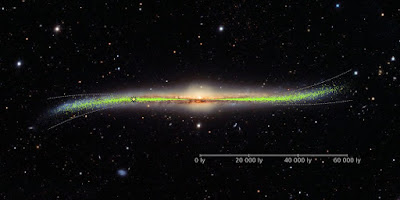
There’s trouble brewing at the Milky Way’s edge: new measurements show that a peculiar distortion of the galactic disk is moving slowly, contradicting previous reports.

As yet, nobody knows which result will be correct. Some crucial details in the structure and genesis of spiral galaxies throughout the cosmos are at stake.

The Milky Way is characterized by astronomers as a flat disk-shaped, double-armed spiral galaxy twirling and twinkling with stars. However, astronomers have known since the mid-twentieth century that this picture is partially inaccurate.

Observations in the radio region of the electromagnetic spectrum initially indicated that our galaxy’s farthest borders are warped, with some parts drooping down and others bending upward, similar to a vinyl record left on a hot plate.

Subsequent data has shown that this feature, known as a galactic warp, is common for spiral galaxies, Žofia Chrobáková, an astrophysics doctoral candidate at the Institute of Astrophysics of the Canary Islands (IAC) in Spain, told Live Science.

Various explanations for the warp’s formation have been offered, including the possibility that it is caused by surrounding material falling onto the galactic disk, according to Chrobáková. The distortion would most likely be static or moving very slowly in that case.

Other theories propose that warps are produced by more dynamic mechanisms, such as interactions with dark matter at the galaxy’s edge or smaller galaxies orbiting their larger brethren, tugging on them gravitationally and causing ripples. These principles would result in an active warp that might spin like a top, a movement known as precession.

“If we know how fast or if the warp rotates, it could be like a piece of a puzzle,” Chrobáková said. “It tells us a lot of information about how the warp was created.”

Last year, a team reported in the journal Nature Astronomy that our galaxy’s warp was spinning using data from the European Space Agency’s Gaia satellite, which gives ultraprecise measurements of the location of the Milky Way’s stars. A second paper, published in The Astrophysical Journal in December, confirmed these results, indicating that the warp was zipping along rather quickly, orbiting with a period of 600 million to 700 million years.

If this is the case, the procession will be roughly 10 times faster than previous models predicted, according to Chrobáková.

However, in a new study, she and her IAC co-author Martn López-Corredoira put the brakes on the previous measurements. Chrobáková and López-Corredoira found that the warp is traveling about 3.4 times faster than the results announced last year by looking at the identical Gaia data but modeling the features differently. Their findings were published in The Astrophysical Journal on May 13th.

“My research puts down this new breakthrough and says we are back to where we started,” Chrobáková said. “We call it an anti-discovery.”

However, the error bars on Chrobáková’s findings are large enough to leave the matter unsolved, according to Ronald Drimmel, an astronomer at Italy’s University of Turin who was part of the team that first measured a precessing warp.

“It might be indicating that there’s no motion, or that it has a large motion,” he told Live Science. “There’s quite a bit of uncertainty.”

Much of the disagreement comes down to the precise shape of the warp itself, which neither team has a perfect handle on, Drimmel said. “Making such measurements is hard. We’re right in the disk of the galaxy, and dust clouds limit how far we can see.”

Chrobáková agreed that further information is needed to address this problem. Gaia is expected to produce a new catalog next year, which may contain additional information on this controversy.

That’s a good thing, because other galaxies are likely too far away to settle the debate. “The Milky Way is the galaxy we have the best chance of exploring in such detail,” Chrobáková said.

Reference(s): The Astrophysical Journal

This X-Ray View of The Night Sky Reveals a Whole New Way of Seeing The Universe

Based on this recently released snapshot of the night sky captured by NASA's Neutron star Interior Composition Explorer (NICER), we can safely assume Superman gets no sleep at night. 

Just look at that thing.

The sparkling dots and tangled loops are the result of nearly two years of effort to study cosmic sources of X-rays from Earth's orbit.

As a piece of art, it's stunning. Check it out in all its glory below, complete with details identifying the relevant spots, or in high detail here on NASA's Goddard media page.


To fully appreciate its beauty, though, let's break down what this golden fireworks display actually describes.

On board the International Space Station (ISS) sits the workhorse of the NICER payload – a washing-machine sized cube called an X-ray Timing Instrument.

Roughly every hour and a half, after the Sun sets on the ISS orbit, the instrument scoops up high energy photons from up to eight locations per orbit in the night sky.

Every curved line is the path traced as the instrument's attention shifts from one source to the next. The smaller flecks and lines are energetic particles crashing into the sensors.

But the bigger 'sparkles' are of particular interest, their brightness the result of both the amount of time NICER spends focussed on that spot and their generous outpouring of X-ray radiation.

Many of the locations are home to dead suns called neutron stars; objects so dense, the only thing keeping them from collapsing into a black hole is a law that says their nuclei can't all pile into the same volume. Not without considerably more force, at least.

The problem is, we're still not entirely sure how that works, as the exact sizes of neutron stars aren't clear.

Knowing their precise radius can tell us more about the crazy physics going on inside their bodies. It's hoped this mission could determine their size to within a precision of just 5 percent.

Some of those neutron stars are quick spinners called pulsars. Nailing down the time of each sweep of their lighthouse-like X-ray beams can provide astronomers with a highly detailed set of coordinates.

An upgrade to NICER called the Station Explorer for X-ray Timing and Navigation Technology (SEXTANT) experiment will collect information that should not only help guide the future of the mission, but contribute to future space exploration as a whole.

It might look messy, but there's a lot of information in that bowl of cosmic spaghetti and meatballs.

"Even with minimal processing, this image reveals the Cygnus Loop, a supernova remnant about 90 light-years across and thought to be 5,000 to 8,000 years old," says principal investigator Keith Gendreau from NASA's Goddard Space Flight Center.

"We're gradually building up a new X-ray image of the whole sky, and it's possible NICER's night time sweeps will uncover previously unknown sources."

Even if none of that impresses you, at least you can look at it and imagine you're an astronomer with X-ray vision - casually star-gazing on Krypton.

Astronomers Reveal The Biggest 3D Map of the Milky Way and it’s Ridiculously Stunning

The greatest three-dimensional map of the Milky Way has been developed by an international team of scientists, and the results have been published in the journal Science. 

Our planet isn't flat, and guess what? Neither is our galaxy.

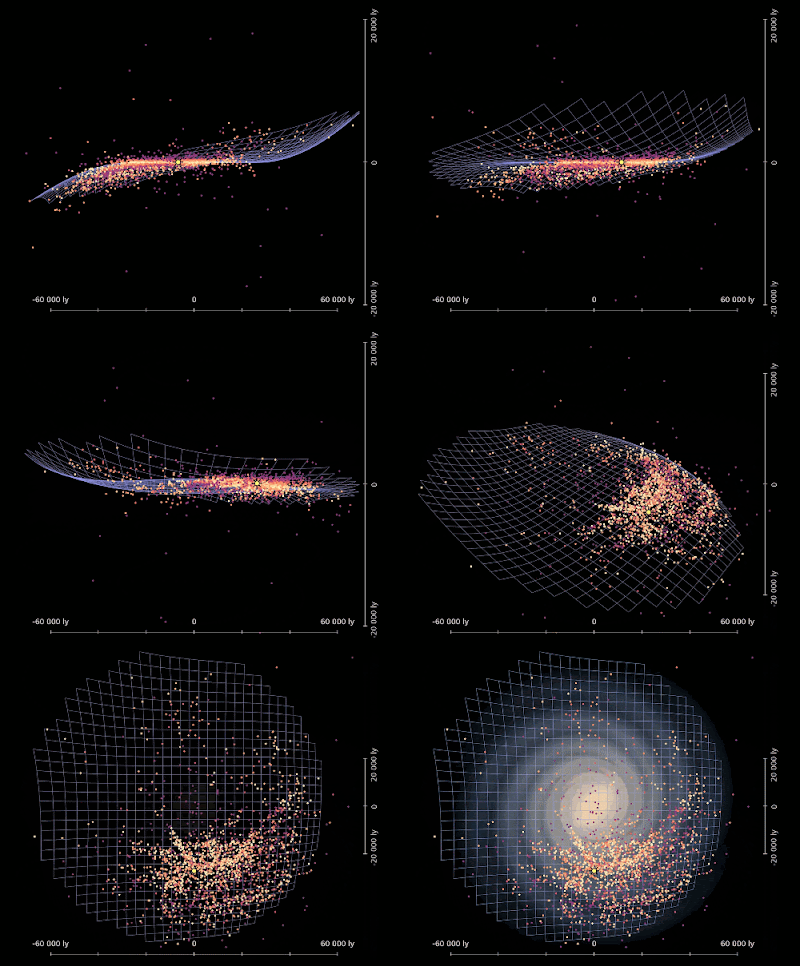
Researchers created a 3D map that shows the S-shaped structure of the Milky Way galaxy's combined star disc, our cosmic address, by calculating the distance from our Sun to hundreds of pulsating stars spread around our galaxy.

“Our map shows that the Milky Way disk is not flat. Instead, it is deformed and twisted in shape,” revealed study co-author Przemek Mróz of the University of Warsaw in Poland.“This is the first time we can use individual objects to display it in three dimensions,” he added.

Much of our present understanding of the spiral shape and structure of our galaxy is based on indirect observations of celestial objects and conclusions based on other distant galaxies in the Universe.


However, as scientists have discovered, the galactic map provided by these restricted observations is insufficient.


The classical Cepheids (giant stars that burn hundreds, if not thousands, of times brighter than our Sun) pulse frequently and are visible through the huge interstellar dust clouds that often cover less luminous interstellar objects, much like numerous distant lighthouses.


Distances to these stars may be estimated precisely owing to periodic fluctuations in brightness.


Dorota Skowron of Warsaw University, in collaboration with scientists from Ohio State University in the United States and the University of Warwick in the United Kingdom, traced the distance to over 2,400 cepheids along the Milky Way, the majority of which were discovered by the Optical Gravitational Lensing Experiment (OGLE), a project that helped double the number of known galactic classical cepheids.


The researchers were able to create an extremely precise three-dimensional model of the Milky Way by assigning coordinates to each distant pulsing star in reference to our Sun.


As a consequence, a beautiful, never-before-seen map of the Milky Way Galaxy has been created.


The findings of the study have helped astronomers better grasp our cosmic surroundings and precisely depict the form of the galaxy.


And it's not flat, but it does have an unusual form.


As noted by Space.com, “this new map helped reveal more details on distortions that astronomers had “previously detected in the shape of the Milky Way.”


The map took scientists six years to create, but as participating astronomers disclosed, "it was worth it."


At a distance of almost 25,000 light-years from the galactic core, we discovered that the galaxy's disc is not flat. It's twisted. This bending might have been generated by interactions between the galaxy and nearby galaxies, intergalactic gas, or even dark matter.


“Warping of the galactic disk has been detected before, but this is the first time we can use individual objects to trace its shape in three dimensions,” explained Mróz in a statement.


The quantity of 'warping' observed in our galaxy was shockingly pronounced, according to the researchers.


“It is not some statistical fact available only to a scientist’s understanding,” Mróz said. “It is apparent by eye.”


Reference(s): Science 

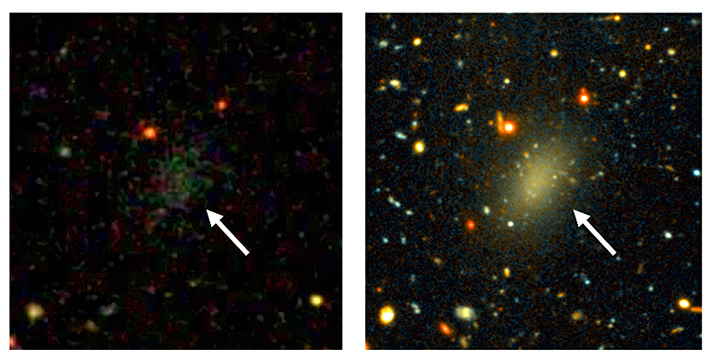
Astronomers have discovered a massive "Ghost Galaxy" made up of 99.99% dark matter

Astronomers have found a nearby galaxy that's roughly the same mass as the Milky Way, but somehow contains less than 1 percent of its stars.

The galaxy is so dim, it's evaded detention for decades, and now the team behind its discovery has figured out how its lack of stars hasn't ripped it apart - it's made from 99.99 percent dark matter.

Dark matter is estimated to make up around 27 percent of all the mass and energy in the observable Universe, and while we can detect its gravitational force, it doesn't appear to emit any form of light or radiation that we can observe.


Despite years of searching, we have no idea what dark matter actually is, but this invisible matter is crucial to the stability of the Universe. 

Pieter van Dokkum, Roberto Abraham, Gemini, Sloan Digital Sky Survey


Galaxies rotate at such speeds, they'd rip themselves apart if the only thing trying to hold them together was their own gravitational force. Something else has to be holding them and the rest of the Universe together, and physicists think the answer is a whole lot of dark matter. 


In fact, the standard model of cosmology suggests that there's so much dark matter in the Universe, for every 1 gram of atoms in existence, there's at least five times more dark matter.


Now scientists have found a galaxy that's almost entirely made up of the stuff. 


Named Dragonfly 44, the galaxy was discovered back in 2014, when a team using the WM Keck Observatory and the Gemini North Telescope in Manuakea, Hawaii, located a whole bunch of 'fluffy galaxies' in a region called the Coma Cluster, some 320 million light-years away.


"If the Milky Way is a sea of stars, then these newly discovered galaxies are like wisps of clouds," one of the researchers, Pieter van Dokkum from Yale University, said at the time.

"We are beginning to form some ideas about how they were born, and it's remarkable they have survived at all," he added. 


"They are found in a dense, violent region of space filled with dark matter and galaxies whizzing around, so we think they must be cloaked in their own invisible dark matter 'shields' that are protecting them from this intergalactic assault."


Now van Dokkum and his team have had a chance to test out their hypothesis, and by figuring out the mass of Dragonfly 44, they say they have enough evidence to suggest that dark matter truly is the glue holding this whole thing together. 


The researchers measured the velocities of stars in Dragonfly 44 for 33.5 hours over a period of six nights, and used this information to calculate the mass of the galaxy as a whole.


An increase in the velocity of an object will increase its kinetic energy and therefore its mass, which means the faster these stars are going will equate to a more massive galaxy. 


Having measured the speed of Dragonfly 44's stars as around 47 kilometres per second, the team calculated that it's around 1 trillion times more massive than our Sun - far too heavy to be held together by its stars alone.


"Motions of the stars tell you how much matter there is," van Dokkum told Avery Thompson at Popular Mechanics. "They don't care what form the matter is, they just tell you that it's there. Using the Keck Observatory, we found many times more mass indicated by the motions of the stars than there is mass in the stars themselves."


Having estimated that the galaxy needs to be made up of 99.99 percent of dark matter to remain intact, the team has officially found the darkest known galaxy in the Universe. 


A similarly dark galaxy in the Virgo cluster was identified earlier this year, but its 99.96 percent dark matter just got beat.


As cool as this discovery is, it's thrown up a whole lot more questions than answers. Right now, every potential candidate for dark matter has failed to yield enough evidence to explain what it's made from, and until recently, the only dark matter galaxies we've known about have been tiny.


Dragonfly 44 is huge, and no one can figure out how it got so big - and stayed so big - with so little visible matter. But at least now we've now got an entire galaxy full of dark matter to study, right?


"It's hard to argue with the observations, yet the conclusion from this paper runs counter to my understanding of how galaxies are formed," one of the team, astronomer Marla Geha from Yale University, who wasn't involved in the research, told New Scientist.

"I'm hoping these objects are rather rare and/or only form in special environments such as a dense galaxy cluster. Otherwise we may need to rewrite galaxy formation."


The research has been published in Astrophysical Journal Letters.