Showing posts with label Journey to Mars. Show all posts

Scientists Develop A New Propulsion System For NASA That Will Take Humans To Mars In Just 45 days

How to quickly add more people to Mars is one of the hardest problems to solve if we want to live there. A group of academics came up with a clever way to get a spaceship to Mars in 45 days by using a laser. This would save months of travel time.


Phys.org says that a group of researchers at McGill University made a system that uses a 10-meter-wide laser array on Earth to power a spacecraft in orbit. The laser would heat the hydrogen plasma in the ship until it made enough superheated hydrogen gas to power the ship all the way to Mars. Basically, it would let us push things between planets from Earth instead of sending all that heavy fuel into orbit.


Emmanuel Duplay, the lead author of a research paper and a former McGill University Summer Undergraduate Research in Engineering Program student, said, “Laser-thermal propulsion allows quick transport missions of one ton with laser arrays the size of a volleyball court.”


NASA issued an engineering challenge to come up with a way to send a 1,000-kilogram payload to Mars in no more than 45 days. This is where the idea came from.


Their method, which they wrote about in an article for the journal Acta Astronautica, could get important supplies and astronauts to Mars settlements in a few weeks, whereas it would take chemically-fueled rockets months to make the same trip.


When it gets to Mars, it will use the thin atmosphere to “aerobrake,” which is a tricky and possibly dangerous maneuver that quickly slows down the ship. Chemical propellants were used to stop older spacecraft, but carrying the fuel made the payload heavier. By using the atmosphere of Mars, we can avoid this.


Here, you can read more in depth about this.
It’s Official: Humans Are Going to Mars, NASA Has Unveiled Their Mission

NASA's got a whole new plan. It wants boots on the Moon in 10 years and on Mars in 20. Give or take.

On Wednesday, the space agency announced its detailed National Space Exploration Plan to achieve the President's lofty goals set out in his December 2017 Space Policy Directive-1.

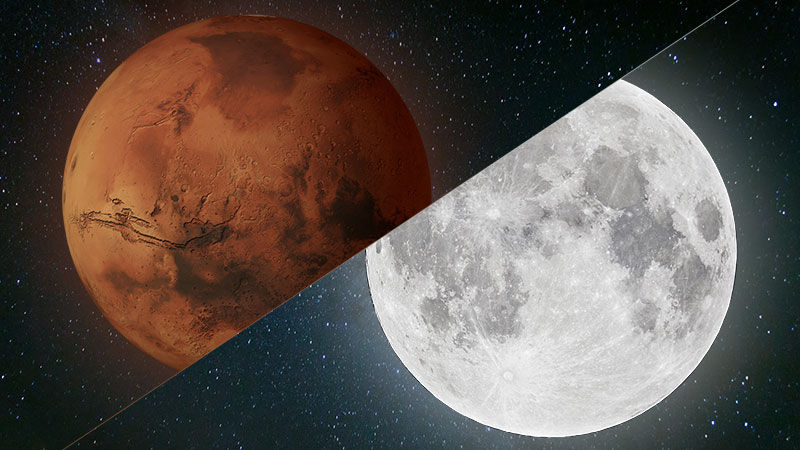
Image result for moon and mars

Those bold plans include: planning a new Moon landing, long-term human deployment on and around the Moon, reassertion of America's leadership in space, strengthening private space companies, and figure out how to get American astronauts to the surface of Mars.

There are a lot of unknowns built into the plan, not the least of which is whether or not scientists can figure out a way to keep astronauts safe from the many hazards of space.


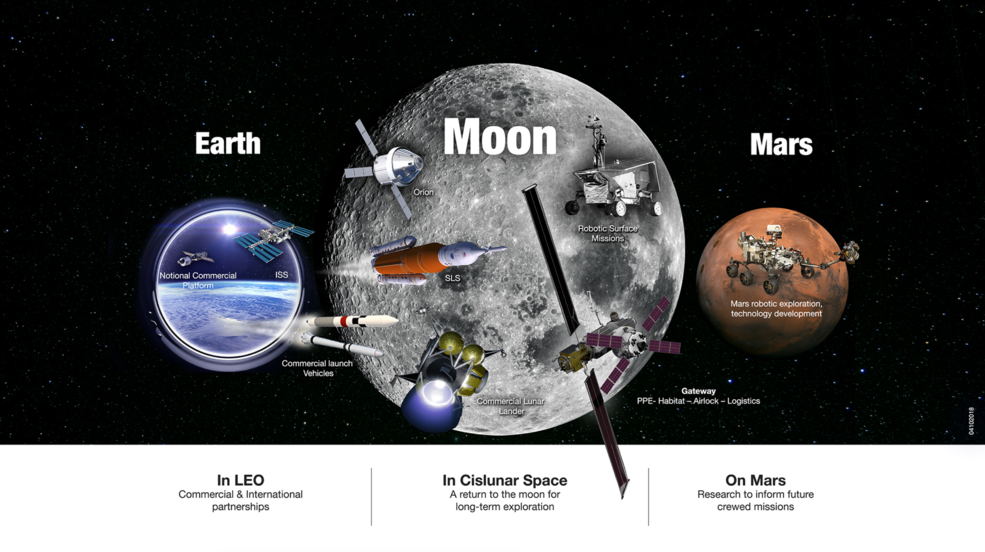
Those smarties at NASA took that into account when detailing expected timelines for completing each goal in the 21-page report - from low Earth orbit (LEO), to cislunar space and then on Mars.

 earth moon mars 2018 2

(NASA)

Indeed, the timeframe within which NASA expects to reach key milestones along the way to their goals includes dates that NASA expects it will actually figure out certain parts of the plan.

That's important because it means NASA will be able to incorporate what it learns along the way.


 Image result for moon and mars

Any claims - like the one published in NASA's new report - that astronauts will stroll around on Mars by the 2030s has flexibility built in and could change if NASA researchers hit a snag or two in the process.

For instance, NASA plans to wait until the results of the Mars 2020 mission, during which a rover will collect and analyze samples from Mars' surface, before it will even begin to draft up a budget ask for the crewed mission that is slated for some time in the 2030s.

That's just good thinking.

But before NASA even starts to think about sending astronauts to Mars, there are even more fundamental mysteries to solve.

For instance, NASA will be launching 13 CubeSats into low Earth orbit in 2020 so it can learn how to better prepare payloads for space travel, whether it be to the Moon, Mars, or beyond.

Once those satellites are in orbit, NASA hopes to use what it's learned to put astronauts in lunar orbit by June 2022.

These gaps in NASA's proposed plans aren't an accident - they represent key gaps in our understanding of space and interplanetary travel. Put another way: they represent the things NASA scientists want to learn.

And if NASA sticks to this timeline, it will hopefully achieve it, which will guide us further into exploring space. So this is going to be such an awesome adventure. 

This article was originally published by Futurism. Read the original article.