Showing posts with label Atoms. Show all posts

This is the most accurate image of an atom

A mysterious quantum phenomenon reveals an image of an atom like never before. You can even see the difference between protons and neutrons.

The Relativistic Heavy Ion Accelerator (RHIC), from the Brookhaven Laboratory in the United States, is a sophisticated device capable of accelerating gold ions to a speed of up to 99.995% that of light. Thanks to him, it has recently been possible to verify, for example, Einstein's famous equation E=mc2.
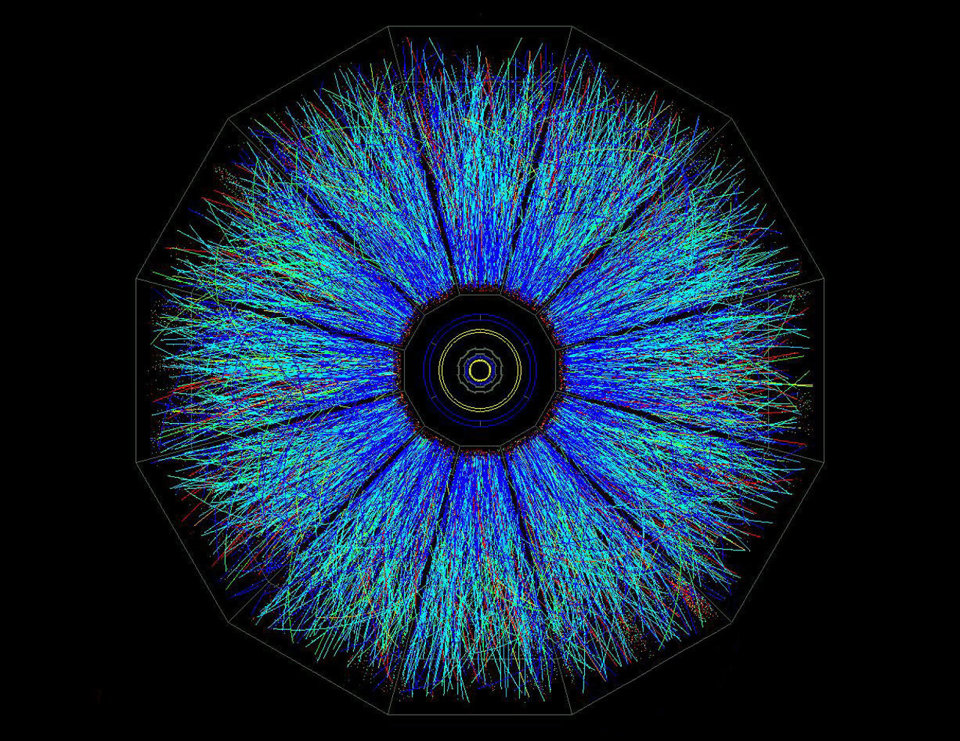
IMAGE: BROOKHAVEN LABORATORY. Final view of a gold atom particles colliding in the STAR detector of the Relativistic Heavy Ion Collider at Brookhaven National Laboratory. The beams travel in opposite directions at nearly the speed of light before colliding.

Now, researchers in this laboratory have shown how it is possible to obtain precise details about the arrangement of protons and neutrons in gold using a type of quantum interference never seen before in an experiment . The technique is reminiscent of the positron emission tomography (PET) scan that doctors use to peer into the brain and other anatomical parts.

BEYOND WHAT WAS SEEN BEFORE

No microscopic probe or X-ray machine is capable of peering into the innards of the atom, so physicists can only theorize what happens there based on the remains of high-speed collisions that take place in particle colliders , such as CERN 's LHC .

However, this new tool opens the possibility of making more precise inferences of protons and neutrons (which make up atomic nuclei) thanks to the quantum entanglement of particles produced when gold atoms rub against each other at high speed.

PHOTO: BROOKHAVEN LABORATORY, UNITED STATES.

The researchers   have shown how it is possible to obtain precise details about the arrangement of protons and neutrons in gold using a type of quantum interference never seen before in an experiment. 

At this scale, nothing can be observed directly because the very light used to carry out the observation interferes with the same observation. However, given enough energy, light waves can actually stir up pairs of particles that make up protons and neutrons, such as quarks and antiquarks . 

When two nuclei intersect within a few nuclear radii, a photon from one nucleus can interact through a virtual quark-antiquark pair with gluons from the other nucleus (gluons are mediators of the strong interaction, the force that binds nuclei). quarks inside protons and neutrons).

This allows for the equivalent of the first experimental observation of entanglement involving different particles, allowing images so precise that the difference between the place of neutrons and protons within the atomic nucleus can even begin to be appreciated.

Oxford student uses ordinary camera to capture atom in prize-winning photograph


A British student has used an ordinary camera and tripod to capture a prizewinning photograph of a single atom.


David Nadlinger was able to capture the atom, which was held between two small needle tips about 2 millimetres apart.(David Nadlinger, The University of Oxford )


The long exposure photograph was taken by University of Oxford student David Nadlinger through a window of a ultra-high vacuum chamber.


Apart from using a lens accessory that increases the focal length of an existing lens, much of the camera technology Mr Nadlinger used was simplistic.


But the scientific process behind capturing the atom in the photo was much more complex.


The single positively-charged strontium atom, held near motionless by electric fields, was illuminated by a laser of a blue-violet colour which caused the atom to absorb and re-emit light quickly enough for an ordinary camera to capture it in a long exposure photograph.


Mr Nadlinger was able to zoom in close enough to capture the atom, which was held between two needle tips about 2 millimetres apart.


The resulting image named Single Atom in an Ion Trap came first in the Equipment and Facilities category of the Engineering and Physical Sciences Research Council's national science photography competition.


You might have the right camera rig, but it might not be so simple to snap your own atom selfie just yet.


"The idea of being able to see a single atom with the naked eye had struck me as a wonderfully direct and visceral bridge between the miniscule quantum world and our macroscopic reality," Mr Nadlinger said.

"A back-of-the-envelope calculation showed the numbers to be on my side, and when I set off to the lab with camera and tripods one quiet Sunday afternoon, I was rewarded with this particular picture of a small, pale blue dot."


Reference: ABC News 

Physicists take the most detailed image of atoms to date


According to Scientific American, physicists have outdone Apple's newest iPhone by creating the most accurate image of atoms to date using a gadget that magnifies images 100 million times. With a study released last month, the researchers that broke the record for the highest resolution microscope in 2018 outdid themselves.


The sample was visualised using an approach known as electron ptychography, in which an electron beam is fired at an object and bounces off of it to produce a scan that algorithms use to reverse engineer the above image. This technique was previously limited to imaging things that were a few atoms thick.


But the new study lays out a technique that can image samples 30 to 50 nanometers wide—a more than 10-fold increase in resolution, they report in Science. The breakthrough could help develop more efficient electronics and batteries, a process that requires visualizing components on the atomic level.


Reference(s): Science

Pear-Shaped Nuclei Explains The Deficiency Of Anti-Matter And Made Time-Travel Impossible

The shape of 224RA assumed from the CERN measurements, ISOLDE/CERN


In physics sometimes verifying the obvious is more difficult than proving the difficult. The obvious, in this case, is why the universe is made of “Matter”. From your loud neighbor to the outermost galaxy everything is made of matter, but the laws of physics are balanced so there should be just as much antimatter. So why is not there?

We have not got a full image yet, but an international team of scientists might have discovered very significant evidence. They discovered that some atomic nuclei are not symmetric, but are in fact pear-shaped.

In a paper printed in Physical Review Letters, scientists experimented that the isotope Barium-144 is not sphere shaped or oval shaped. In this short-lived atom, protons and neutrons end up scattered in an irregular shape, with more mass at one end of the nucleus than another. This discovery is in conflict with some nuclear theories, and it could even prove that time travel is unmanageable or even impossible. The pear-shaped scattering of particles break up the so-called CP-symmetry (CP stands for charge and parity). In C-symmetry, if you change every particle for its anti-particle, they are expected to act in the same way. Anti-hydrogen will act like hydrogen, for instance. The P-symmetry is about space: A system can be reversed, like in a mirror, and the physics should still be unchanged. CP-symmetry recommends that for every particle rotating anti-clockwise and decaying in a certain direction, there is an anti-particle rotating clockwise and decaying in the different direction. Violation of C and CP symmetry are suggested and expected to clarify the absence of anti-matter in the universe, but so far only a one or two examples have been discovered.

This is the 2nd atom discovered with an asymmetric-shape and is another signal that there is more physics beyond what is now expected by the Standard Model of particle physics. As far as we know, the whole universe is symmetric under CPT (charge, parity, and time), which adds a time reversal situation. This indicates that if CP is violated, then also the T symmetry essentially be violated so things do not occur forward and backward in time. This is another example of a noticeable thing at our level (cracked eggs do not jump back together) but not in ultimate physics. This discovery strongly specifies that time is actually broken and it has a definite direction. Co-author Dr Marcus Scheck told the BBC, "We have found these nuclei exactly point towards a direction in space. This relates to a direction in time, proving there is a well-defined direction in time and we will permanently travel from past to present".

The research will now be repeated at CERN at its Isotope Separator On Line Detector (ISOLDE) facility in Switzerland, which can create Barium-144 in huge amounts, in the hope of glimpsing what anticipates us further than the horizon of current physics.