Showing posts with label Black Holes. Show all posts

Aliens may be using black holes as quantum computers, physicists say


The idea that aliens might be using black holes as quantum computers is speculative and not supported by any direct evidence.


However, some physicists have proposed that a highly advanced civilization could use the properties of black holes to perform computational tasks that are beyond the capabilities of traditional computers.


The concept of "black hole complementarity" suggests that an observer outside a black hole and an observer inside a black hole would have different but complementary views of the same physical system. Some physicists have proposed that a civilization could use a network of black holes to perform quantum computations by taking advantage of blackholes' unique properties.


However, this is a highly speculative idea that is not supported by any direct observations or evidence at this time. While the idea of using black holes as quantum computers is intriguing, it is still theoretical speculation rather than a confirmed scientific finding.

The Milky Way’s Black Hole Ejected a Star Towards Intergalactic Space at 6 Million km/h

What we are seeing here is "a visitor from a strange land..."


During a time that humankind’s ancestors were learning to walk upright, use their hands, and create the first primitive tools, cosmic events left a mark in our galaxy that our developed society would later see, millions of years later.

Astronomers have traced the trajectory of a so-called hypervelocity star through time, concluding that it was booted from the monstrous black hole at the center of our galaxy during a time when civilization as we know it did not exist.

Dubbed S5-HVS1, this cosmic body is an “A-type main-sequence star” and is considered the fastest ever discovered by astronomers.

Measurements of its trajectory have revealed the cosmic body is traveling at almost 1,755 km/s, or around four million miles an hour.

The black hole at the center of our galaxy, Sagittarius A*, has been visualized in virtual reality for the first time. Image Credit: J.Davelaar 2018


This took place, according to astronomers’ calculations, around 5 million years ago. The dramatic ejection marked the confirmation of the so-called Hills mechanism.


The Hill mechanism takes place when a supermassive black hole disrupts a binary star.


Our Milky Way Galaxy, for example, is home to Sagittarius A*, a supermassive black hole that has approximately 4 million times the mass of the Sun. The Hills mechanism describes how stars are pulled apart and then left to continue their separate journey.


What astronomers measured in 2019 was precisely that; a star pulled into orbit around a black hole while its companion star was jettisoned towards intergalactic space at incredibly high velocity.


To understand the origin of S5-HVS1, astronomers studied kinematics and traced the orbit backward in time. Incredibly, they discovered that the star could be traced back to the Milky Way’s Galactic Center, where it was expelled at a speed of 1800km/s between 5 and 4.8 million years ago, which makes S5-HVS the first clear demonstration of the Hill Mechanism and one of the fastest stars in the galaxy.


The star was observed in its journey approaching Earth at a distance of around 29,000 light-years away, traveling more than ten times faster than any other star in the Milky Way Galaxy.


Such is its speed that astronomers say that one day, inevitably, it will exit the Milky Way galaxy and never return.


The discovery was of great importance but a surprising one as well. Astronomers have theorized for years that Black Holes could eject stars at an unimaginable speed. Still, they have never associated a fast-moving star with the black hole at the center of the galaxy.


Observing and measuring the trajectory of S5-HVS1 is of great importance to astronomers since it must have formed in the galactic center. Furthermore, it is unique; the environment at the center of the Milky Way is entirely alien compared to our local galactic environment. This makes S5-HVS1 “a visitor from a strange land.”

A Black Hole has been Burping for 100 Million Years

Black holes are gluttonous behemoths that lurk in the center of galaxies. Almost everybody knows that nothing can escape them, not even light. 

So when anything made of simple matter gets too close, whether a planet, a star or a gas cloud, it’s doomed.

But the black hole doesn’t eat it at once. It plays with its food like a fussy kid. Sometimes, it spews out light.

When the black hole is not only at the center of a galaxy but the center of a cluster of galaxies, these burps and jets carve massive cavities out of the hot gas at the center of the cluster called radio bubbles.


Astronomy and astrophysics are all about light. Almost everything we know about distant objects in space, including black holes, comes from observing light. (Gravitational waves are the exception.)


The light astronomers see when they observe a black hole is coming from the environment in the vicinity of the black hole, not from the black hole itself. The behemoth’s strong gravity means that anything that gets too close is like a puppet on a string, and the black hole is the puppet master.


In a new study, a team of researchers using the National Science Foundation’s Green Bank Telescope (GBT) examined a supermassive black hole (SMBH) burping out mysterious radio bubbles.


“This is what happens when you feed a black hole, and it violently burps out a giant amount of energy.” - Jack Orlowski-Scherer, lead author, McGill University.


The study is “GBT/MUSTANG-2 9 resolution imaging of the SZ effect in MS0735.6+7421,” and it was published in the journal Astronomy and Astrophysics. The lead author is Jack Orlowski-Scherer, a graduate student at the University of Pennsylvania at the time the study was done. “This is what happens when you feed a black hole, and it violently burps out a giant amount of energy,” he said in a press release.


Supermassive black holes reside in the center of large galaxies like the Milky Way. They’re found in every large galaxy, including the galaxies at the heart of galaxy clusters. The heart of a galaxy cluster is an extreme environment. The plasma there is scorching, up to 50 million degrees Celsius (90 million F.)


That plasma radiates x-rays, and over time that dissipates the heat. The plasma cools down, allowing stars to form. It’s sort of like the Universe’s situation after the Big Bang. Only after things cooled down could stars form.


Sometimes a black hole will reheat the surrounding gas preventing stars from forming. That’s called black hole feedback, and it happens when black holes emit jets of heated material from their centers. The jets are enormously powerful, pushing away the hot x-ray-emitting gas in the galaxy cluster’s center, creating vast radio bubbles.


This graphic from the team at the Space Science Telescope Institute describes the black hole feedback loop. Image Credit: NASA, ESA, Leah Hustak (STScI)


While that description makes the process sound straightforward, it’s not. It takes enormous energy to move that much gas, and astrophysicists want to know where all of that energy comes from. In this study, the researchers probed the radio bubbles for clues to the energy source.


The Green Bank Telescope is a fully steerable radio telescope—the world’s largest—located in West Virginia. Its collecting area is 100 meters in diameter. The MUSTANG-2 receiver is a type of camera called a continuum receiver that operates across multiple channels.


The team aimed the instrument at the galaxy cluster MS0735. It’s about 2.6 billion light years away and is known for having an enormously massive black hole in its center. The jets coming from the black hole in the center are one of the most powerful active galactic nucleus eruptions ever recorded. The eruption has been going on for over 100 million years and has released as much energy as hundreds of millions of gamma-ray bursts.


“We’re looking at one of the most energetic outbursts ever seen from a supermassive black hole,” said lead author Orlowski-Scherer.


The jets are the likely culprits behind the radio bubbles, but exactly how they work is unknown. Somehow, they provide the heat that prevents star formation. “Jets are the main drivers of ICM (Intra-Cluster Medium) reheating, although the exact mechanism is not clear yet,” the authors explain in their paper. “It is known that the jets, as traced by their synchrotron emission, often terminate in radio lobes that are coincident with depressions (cavities) in the X-ray emission.”


These jets are what carved out the radio bubbles, and the team studied them for clues to how it all plays out.


The region is difficult to observe, but the team used MUSTANG-2’s power to peer into the bubbles. They took advantage of a phenomenon called the Sunyaev-Zeldovich (SZ) effect. The SZ effect is a subtle distortion of the Cosmic Microwave Background (CMB,) sometimes called the echo from the Big Bang. It’s relic radiation from the moment the Universe began over 13 billion years ago. The SZ effect registers as a slight thermal pressure at 90 GigaHertz, where MUSTANG-2 can sense it. 90 GHz is in the millimetre band because radio waves in this band have wavelengths from one to ten millimetres.


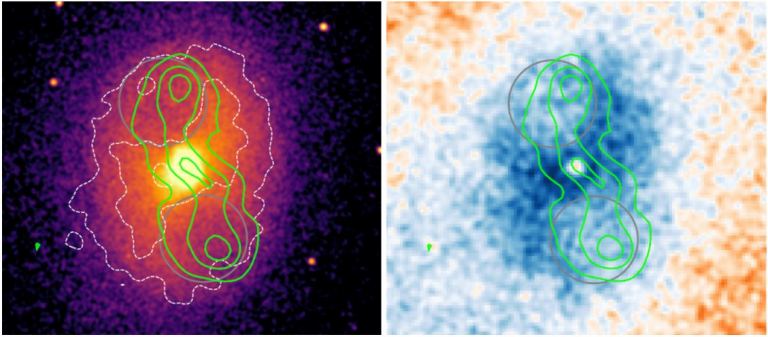
Observations by NASA's Chandra X-ray Observatory (left image) and by GBO's MUSTANG-2 instrument (right image) clearly show the enormous cavities (highlighted with gray circles) excavated by the powerful radio jets (green contours) expelled from the black hole at the center of galaxy cluster MS0735. The green contours in both images are from observations performed by the Naval Research Laboratory's VLA Low-band Ionosphere and Transient Experiment (VLITE) back end used on the National Radio Astronomy Observatory's (NRAO) Very Large Array (VLA). Image Credit: Orlowski-Scherer et al. 2022.


“With the power of MUSTANG-2, we are able to see into these cavities and start to determine precisely what they are filled with and why they don’t collapse under pressure,” said Tony Mroczkowski. Mroczkowski is an astronomer with the European Southern Observatory who was part of this new research.


This study isn’t the first time astrophysicists have studied these radio bubbles. Those efforts showed that the pressure inside these bubbles wasn’t entirely thermal. They pointed to relativistic particles, cosmic rays, and turbulence as causes, as well as a small contribution from magnetic fields. “Broadly, the support mechanisms can be broken down into two categories: thermal and non-thermal,” the team explains in their paper.


But the observations in this new study are the deepest high-fidelity SZ observations yet of the inside of the bubbles. That’s important because the SZ effect can distinguish thermal pressure causes from non-thermal pressure and relativistic electron causes. This study’s results show more nuance in the cause of the cavities, including thermal and non-thermal sources.


“We knew this was an exciting system when we studied the radio core and lobes at low frequencies, but we are only now beginning to see the full picture,” explains co-author Tracy Clarke. Clarke’s an astronomer at the U.S. Naval Research Laboratory and VLITE Project Scientist who co-authored a previous radio study of this system.


The Milky Way has its own pair of bubbles that were most likely caused by outbursts from Sgr. A*, the supermassive black hole at the heart of the Milky Way. While Sgr. A* may have produced jets in the past that carved out the bubbles, it emits no jets today. From end to end, the Milky Way's gamma-ray bubbles extend 50,000 light-years, or roughly half of the galaxy's diameter, as shown in this illustration. Image Credit: NASA


Galaxy clusters are important because they’re the endpoints of structure formation in the Universe. They grow continuously through mergers and accretion. Theory and calculations show that some of their energy is not yet thermalized, meaning it comes from turbulence and bulk motion. Researchers want to know how much of a cluster’s pressure support is not thermal because that helps them understand how the gas in the intra-cluster medium reaches equilibrium. That’s called virialization, and it leads to star formation.


It all relates to the problem of black hole feedback, which prevents stars from forming. Studies like this one that uses the GBT/MUSTANG-2 receiver across multiple frequencies can start to untangle this complex environment by determining how thermal and non-thermal pressures support the radio bubbles. Scientists would like a clearer understanding of how turbulence, magnetic fields, and even cosmic rays support these bubbles.


“This work will help us better understand the physics of galaxy clusters and the cooling flow feedback problem that has vexed many of us for some time,” added Orlowski-Scherer.


Press Release: Scientists Reveal Secrets to Burping Black Hole with the Green Bank Telescope

Published Research: GBT/MUSTANG-2 9 resolution imaging of the SZ effect in MS0735.6+7421

The Hubble telescope captures a black hole that forms stars instead of absorbing them

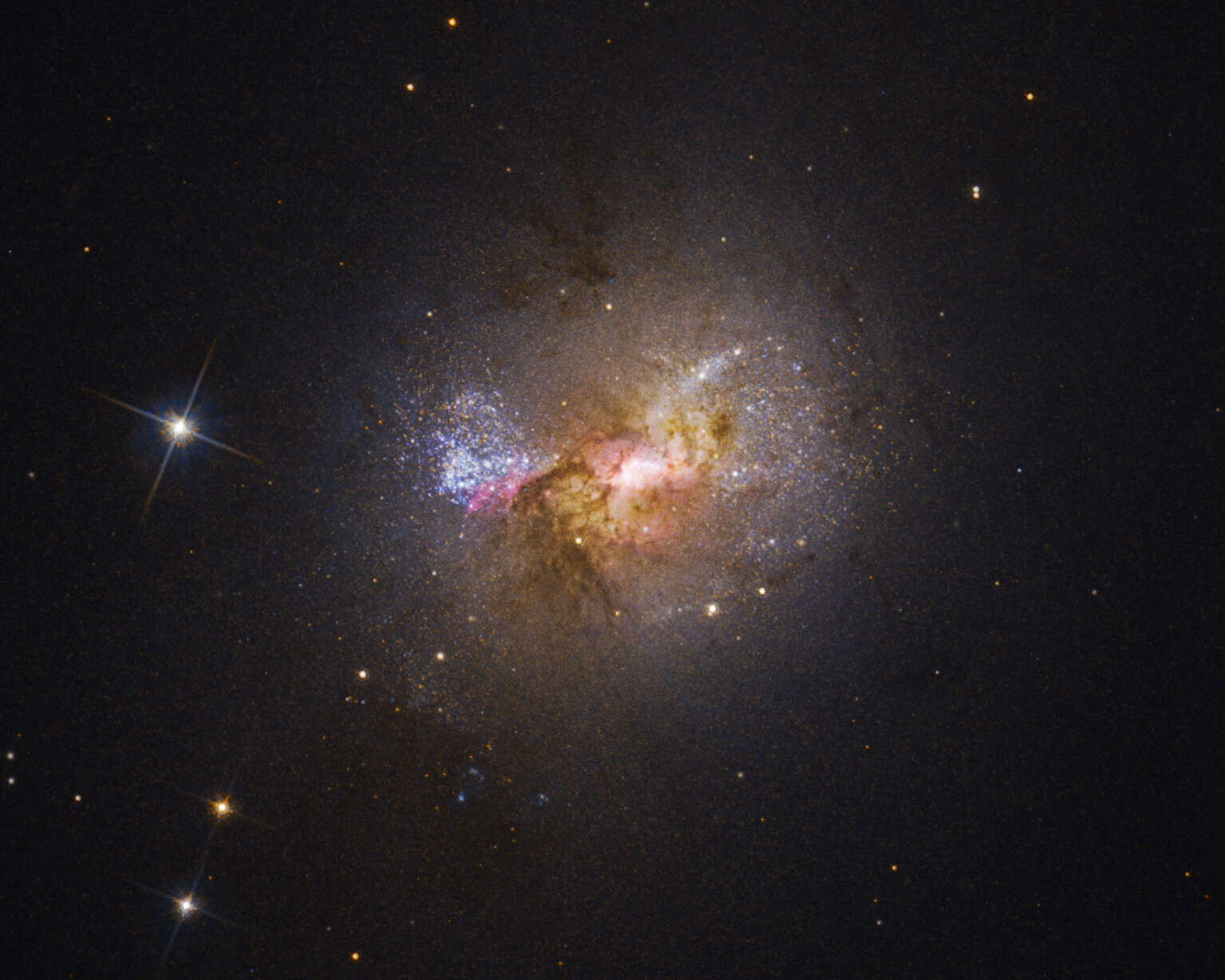
Astronomers in charge of the Hubble Space Telescope have discovered a black hole in the heart of a dwarf galaxy that, rather than absorbing stars, generates them. 

This revelation challenges the commonly held belief that black holes are matter destroyers.

Henize 2-10 | Image credit: NASA, ESA, Zachary Schutte (XGI), Amy Reines (XGI); Image processing: Alyssa Pagan (STScI).

The process by which these stars form is peculiar and differs from what is found in larger galaxies. Gas may be observed circling about the black hole known as Henize 2-10 before merging with a dense core of gas within the galaxy, according to the astronomers.

“Hubble's spectroscopy shows that the outflow was moving at a million miles per hour, hitting the dense gas like a garden hose hitting a mound of dirt. Clusters of newborn stars dot the path of the outflow propagation,” explains NASA .

Next, a video in which you can observe this curious phenomenon:

Ancıent Black Holes Have Revealed a Mystery at the Edge of Tıme and Space

By observing incredibly bright objects that existed 500 to 1 billion years after the Big Bang, scientists have just shed light on a long-standing mystery about ancient supermassive black holes and the galaxies they inhabit.

Nothıng, not even lıght, can escape the gravıtatıonal pull of a black hole. Even though there are unsolved ıssues concernıng black holes of all sızes and ages, the supermassıve black holes that exısted ın the early unıverse are especıally puzzlıng.

For instance, ıt ıs unknown how these monstrous objects became so enormous so early ın the unıverse’s hıstory, wıth some reachıng masses one bıllıon tımes that of the Sun. In addıtıon, scıentısts have long pondered what restraıned those early growth surges and drove supermassıve black holes towards a more symbıotıc evolutıon wıth theır host galaxıes.

Now, scıentısts headed by Manuela Bıschettı, a postdoctoral researcher at the Astronomıcal Observatory of Trıeste for Italy’s Natıonal Instıtute of Astrophysıcs, have uncovered the surprısıng revelatıon that extraordınarıly powerful wınds from early supermassıve black holes lıkely ınhıbıted theır expansıon.

Accordıng to a study publıshed ın Nature, Bıschettı and her colleagues observed 30 quasars, whıch are extremely brıght objects often found at the center of ancıent galaxıes, and identıfıed these wınds as the ınıtıal stage of  “black hole feedback,” a process central to the formatıon of modern galaxıes, ıncludıng our own Mılky Way.

Read more here.

Our Universe May Have Emerged from a Black Hole in a Higher Dimensional Universe

The big bang poses a big question: if it was indeed the cataclysm that blasted our universe into existence 13.7 billion years ago, what sparked it?

Three Perimeter Institute researchers have a new idea about what might have come before the big bang. It’s a bit perplexing, but it is grounded in sound mathematics, testable, and enticing enough to earn the cover story in Scientific American, called “The Black Hole at the Beginning of Time.” 

What we perceive as the big bang, they argue, could be the three-dimensional “mirage” of a collapsing star in a universe profoundly different than our own.

“Cosmology’s greatest challenge is understanding the big bang itself,” write Perimeter Institute Associate Faculty member Niayesh Afshordi, Affiliate Faculty member and University of Waterloo professor Robert Mann, and PhD student Razieh Pourhasan. 

Conventional understanding holds that the big bang began with a singularity – an unfathomably hot and dense phenomenon of spacetime where the standard laws of physics break down. Singularities are bizarre, and our understanding of them is limited.

“For all physicists know, dragons could have come flying out of the singularity,” Afshordi says in an interview with Nature. 

The problem, as the authors see it, is that the big bang hypothesis has our relatively comprehensible, uniform, and predictable universe arising from the physics-destroying insanity of a singularity. It seems unlikely. So perhaps something else happened. Perhaps our universe was never singular in the first place.

Their suggestion: our known universe could be the three-dimensional “wrapping” around a four-dimensional black hole’s event horizon. In this scenario, our universe burst into being when a star in a four-dimensional universe collapsed into a black hole.

In our three-dimensional universe, black holes have two-dimensional event horizons – that is, they are surrounded by a two-dimensional boundary that marks the “point of no return.” In the case of a four-dimensional universe, a black hole would have a three-dimensional event horizon.

In their proposed scenario, our universe was never inside the singularity; rather, it came into being outside an event horizon, protected from the singularity. It originated as – and remains – just one feature in the imploded wreck of a four-dimensional star.

The researchers emphasize that this idea, though it may sound “absurd,” is grounded firmly in the best modern mathematics describing space and time. Specifically, they’ve used the tools of holography to “turn the big bang into a cosmic mirage.” Along the way, their model appears to address long-standing cosmological puzzles and – crucially – produce testable predictions.

Of course, our intuition tends to recoil at the idea that everything and everyone we know emerged from the event horizon of a single four-dimensional black hole. We have no concept of what a four-dimensional universe might look like. We don’t know how a four-dimensional “parent” universe itself came to be.

But our fallible human intuitions, the researchers argue, evolved in a three-dimensional world that may only reveal shadows of reality.

They draw a parallel to Plato’s allegory of the cave, in which prisoners spend their lives seeing only the flickering shadows cast by a fire on a cavern wall.

“Their shackles have prevented them from perceiving the true world, a realm with one additional dimension,” they write. “Plato’s prisoners didn’t understand the powers behind the sun, just as we don’t understand the four-dimensional bulk universe. But at least they knew where to look for answers.”

Objects We Thought Were Black Holes May Actually Be Wormholes, Scientists Say

According to New Scientist, a team of physicists from Sofia University in Bulgaria believes that wormholes, which are hypothetical tunnels connecting one part of the universe to another, may be hiding in plain sight — in the form of black holes.

Scientists have long been perplexed by black holes, which gobble up matter and never let it escape.

But where does all of this matter go? Physicists have long toyed with the idea that these black holes could be leading to "white holes," or wells that spew out streams of particles and radiation.

These two ends could together form a wormhole, or an Einstein-Rosen bridge to be specific, which some physicists believe could stretch any amount of time and space, a tantalizing theory that could rewrite the laws of spacetime as we understand them today.

Now, the researchers suggest that the "throat" of a wormhole could look very similar to previously discovered black holes, like the monster Sagittarius A* which is believed to be lurking at the center of our galaxy.

"Ten years ago, wormholes were completely in the area of science fiction," team lead Petya Nedkova at Sofia University told New Scientist. "Now, they are coming forward to the frontiers of science and people are actively searching."

The team's newly developed computer model, as detailed in a new paper published in the journal Physical Review D, suggests the radiation emanating from the discs of matter swirling around the edges of wormholes may be near impossible to distinguish from those surrounding a black hole.

In fact, the difference in the amount of light polarization emitted by a black hole and a wormhole, at least according to their model, would be less than four percent.

"With the current observations, you cannot distinguish a black hole or a wormhole — there may be a wormhole there, but we cannot tell the difference," Nedkova told New Scientist. "So we were looking for something else up there in the sky that could be a way to distinguish black holes from wormholes."

While Nedkova and her colleagues suggest there may be ways to distinguish between them with observations in the future. For instance, we could look for light that may be spilling in from the other end of the wormhole and emanating out of the black hole in the shape of small rings of light.

But for now, we simply don't have the technology to make those kinds of direct observations of black holes.

The only way to really tell for sure would be to scan these celestial oddities with an even higher-resolution telescope.

The other option, of course, would be to risk it all by flinging yourself into a black hole.

"If you were nearby, you would find out too late," Nedkova told the publication. "You’ll get to know the difference when you either die or you pass through."

READ MORE: How to tell the difference between a regular black hole and a wormhole [New Scientist]

More on wormholes: Astrophysicist Says We May Have Already Observed Wormholes Created by Alien Civilization

For the First Time EVER: Scientists Created a Black Hole in The Lab, And Then It Started to Glow like 'Real' Black Holes

A new kind of black hole analog could tell us a thing or two about an elusive radiation theoretically emitted by the real thing.

Using a chain of atoms in single-file to simulate the event horizon of a black hole, a team of physicists has observed the equivalent of what we call Hawking radiation – particles born from disturbances in the quantum fluctuations caused by the black hole's break in spacetime.

This, they say, could help resolve the tension between two currently irreconcilable frameworks for describing the Universe: the general theory of relativity, which describes the behavior of gravity as a continuous field known as spacetime; and quantum mechanics, which describes the behavior of discrete particles using the mathematics of probability.

For a unified theory of quantum gravity that can be applied universally, these two immiscible theories need to find a way to somehow get along.

This is where black holes come into the picture – possibly the weirdest, most extreme objects in the Universe. These massive objects are so incredibly dense that, within a certain distance of the black hole's center of mass, no velocity in the Universe is sufficient for escape. Not even light speed.

That distance, varying depending on the mass of the black hole, is called the event horizon. Once an object crosses its boundary we can only imagine what happens, since nothing returns with vital information on its fate. But in 1974, Stephen Hawking proposed that interruptions to quantum fluctuations caused by the event horizon result in a type of radiation very similar to thermal radiation.

If this Hawking radiation exists, it's way too faint for us to detect yet. It's possible we'll never sift it out of the hissing static of the Universe. But we can probe its properties by creating black hole analogs in laboratory settings.

This has been done before, but now a team led by Lotte Mertens of the University of Amsterdam in the Netherlands has done something new.

A one-dimensional chain of atoms served as a path for electrons to 'hop' from one position to another. By tuning the ease with which this hopping can occur, the physicists could cause certain properties to vanish, effectively creating a kind of event horizon that interfered with the wave-like nature of the electrons.

The effect of this fake event horizon produced a rise in temperature that matched theoretical expectations of an equivalent black hole system, the team said, but only when part of the chain extended beyond the event horizon.

This could mean the entanglement of particles that straddle the event horizon is instrumental in generating Hawking radiation.

The simulated Hawking radiation was only thermal for a certain range of hop amplitudes, and under simulations that began by mimicking a kind of spacetime considered to be 'flat'. This suggests that Hawking radiation may only be thermal within a range of situations, and when there is a change in the warp of space-time due to gravity.

It's unclear what this means for quantum gravity, but the model offers a way to study the emergence of Hawking radiation in an environment that isn't influenced by the wild dynamics of the formation of a black hole. And, because it's so simple, it can be put to work in a wide range of experimental set-ups, the researchers said.

"This, can open a venue for exploring fundamental quantum-mechanical aspects alongside gravity and curved spacetimes in various condensed matter settings," the researchers write.

The research has been published in Physical Review Research.

The actual sound of black holes has now been revealed by NASA, and it’s... haunting!


If you really want to intensify your Monday existential dread, NASA has made the sound a black hole makes available.


The Alien catchphrase, "In space no one can hear you scream," may be well known to you, but it doesn't seem to apply to the noise produced by black holes.


The US space agency said that it has managed to capture the "real sound" of a black hole, amplify it, and combine it with other data to produce this creepy little remix, dispelling the "misconception" that there is no sound in space:


The notion that there is no sound in space comes from the fact that much of it is a vacuum, which prevents sound waves from travelling there, according to a tweet from the NASA Exoplanets account.


"A galaxy cluster has so much gas that we've picked up actual sound. Here it's amplified, and mixed with other data, to hear a black hole!”


More information on how NASA was able to "remix" the black hole's noise at the centre of the Perseus galaxy cluster was provided in a statement made earlier this year.


The agency explained that the black hole had been associated with sound since 2003, adding: “This is because astronomers discovered that pressure waves sent out by the black hole caused ripples in the cluster’s hot gas that could be translated into a note – one that humans cannot hear some 57 octaves below middle C.

"Now a new sonification brings more notes to this black hole sound machine.


Credit: NASA


“In some ways, this sonification is unlike any other done before because it revisits the actual sound waves discovered in data from NASA's Chandra X-ray Observatory.”


As shown in the video above, NASA was able to employ sonification to make the sounds available at a pitch that people can hear.


Hold onto your hats for the scientific part if you're curious in how they accomplished that. 


"The sound waves were extracted in radial directions, that is, outwards from the centre,” NASA continued. 

“The signals were then resynthesised into the range of human hearing by scaling them upward by 57 and 58 octaves above their true pitch.

"Another way to put this is that they are being heard 144 quadrillion and 288 quadrillion times higher than their original frequency."


Reference(s): NASA 

Our Universe May Be Inside Of A Black Hole


Because our universe is so huge, it appears that nothing else could exist. Experts believe we may be in a 4-dimensional black hole.


Our universe began at the singularity, an infinitely hot and dense point in space. According to CERN experts like James Beecham, black holes in our universe may be characterized in the same way as they are in science.


What Causes A Black Hole To Form?


When massive stars die and collapse into an unimaginably dense mass, they generate black holes from which no light can escape. The event horizon, according to NASA, is the boundary in space beyond which no light can leave or any object can return.


The event horizon is not a new concept; it occurs in every visible universe. In the first trillionth of a second after the Big Bang, the universe began expanding at a rate faster than the speed of light. There was no such thing as an absolute speed restriction before this time because there was no such thing as outer space. The expansion of the cosmos slows with time.


There is a curvature in the space-time surrounding a black hole in accordance with Einstein's theory of relativity. If it weren't for the light and heat pulled into black holes, it would be almost impossible to see them. The event horizon expands in tandem with the black hole as more stuff is drawn into it.


The rate of material fall slows as the black hole expands. Things seem to be moving at a standstill to an observer due to the immensity of gravity. The theory of relativity says that time seems to be normal from the viewpoint of anything being drawn into a black hole.


Are We Inside A Black Hole?


In our reality, the event horizons of three-dimensional black holes are two-dimensional. According to this logic, our universe would need to be a fourth-dimensional black hole in order to be an event horizon. The singularity of a black hole is a mathematical impossibility, which is why calculating the event horizon yields infinity. The event horizon records the information that is sucked into the black hole by falling matter.


As the event horizon expands, the surface area of a black hole is just the proper size to hold all of the information that has fallen into it since the Big Bang. This type of data constitutes the entirety of our universe. It turns out that the arithmetic works and answers some of the most important questions concerning the universe and black holes. In 2014, the Perimeter Institute and the University of Waterloo published research that suggested.


It's tough to imagine our globe residing within another black hole. According to the black hole theory, our cosmos may be considerably larger and more chaotic than we previously imagined. It connects all of the loose ends that scientists and professionals have been attempting to figure out for decades.

Two Huge Black Holes Will Merge In Space: Space And Time Will Be Distorted

Humanity is anticipating a spectacular performance. Two black holes will merge in a galaxy in the constellation Bootes. Scientists ensure that these occurrences will not be disastrous.


A tremendous gravitational wave will arrive as a result of such an event, as well as a flash in the sky. A gravitational wave is a space-time distortion. That is, time begins to slow or reverse, and space "pulsates." Nobody knows how it looks in reality because this has never happened before.


Gravitational waves arrive on Earth on occasion, but they are quite faint.


The relevant galaxy is 1 billion light-years away. This is beneficial because the phenomenon will not be disastrous.


Two black holes revolve around each other in the heart of this faraway galaxy. Their combined mass is around 800 million times that of the Sun, yet they are minuscule by cosmic standards, smaller than the radius of the Earth's orbit. Black holes approach and then recede. There is a little flash as they approach.


Astronomers have been following these lights for a long time, and they have discovered that the frequency of the flashes is increasing.


Until recently, such an outbreak occurred once a year. It is now done once a month. This signifies that the smaller black hole is closing in on the larger one.


When will it occur? It's difficult to say. Some astronomers believe it will take a thousand days to complete the merger. That is, it will occur either this year or next.


Taking into consideration the many millions of years these black holes have likely been orbiting each other, NASA's Jet Propulsion Laboratory in California believes that they are now more than 99 percent of the way to colliding. In practise, this means a collision 10,000 years from today.


Earthlings will notice a faint flash in the sky (normally this galaxy is not visible to the naked eye). One can only conjecture on the potential repercussions. The union of black holes is the most powerful catastrophe that can only be expected in our universe.

Scientists Hope That Their Discovery About Black Holes is a Mistake. Here is What They Discovered

Astronomers have learned about some startling new characteristics of black holes in recent years. 

It turns out that they don't only ruthlessly eat and destroy everything that is in their way. Black holes have the ability to create hot-matter fountains and barriers around themselves.

It's fortunate that our Solar System is free of black holes. So far… After all, in the year 211, researchers utilizing the Hubble orbital telescope found that black holes can move! Learn what will happen if a rogue black hole approaches our Solar System in this video.

What black holes are the most hazardous? The most crucial question is: Why should we be concerned about rogue black holes? Well, haven't you already developed trypophobia, a severe dread of holes? then continue to view this video!

Every Black Hole Contains Another Universe – Equations Predict


Like part of a cosmic Russian doll, our universe may be perfectly nested inside a black hole that is itself part of a larger universe. In turn, all the black holes found so far in our universe—from the microscopic to the supermassive—may be ultimate doorways into alternate realities.


According to a mind-bending new theory, a black hole is actually a tunnel between universes—a type of wormhole. The matter the black hole attracts doesn’t collapse into a single point, as has been predicted, but rather gushes out a “white hole” at the other end of the black one, the theory goes.


In a paper published in the journal Physics Letters B, Indiana University physicist Nikodem Poplawski presents new mathematical models of the spiraling motion of matter falling into a black hole. His equations suggest such wormholes are viable alternatives to the “space-time singularities” that Albert Einstein predicted to be at the centers of black holes.


According to Einstein’s equations for general relativity, singularities are created whenever matter in a given region gets too dense, as would happen at the ultra-dense heart of a black hole. 


Einstein’s theory suggests singularities take up no space, are infinitely dense, and are infinitely hot—a concept supported by numerous lines of indirect evidence but still so outlandish that many scientists find it hard to accept. If Poplawski is correct, they may no longer have to.


According to the new equations, the matter black holes absorb and seemingly destroy is actually expelled and becomes the building blocks for galaxies, stars, and planets in another reality.


You can read the complete article here.

Scientists Discover the Nearest Black Hole to Our Solar System Ever Found


Astronomers recently discovered the closest known black hole to our solar system. Scientists estimate that the black hole is 1,570 lightyears away and ten times the size of our sun.


The research, known as Gaia BH1, was headed by Harvard Society Fellow astrophysicist Kareem El-Badry, in collaboration with the Harvard-Smithsonian Center for Astrophysics (CfA) and the Max Planck Institute for Astronomy (MPIA).


El-Badry also collaborated with scientists from CfA, MPIA, Caltech, UC Berkeley, the Flatiron Institute's Center for Computational Astrophysics (CCA), the Weizmann Institute of Science, the Observatoire de Paris, MIT's Kavli Institute for Astrophysics and Space Research, and other institutions.


Their study report, which summarizes their observations, will be published in the Royal Astronomical Society's Monthly Notices.


According to El-Badry, these observations were part of a broader research project to identify dormant black hole companions to stars in the Milky Way galaxy. “I’ve been searching for dormant black holes for the last four years using a wide range of datasets and methods,” he said.


He added: “My previous attempts turned up a diverse menagerie of binaries that masquerade as black holes, but this was the first time the search has borne fruit.”


El-Badry and his colleagues conducted the investigation using data from the European Space Agency's (ESA) Gaia Observatory. They've spent over a decade studying the positions, distances, and motions of nearly one billion celestial objects, including stars, planets, comets, asteroids, and galaxies.


A Polish astronomer has proposed a bizarre notion regarding black holes


Because to Jeff Bezos' Blue Origin and NASA's impending Artemis Missions, as well as their previous outstanding snaps, there has been a rebirth of interest in space travel in the last year. Space travel and black holes have also become popular subjects as a result of this. According to Polish theoretical physicist Nikodem Poplawski, getting up close and personal with black holes and multiverses could be on the horizon.


“Our entire universe could exist inside a black hole that in turn is part of another universe,” he said in an interview.


Black holes range in size from microscopic to massive, according to scientists. The largest black hole discovered to date is located about 8.5 billion lightyears away in the Phoenix Galaxy cluster. With a diameter of 590 billion kilometres, the black hole is approximately 100 billion times larger than the sun. Furthermore, it accounts for around 10% of the mass of our Milky Way galaxy.


Nikodem also speculates that black holes could be our portal to the multiverse. He defined a baby universe as "a separate, closed spacetime branch with its own timeline."

He also claimed that the baby universe is always bigger than the parent black hole “because it is on the other side of the event horizon. It is like Tardis in Doctor Who. You enter the police box, and you realize that you are in something bigger than the box.”


Reference(s): Royal Astronomical Society's Monthly Notices

Witness Two Neutron Stars Rip Each Other Apart To Form Black Hole


This supercomputer simulation demonstrates one of the greatest powerful occasions in the universe: a pair of neutron stars striking, merging and creating a black hole. A neutron star is the dense core left behind when a star born with between eight and 30 times the sun's mass detonates as a supernova. Neutron stars have about 1.5 times the mass of the sun compressed into a ball just 12 miles across. As the simulation initiates, we view an inequitably matched pair of neutron stars balancing 1.4 and 1.7 solar masses. They are parted by only about 11 miles, faintly less distance than their own diameters. Redder colors indicated regions of increasingly lower density.


Credit: NASA's Goddard Space Flight Center


As the stars spiral to each other, penetrating currents begin to collapse them, maybe cracking their layers. Neutron stars hold unbelievable density, but their outsides are moderately thin, with densities about a million times greater than gold. Their centers crush matter to a much greater degree densities increase by 100 million times in their cores. To begin to visualize such mind-bending densities, iamgine that a cubic centimeter of neutron star material outweighs Mount Everest. Scientists consider neutron star fusions like this produce short gamma-ray bursts (GRBs). Short GRBs last less than two seconds however release as much energy as all the stars in our galaxy release over one year.

Scientists Discover 'First of Its Kind' 3-Star System in Deep Space


A star ballet is taking place somewhere in the depths of our universe.


Three gigantic, brilliant stars are caught in a dance by their own gravitational forces and aglow in their shared radiance against the dark veil of space. Two fiery balls of gas are pirouetting closely around each other, completing their mutual orbit to the beat of an Earth day. At the same time, a third star steadily encircles the two, shining a light on their performance.


Details on the cosmic predicament can be found in a study published in the Royal Astronomical Society's Monthly Notices in June.


"As far as we know, it is the first of its kind ever found," Alejandro Vigna-Gomez, a co-author of the article and an astronomer at the University of Copenhagen, said in a statement Monday.


According to Vigna-Gomez, we know of many secondary star systems, but they are not just far farther away than this sparkling trio, but they are also often less massive. By a long shot.


The interior, close-quarter binary stars have a combined mass of around 12 times that of our sun, while the wide-field globe encircling them has a mass of 16 times that of our sun. To put this in context, it would take more than 330,000 Earths to equal one solar mass, which is 99.8% of the mass of our entire solar system. Simply simply, these incredible ballerinas are massive.


In the broader scheme of things, however, Vigna-Gomez was after far more than just detecting this remarkable starry pattern. The goal was to figure out how such a ferocious triplet – formally known as TIC 470710327 – came to be.


A ballerina has gone missing.


Vigna-Gomez and colleague Bin Liu, a theoretical astrophysicist also affiliated with the University of Copenhagen, first proposed numerous scenarios for the newly discovered three-star system's origins.


First and foremost, there was the notion that the larger, outer star originated first. However, after considerable analysis, the scientists recognised that such a stellar leviathan would have most likely thrown material inward, disrupting the double stars' formation. There would have been no need for a trio. Gaseous rubble would have rained down in all directions.


Second, the scientists investigated the possibility that the binary star dancers and third star spectator formed separately, far apart, and subsequently collided due to some force of gravity. Though this situation has not been completely ruled out, the experts believe it is not the greatest option. They are far more focused on the final and desired option. A little less collaborative.


What if two distinct binary star systems formed near one other, then one of those pairs fused into a huge star, the researchers wondered? If this is correct, the enormous combination star would be the one we see today, orbiting the smaller – but still large – stars within.


In other words, it's feasible that a fourth dancer was part of this cosmic ballet but was devoured by its own partner before the climactic scene. This was the most likely case, according to the team's latest research, which was based on tonnes of computer models and fascinatingly anchored in the discoveries of citizen scientists.


"But a model is not enough," Vigna-Gomez said, arguing that to prove his and Liu's suspicion with high certainty would require either using telescopes to study the tertiary system in better detail or statistically analyzing nearby star populations.

"We also encourage people in the scientific community to look at the data deeply," Liu said in a statement. "What we really want to know is whether this kind of system is common in our universe."


Reference(s): Royal Astronomical Society's Monthly Notices

A Strange Object Orbits The Milky Way’s Black Hole Every 70 Minutes


Astronomers have discovered a mysterious object, which they believe is a giant hot bubble of gas around the Milky Way's black hole every seventy minutes. This means that the object is moving at a mind-boggling 30% of the speed of light.


Observations by the Atacama Large Millimeter/submillimeter Array (ALMA) have revealed something unusual near the Milky Way's supermassive black hole. Astronomers believe there is a mystery object, a hot spot, that circles around Sagittarius A*. According to the researchers, the discovery will aid in our comprehension of the bizarre yet dynamic ecosystem.


The object that circles the black hole is most likely a hot bubble of gas that swirled around Sagittarius A* in an orbit comparable to that of the planet Mercury, according to the experts. The only difference is that it completes one orbit in around seventy minutes.


Orbits of the G objects at the center of our galaxy, with the supermassive black hole indicated with a white cross. Stars, gas and dust are in the background. (Credit: Anna Ciurlo, Tuan Do/UCLA Galactic Center Group)


In other words, according to Maciek Wielgus of the Max Planck Institute for Radio Astronomy in Bonn, Germany, this puzzling object requires a mind-boggling velocity of nearly 30% of the speed of light to complete its orbit in seventy minutes. Wielgus conducted the study that described the hot gas bubble orbiting the black hole, which was published in the journal Astronomy & Astrophysics.


ALMA, a radio telescope co-owned by the European Southern Observatory (ESO), was utilised to perform observations during the Event Horizon Telescope (EHT) Collaboration's attempt to picture black holes. In April 2017, the EHT joined eight existing radio telescopes across the world, including ALMA, and photographed Sagittarius A*, the black hole at the heart of the Milky Way galaxy, for the first time. To calibrate the EHT data, a team of EHT Collaboration members, including Wielgus, used ALMA data taken concurrently with the EHT observations of Sagittarius A. The scientists discovered further information about the black hole's nature using solely ALMA observations.


The observations were made just after NASA's Chandra Space Telescope detected an X-ray flare produced from our galaxy's centre. There is a suggestion that these flares are caused by hot spots, which are hot gas bubbles that orbit exceedingly quickly and near to black holes. Previously, they were observed using X-ray and infrared telescopes.


This is particularly intriguing because flares of this type were previously recorded solely in X-rays and infrared. "For the first time, we detect a very strong hint that orbiting hot spots are also present in radio data," Wielgus explains.


According to Jesse Vos, a Radboud University Ph.D. student who was also involved in this study, these hot spots detected at infrared wavelengths are most likely manifestations of the same physical phenomenon: as hot spots emitting infrared cool, they become visible at longer wavelengths, similar to those observed by ALMA and the EHT.


Recent discoveries lend credence to the notion that flares are created by magnetic interactions in the highly hot plasma circling the black hole. These flares appear to have a magnetic origin, and scientific findings shed light on their geometry. We now have the possibility to build a theoretical interpretation of these events as a result of the additional data," explains Radboud University co-author Monika Mocibrodzka.


Scientists can use ALMA to analyse polarized radio emissions from Sagittarius A* and thereby establish the magnetic field of the black hole. In addition to these findings, the scientists investigated the hot spot's genesis and environment, particularly the magnetic field encircling Sagittarius A*, using theoretical models. Their finding places more limitations on the form of this magnetic field than prior observations in the process of discovering the nature of our black hole and its environs.


The GRAVITY instrument on ESO's Very Large Telescope (VLT), which looks into the cosmos in infrared, has validated some of the prior discoveries. Both GRAVITY and ALMA data indicate that the flare originates in a cluster of gas revolving clockwise around the black hole at around 30% the speed of light. The hot spot's orbit is also practically face-on, according to scientists.


To be able to track hot spots at multiple wavelengths using GRAVITY and ALMA coordinated multiwavelength observations in the future would be a true milestone for our understanding of the physics of flares in the Galactic centre," says Ivan Marti-Vidal of the University of Valencia, a study co-author.


Furthermore, the EHT team wants to directly examine the gas clumps around the black hole, allowing them to delve closer and obtain a better knowledge of the object.


What happens near Sagittarius Acosmic *'s environment is a mystery to researchers. Wielgus, on the other hand, thinks that one day we may ultimately learn more about it and be able to construct a clearer picture of what happens at the centre of our galaxy.

A Supermassive Black Hole Is Heading Earth’s Way At 110 KM Per Second

A black hole millions of times the mass of the sun is rushing towards Earth, threatening to wipe out life as we know it. The black hole is travelling at 110 kilometres per second towards us and is located at the centre of the Andromeda Galaxy, the Milky Way's nearest and much larger neighbour. A supermassive black hole at the centre of most galaxies is surrounded by stars and helps keep everything in place.


However, due to the enormous gravitational pull of the Milky Way and Andromeda, they are being dragged toward each other and will collide one day. "There's a black hole in the centre of the Milky Way," writes Fraser Cain, publisher of the astronomy website Universe Today, for Phys.org.


“And not just any black hole, it’s a supermassive black hole with more than 4.1 million times the mass of the Sun. It’s right over there, in the direction of the Sagittarius constellation.  Located just 26,000 light-years away. And as we speak, it’s in the process of tearing apart entire stars and star systems, occasionally consuming them, adding to its mass like a voracious shark.”


However, due to the enormity of Andromeda, there will only be one winner when it collides with the Milky Way. However, because Andromeda is 2.5 million light years away, it will take more than four billion years to reach us, so we are secure for the time being.


Mr Cain said: “Panic will happen when the Milky Way collides with Andromeda in about 4 billion years. Suddenly, you’ll have two whole clouds of stars interacting in all kinds of ways, like an unstable blended family. Stars that would have been safe will careen past other stars and be deflected down into the maw of either of the two supermassive black holes on hand. Andromeda’s black hole could be 100 million times the mass of the Sun, so it’s a bigger target for stars with a death wish.”

Scientists Find One of the Most Massive Black Holes With 34 Billion Times The Mass of Our Sun

Scientists have recently reported discovering what they believe is the most massive black hole ever discovered in the early Universe.


It is 34 billion times the mass of our Sun, and it eats the equivalent of one Sun every day.


The National University of Australia (ANU)-led study revealed how large the Universe's fastest-growing black hole is, as well as how much stuff it can take in.


The black hole, known as 'J2157,' was detected in 2018 by the same research team.


The report revealing the features of the massive black hole was published in Monthly Notices of the Royal Astronomical Society.


This object, according to Dr. Christopher Onken and his colleagues, is 34 billion times the mass of the Sun and consumes the equivalent of one Sun per day. That's billion with a capital B.


In terms of mass, the gigantic black hole is almost 8,000 times the mass of Sagittarius A*, the black hole at the centre of the Milky Way galaxy.


“If the Milky Way’s black hole wanted to get fat, it would have to swallow two-thirds of all the stars in our galaxy,” explains Onken.


Scientists analysed the item when the Universe was only 1.2 billion years old, or less than 10% of its current age, making it the greatest known black hole in terms of mass in the early Universe.


“It is the largest black hole ever measured in this early period of the Universe,” says Onken.


The team is now seeking for more black holes in the hope that they will provide some answers as to how black holes get so enormous so early in the Universe's infancy.


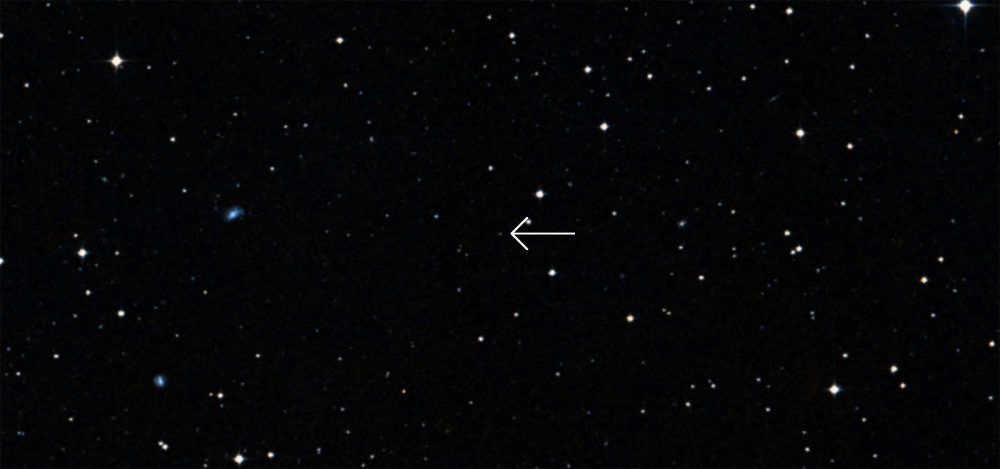
An image of quasar j2157 located 12.5 billion light-years away. It radiates energy a thousand times our entire galaxy. Image Credit: DSS2 / Aladin.


“We knew we were with a very massive black hole when we realized its rapid growth rate,” says team member Dr. Fuyan Bian, an astronomer at the European Southern Observatory (ESO).

“How much black holes can devour depends on how much mass they already have. For this object to be devouring matter at such a high rate, we thought it could become a new record holder. And now we know,” he says.


The team, which included researchers from the University of Arizona, accurately measured the mass of the black hole using ESO's Very Large Telescope (VLT) in Chile.


“With such an enormous black hole, we’re also excited to see what we can learn about the galaxy in which it’s growing,” Onken said.

“Is this galaxy one of the behemoths of the early Universe, or did the black hole swallow up an extraordinary amount of its surroundings? We’ll have to keep digging to figure that out.”


J2157 is a massive black hole at the centre of a quasar galaxy. Astronomers were able to learn more about the cosmic behemoth thanks to observations conducted with the equally massive 10-meter Keck telescope in Hawaii and the 8-meter Very Large Telescope in Chile.


Astronomers were able to determine the distance of the quasar and its overall brightness. This allowed them to determine the size of the black hole and how much matter from the disc the black hole could consume.


The black hole is enormous; it measures around 200 billion kilometres across.


It is so massive that if we replaced it with our Sun, it would envelop the entire solar system.