Showing posts with label Mars. Show all posts

Scientists Just Found a 'Significant' Volume of Water Inside Mars' Grand Canyon

The Red Planet is hiding an appealing secret.

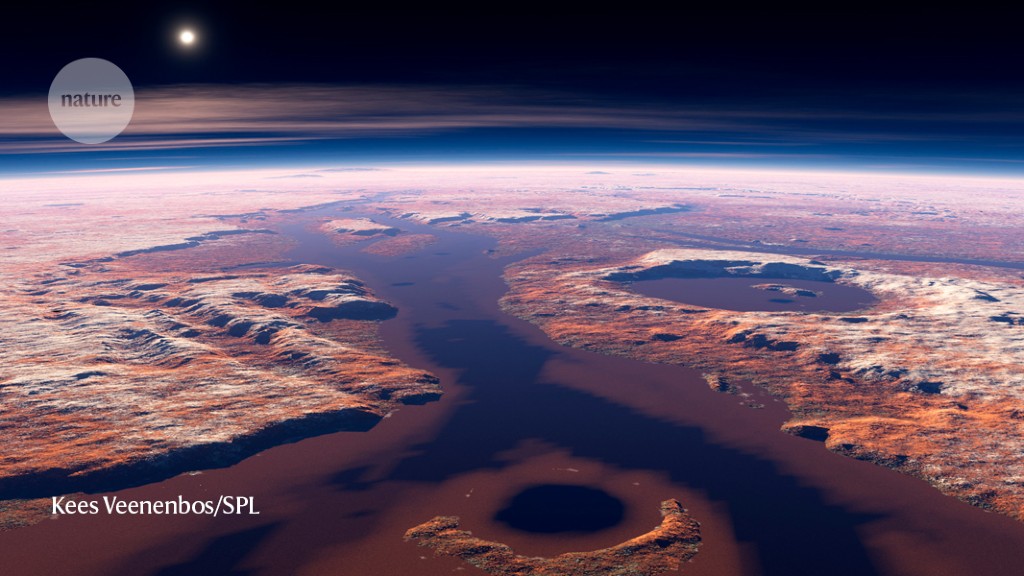
Scientists have discovered a world-historic discovery on Mars: "significant amounts of water" are hiding inside the Red Planet's Valles Marineris, its version of our grand canyon system, according to a recent press release from the European Space Agency (ESA).

And up to 40% of material near the surface of the canyon could be water molecules.

Mars' Valles Marineris canyon system is hiding water

The newly discovered volume of water is hiding under the surface of Mars, and was detected by the Trace Gas Orbiter, a mission in its first stage under the guidance of the ESA-Roscosmos project dubbed ExoMars. Signs of water were picked up by the orbiter's Fine Resolution Epithermal Neutron Detector (FREND) instrument, which is designed to survey the Red Planet's landscape and map the presence and concentration of hydrogen hiding in Mars' soil. It works like this: while high-energy cosmic rays plunge into the surface, the soil emits neutrons. And wet soil emits fewer neutrons than dry soil, which enables scientists to analyze and assess the water content of soil, hidden beneath its ancient surface. 

"FREND revealed an area with an unusually large amount of hydrogen in the colossal Valles Marineris canyon system: assuming the hydrogen we see is bound into water molecules, as much as 40% of the near-surface material in this region appears to be water," said Igor Mitrofanov, the Russian Academy of Science's lead investigator of the Space Research Institute, in the ESA press release.

Scientists have already discovered water on Mars, but most earlier discoveries detected the substance crucial to life as we know it near the poles of the Red Planet, subsisting as ice. Only very small pockets of water had shown up at lower latitudes, which was a big downer because future astronauts on Mars will need a lot of water, and there are better prospects for settling the planet at lower latitudes. But now, with what seems like a comparative abundance of water in Valles Marineris, we've taken a major step toward establishing a reliable source of water on the closest alien world.

Mars' canyon water could be liquid, ice, or a messy mix


"The reservoir is large, not too deep below ground, & could be easily exploitable for future explorers," read a tweet on the announcement from ExoMars. That sounds basically great! But it's too soon for Musk to pack up his bags and fly to the site, since much work is left to be done. A study accompanying the announcement, published in the journal Icarus, shows that neutron detection doesn't distinguish between ice and water molecules. This means geochemists need to enter the scientific fray to reveal more details. But several features of the canyon, including its topology, have led the researchers to speculate that the water is probably in solid form (ice). But it could also be a mixture of solid and liquid.


"We found a central part of Valles Marineris to be packed full of water — far more water than we expected," said Alexey Malakhov, co-author of the study, in the ESA release. "This is very much like Earth's permafrost regions, where water ice permanently persists under dry soil because of the constant low temperatures." So while we don't yet know the specific form of water is lying under Mars' vast system of canyons, the first human mission to Mars may consider exploring this area a major priority.


This was a breaking story and was regularly updated as new information became available.
NASA's probe orbiting Mars Has Just Released 2000+ Mind-blowing New Photos of the Red Planet

If it's quiet solitude and beauty you seek, there is no better place than the surface of Mars. 

Mars has, long ago, earned its jis moniker as the red planet, but the HiRISE camera aboard NASA's Mars Reconnaissance Orbiter (MRO) can transform the subtle differences of soils into a rainbow of colors.

For 10 years, HiRISE has recorded gorgeous- and scientifically valuable - images of Mars. Its photos are so detailed that scientists can examine the planet's features at the scale of just a few feet, including the recent crash site of Europe's Schiaparelli Mars lander.

We combed through 2,054 of the camera's latest pictures, released in August, September, and October, to bring you some of the best - and hopefully help you temporarily escape Earth.

A large chasm:

Some dark, rust-colored dunes in Russell Crater:

NASA might land its next nuclear-powered Mars 2020 rover mission here.

The black splotch is where the European Space Agency's Schiaparelli Mars lander crashed. The white specks, pointed out with arrows, are pieces of the lander.


Zebra skin. Just kidding, this is a dune field that's speckled with oval-shaped mineral deposits:

False-coloring this image makes a giant dune and its gullies look blue.

A possible landing site for the ExoMars 2020 mission, which the European Space Agency is running.

A North Pole dune field nicknamed "Kolhar," after Frank Herbert's fictional world.


Carbon dioxide that turns from solid to gas carves out these strange shapes at Mars' south pole:

A recent impact crater on Mars. (We're pretty sure no one put out a giant cigarette here.)

'Spiders' are eruptions of dust caused by the way the Martian surface warms and cools:

Cerberus Palus crater showing off layered sediments:

NASA keeps an eye of gullies like this for small landslides - and any water that melts in the warm sun to form darker-colored mud.

Another gully scientists are having HiRISE monitor:

Glacial terrain looks strangely iridescent:

A steep slope in Eastern Noctis Labyrinthus:

Dunes in a Martian crater. The red bar is an artifact of NASA's image processing:

The creation of 'fans' around dunes may help scientists understand seasonal changes on Mars.

Another possible landing site for the Mars 2020 mission:


Terrain near the Martian equator:


Ceraunius Fossae is a region dominated by volcanic flows and large cracks:


Beautiful texture in the region called North Sinus Meridiani:


False colours assigned to certain minerals make Syria Planum an inky blue that's speckled with gold:


A crater on Arcadia Planitia, a large flat region of Mars:


Layers in Martian buttes found in a region called West Arabia:


A picture of Utopia Planitia, a large plain on Mars:


A bright speckle of minerals stands out on Galle (not Gale) Crater:


A small but recent impact crater:


This article was originally published by Business Insider.

Scientists Find Huge Deposits of Water on Mars

Scientists have discovered a large reservoir of water hidden within Mars' gigantic 'Grand Canyon.'

A group of scientists using the European Space Agency's ExoMars Orbiter identified a significant deposit of water immediately beneath the Valles Marineris Martian canyon system, which is ten times longer and five times deeper than our own Grand Canyon.

The scientists discovered genuine water ice around three feet below the canyon's surface after analysing data from the Trace Gas Orbiter's (TGO) Fine Resolution Epithermal Neutron Detector (FREND).

The presence of water on Mars could indicate the presence of microbial alien life, as well as the possibility of more complex life forms - especially if Mars has the vast expanses of water that Earth does.

“With TGO we can look down to one meter below this dusty layer and see what’s really going on below Mars’ surface,” lead author Igor Mitrofanov of the Russian Academy of Sciences said in a statement.

“FREND revealed an area with an unusually large amount of hydrogen in the colossal Valles Marineris canyon system: assuming the hydrogen we see is bound into water molecules, as much as 40 percent of the near-surface material in this region appears to be water,” he added.

The massive area is about the same size as the Netherlands, meaning that there is plenty of room to potentially find more water.

“We found a central part of Valles Marineris to be packed full of water — far more water than we expected,” added coauthor Alexey Malakhov. “This is very much like Earth’s permafrost regions, where water ice permanently persists under dry soil because of the constant low temperatures.”

“Overall, we think this water more likely exists in the form of ice,” Malakhov argued.

Scientists are hailing the discovery as a tremendous first step toward potentially finding signs of ancient life on the Red Planet, or even possible venues that we ourselves may one day inhabit.

Reference(s): Icarus

This is Valles Marineris and it is one of the largest canyons in the Solar System. more..

This is Valles Marieris, and it is one of the Solar System's largest cayos. 

It's deeper than the Grand Cayo, and its length encircles the United States from coast to coast.

Credit: NASA


BREAKING: Scientists Just Found A 'Significant' Volume of Water Inside Mars' Grand Canyon

The Red Planet is hiding an appealing secret.

Scientists have discovered a world-historic discovery on Mars: "significant amounts of water" are hiding inside the Red Planet's Valles Marineris, its version of our grand canyon system, according to a recent press release from the European Space Agency (ESA).

And up to 40% of material near the surface of the canyon could be water molecules.

Mars' Valles Marineris canyon system is hiding water

The newly discovered volume of water is hiding under the surface of Mars, and was detected by the Trace Gas Orbiter, a mission in its first stage under the guidance of the ESA-Roscosmos project dubbed ExoMars. 

Signs of water were picked up by the orbiter's Fine Resolution Epithermal Neutron Detector (FREND) instrument, which is designed to survey the Red Planet's landscape and map the presence and concentration of hydrogen hiding in Mars' soil. 

It works like this: while high-energy cosmic rays plunge into the surface, the soil emits neutrons. And wet soil emits fewer neutrons than dry soil, which enables scientists to analyze and assess the water content of soil, hidden beneath its ancient surface. 

"FREND revealed an area with an unusually large amount of hydrogen in the colossal Valles Marineris canyon system: assuming the hydrogen we see is bound into water molecules, as much as 40% of the near-surface material in this region appears to be water," said Igor Mitrofanov, the Russian Academy of Science's lead investigator of the Space Research Institute, in the ESA press release.

Scientists have already discovered water on Mars, but most earlier discoveries detected the substance crucial to life as we know it near the poles of the Red Planet, subsisting as ice. 

Only very small pockets of water had shown up at lower latitudes, which was a big downer because future astronauts on Mars will need a lot of water, and there are better prospects for settling the planet at lower latitudes. 

But now, with what seems like a comparative abundance of water in Valles Marineris, we've taken a major step toward establishing a reliable source of water on the closest alien world.

Mars' canyon water could be liquid, ice, or a messy mix

"The reservoir is large, not too deep below ground, & could be easily exploitable for future explorers," read a tweet on the announcement from ExoMars. That sounds basically great! But it's too soon for Musk to pack up his bags and fly to the site, since much work is left to be done. A study accompanying the announcement, published in the journal Icarus, shows that neutron detection doesn't distinguish between ice and water molecules. This means geochemists need to enter the scientific fray to reveal more details. But several features of the canyon, including its topology, have led the researchers to speculate that the water is probably in solid form (ice). But it could also be a mixture of solid and liquid.

"We found a central part of Valles Marineris to be packed full of water — far more water than we expected," said Alexey Malakhov, co-author of the study, in the ESA release. "This is very much like Earth's permafrost regions, where water ice permanently persists under dry soil because of the constant low temperatures." So while we don't yet know the specific form of water is lying under Mars' vast system of canyons, the first human mission to Mars may consider exploring this area a major priority.

This was a breaking story and was regularly updated as new information became available.

Mars is Alive! NASA Detects Unusual Activity From Inside The Planet

It turned out that Mars wasn't as silent as first believed. Instead, there is intense seismic activity on the red planet, which is rumbling and groaning. 

The planet is experiencing dynamic shocks deep below its surface, and right now, molten lava may be pouring just below the Martian crust. If it is true, it will alter our knowledge of Martian geodynamics that we have amassed over the years and imply that volcanic activity on the red planet is not only feasible but is continuing, and that it is happening more often than anticipated.

What does this rumbling, nevertheless, mean? How will it alter how we see Martian geology? Lastly, and most significantly, how will this revolutionary finding affect our efforts to find both past and contemporary Martian life?

NASA's probe orbiting Mars Has Just Released 2000+ Mind-blowing New Photos of the Red Planet

If it's quiet solitude and beauty you seek, there is no better place than the surface of Mars. Mars has, long ago, earned its jis moniker as the red planet, but the HiRISE camera aboard NASA's Mars Reconnaissance Orbiter (MRO) can transform the subtle differences of soils into a rainbow of colors.


For 10 years, HiRISE has recorded gorgeous- and scientifically valuable - images of Mars. Its photos are so detailed that scientists can examine the planet's features at the scale of just a few feet, including the recent crash site of Europe's Schiaparelli Mars lander.


We combed through 2,054 of the camera's latest pictures, released in August, September, and October, to bring you some of the best - and hopefully help you temporarily escape Earth.


A large chasm:


Some dark, rust-colored dunes in Russell Crater:


NASA might land its next nuclear-powered Mars 2020 rover mission here.


The black splotch is where the European Space Agency's Schiaparelli Mars lander crashed. The white specks, pointed out with arrows, are pieces of the lander.


Zebra skin. Just kidding, this is a dune field that's speckled with oval-shaped mineral deposits:


False-coloring this image makes a giant dune and its gullies look blue.


A possible landing site for the ExoMars 2020 mission, which the European Space Agency is running.


A North Pole dune field nicknamed "Kolhar," after Frank Herbert's fictional world.


Carbon dioxide that turns from solid to gas carves out these strange shapes at Mars' south pole:


A recent impact crater on Mars. (We're pretty sure no one put out a giant cigarette here.)


'Spiders' are eruptions of dust caused by the way the Martian surface warms and cools:


Cerberus Palus crater showing off layered sediments:


NASA keeps an eye of gullies like this for small landslides - and any water that melts in the warm sun to form darker-colored mud.


Another gully scientists are having HiRISE monitor:


Glacial terrain looks strangely iridescent:


A steep slope in Eastern Noctis Labyrinthus:


Dunes in a Martian crater. The red bar is an artifact of NASA's image processing:


The creation of 'fans' around dunes may help scientists understand seasonal changes on Mars.


Another possible landing site for the Mars 2020 mission:


Terrain near the Martian equator:


Ceraunius Fossae is a region dominated by volcanic flows and large cracks:


Beautiful texture in the region called North Sinus Meridiani:


False colours assigned to certain minerals make Syria Planum an inky blue that's speckled with gold:


A crater on Arcadia Planitia, a large flat region of Mars:


Layers in Martian buttes found in a region called West Arabia:


A picture of Utopia Planitia, a large plain on Mars:


A bright speckle of minerals stands out on Galle (not Gale) Crater:


A small but recent impact crater:


This article was originally published by Business Insider.