Showing posts with label Planets. Show all posts

Exoplanets dance around distant star in stunning 12-year timelapse (video)


Four Jupiter-mass exoplanets dance around their parent star in a stunning new timelapse collected over a dozen years.


The aim of the newly released video is to make the long orbits of these massive exoplanets more recognizable to a wide audience, Northwestern University astrophysicist Jason Wang said in a statement.


"This video shows planets moving on a human time scale. I hope it enables people to enjoy something wondrous," said Wang. In real life, the planet nearest the star HR8799 takes 45 years to make a single circuit. The world farthest away would take half a millennium (500 years) to go around the star once.


A timelapse animation of the four exoplanets "dancing" around the star HR8799. (Image credit: Jason Wang/Northwestern University)


HR8799 is 1.5 times more massive than our sun and lies roughly 133 light-years from Earth in the constellation Pegasus. (By comparison, the closest star system to us, Alpha Centauri, is a bit more than 4 light-years away.)


While a bit more massive than our sun, HR8799 is much more luminous: it has five times the intrinsic brightness of Earth's start. HR8799 is also very young at just 30 million years, compared with our midlife sun, which is 4.5 billion years old. 


Three planets in the HR8799 system. The planets, thought to be gas giants more massive than Jupiter, were first imaged in 2008 and are shown here in a vortex coronagraph image. (Image credit: NASA/JPL-Caltech/Palomar Observatory)


HR8799 was the first star system ever to have its planets directly imaged, which was accomplished and announced in November 2008. The new timelapse uses footage from the W. M. Keck Observatory atop Maunakea in Hawaii. 


Keck has great advantages for astronomy: adaptive optics to compensate for the blurring effects of Earth's atmosphere, and a coronagraph that blocks the light from the parent star, allowing the reflected-light "fireflies" (planets) to shine through.


Wang and his colleagues created one timelapse after using seven years of periodic observations. The newly released timelapse is an updated version, with 12 years of observations from when Wang's team had access to the telescope.


"There’s nothing to be gained scientifically from watching the orbiting systems in a timelapse video, but it helps others appreciate what we’re studying," Wang said. "It can be difficult to explain the nuances of science with words. But showing science in action helps others understand its importance."

Exoplanets dance around distant star in stunning 12-year timelapse (video)


Four Jupiter-mass exoplanets dance around their parent star in a stunning new timelapse collected over a dozen years.


The aim of the newly released video is to make the long orbits of these massive exoplanets more recognizable to a wide audience, Northwestern University astrophysicist Jason Wang said in a statement.


"This video shows planets moving on a human time scale. I hope it enables people to enjoy something wondrous," said Wang. In real life, the planet nearest the star HR8799 takes 45 years to make a single circuit. The world farthest away would take half a millennium (500 years) to go around the star once.


A timelapse animation of the four exoplanets "dancing" around the star HR8799. (Image credit: Jason Wang/Northwestern University)


HR8799 is 1.5 times more massive than our sun and lies roughly 133 light-years from Earth in the constellation Pegasus. (By comparison, the closest star system to us, Alpha Centauri, is a bit more than 4 light-years away.)


While a bit more massive than our sun, HR8799 is much more luminous: it has five times the intrinsic brightness of Earth's start. HR8799 is also very young at just 30 million years, compared with our midlife sun, which is 4.5 billion years old. 


Three planets in the HR8799 system. The planets, thought to be gas giants more massive than Jupiter, were first imaged in 2008 and are shown here in a vortex coronagraph image. (Image credit: NASA/JPL-Caltech/Palomar Observatory)


HR8799 was the first star system ever to have its planets directly imaged, which was accomplished and announced in November 2008. The new timelapse uses footage from the W. M. Keck Observatory atop Maunakea in Hawaii. 


Keck has great advantages for astronomy: adaptive optics to compensate for the blurring effects of Earth's atmosphere, and a coronagraph that blocks the light from the parent star, allowing the reflected-light "fireflies" (planets) to shine through.


Wang and his colleagues created one timelapse after using seven years of periodic observations. The newly released timelapse is an updated version, with 12 years of observations from when Wang's team had access to the telescope.


"There’s nothing to be gained scientifically from watching the orbiting systems in a timelapse video, but it helps others appreciate what we’re studying," Wang said. "It can be difficult to explain the nuances of science with words. But showing science in action helps others understand its importance."

NASA's $10 billion Telescope has just captured its first direct unbelievable image of a Planet outside our Solar system

The James Webb Space Telescope has captured the first direct image of a distant exoplanet, a world beyond our Solar System.

Webb has returned several pictures of the exoplanet HIP 65426 b, a gas giant six to twelve times the mass of Jupiter located roughly 385 light years from Earth, using a range of instruments.

The James Webb Space Telescope captured this image of the exoplanet HIP 65426 b. (Nasa)

The findings are part of an ongoing investigation and have not yet been peer-reviewed or published in a scientific journal, but Nasa announced them in a blog post Thursday morning.

"This is a pivotal moment, not only for Webb but also for astronomy in general," said Sasha Hinkley, associate professor of physics and astronomy at the University of Exeter. She is the principal scientist in an international team studying exoplanets.

HIP 65426 b was discovered in 2017 by the European Southern Observatory's Very Large Telescope in Chile, which observed the exoplanet in short wavelengths of infrared light because longer wavelengths are blocked by Earth's atmosphere for ground-based observatories. Because Webb is in space, he has access to more of the infrared spectrum and can see more details in distant planets.

Webb's images are not the first direct images of exoplanets; the Hubble Space Telescope has captured images of other alien worlds, but it is difficult to do so because the strong brightness of a planet's neighbouring star can obscure the light from that exoplanet. HIP 65426 b, for example, is 10,000 times fainter than its star.


HIP 65426 b, on the other hand, orbits its star at a distance 100 times greater than the Earth does the Sun, which helped astronomers identify the planet in Webb's photographs. Webb's sensors also have coronagraphs, which black out the disc of the distant star to reduce glare and make detecting and focussing on an exoplanet easier.


“It was really impressive how well the Webb coronagraphs worked to suppress the light of the host star,” Dr Hinkley said.


The photographs, captured with different filters and Webb's Near-infrared camera (Nircam) and Mid-infrared instrument (Miri), are just the beginning of what scientists anticipate will be a long series of exoplanet observations and discoveries made possible by the new space observatory. The photographs follow a fresh analysis of one of Webb's earliest sightings, a spectrum of light from the exoplanet Wasp 39b, which confirmed the presence of carbon dioxide in an extraterrestrial world's atmosphere for the first time.


“I think what’s most exciting is that we’ve only just begun,” University of California, Santa Cruz post doctoral researcher Aarynn Carter, who analyzed the new Webb images of HIP 65426 b, said in a statement. “There are many more images of exoplanets to come that will shape our overall understanding of their physics, chemistry, and formation. We may even discover previously unknown planets, too.”

This Is How The Sky Would Look If Planets Appeared Instead Of The Moon

Yeti Dynamics, a YouTuber, developed a movie to demonstrate the size of the planets in our solar system by placing them in a familiar context: the Moon.


See for yourself by scrolling down!


Beautiful Images Show Planets Starting to Form

An international team of astronomers has captured some extremely rare photos of planetary systems forming hundreds of light-years away.

While photos of "protoplanetary discs" have been seen before, the process has never been documented in such detail.

“In [earlier] pictures, the regions close to the star, where rocky planets form, are covered by only few pixels,” lead author Jacques Kluska, from KU Leuven in Belgium, said in a statement.

The photos depict the core regions of young stars where planets begin to form, gathering materials from dust and gas. Dust grains aggregate into larger rocks, some of which grow into entire rocky planets.

“We needed to visualize these details to be able to identify patterns that might betray planet formation and to characterize the properties of the disks,” Kluska said.

To collect the photos, the researchers had to employ a relatively new imaging technology called infrared interferometry at the European Southern Observatory (ESO) in Chile.

The approach does not immediately generate an image. The team was able to isolate the discs from the light radiated by the star itself by using mathematical models, similar to how the first photos of a black hole were created.

The new photos' level of detail is astounding.

“Distinguishing details at the scale of the orbits of rocky planets like Earth or Jupiter (as you can see in the images) — a fraction of the Earth-Sun distance — is equivalent to being able to see a human on the Moon, or to distinguish a hair at a 10 km distance,” Jean-Philippe Berger, principal investigator from the Université Grenoble-Alpes, France, explained in the statement.

So what did they end up seeing in the new images? Brighter and darker spots of light could be a sign that “there could be instabilities in the disk that can lead to vortices where the disk accumulates grains of space dust that can grow and evolve into a planet,” according to Kluska.

READ MORE: The Before Times of a Solar System [The Atlantic]

BEST Christmas Present EVER: All the Planets in the Solar System Have Aligned

All of the planets of the solar system are visible together in the night sky right now, providing stargazers with a "spectacular" show to end the year.

"These nights, we can see all the planets of our solar system at a glance, soon after sunset," Gianluca Masi, an astronomer with the Virtual Telescope Project told Newsweek. "It happens from time to time, but it is always a spectacular sight."

After December 24, the moon will also join the show, which can be seen from any location on Earth, assuming that skies are clear.

Starting from the south-western horizon, the naked eye planets will line-up in the following order: Venus, Mercury, Saturn, Jupiter and Mars. Mercury will be the hardest planet to see, being located in a bright part of the sky. While the planet may be visible to the naked eye, binoculars may help to locate it, as well as Venus.

You will also need binoculars to find Uranus, located between Mars and Jupiter, and Neptune—which is situated between Saturn and Jupiter.

"This way, we can see the entire planetary family," Masi said.

This "planetary parade" is not a regular occurrence, but is not as rare as you might expect—such an alignment takes place every one to two years or so, on average.

The last time all of the planets were visible in the sky simultaneously was June this year. During this show, the five naked eye planets were also lined up in the sky in the same sequential order that they physically orbit the sun—i.e. Mercury, Venus, Mars, Jupiter and Saturn. Such an alignment had not occurred for 18 years.

Uranus and Neptune were also visible with binoculars during this event but, they were not aligned in increasing order of distance from the sun.

The latest planetary parade is set to last until the end of the year, when Mercury will fade away, so you only have a few days to catch a glimpse of it.

If you would prefer to watch the event from the comfort of your own home, the Virtual Telescope Project will be providing a live stream showing the planets and the moon above the skyline of Rome.

The Virtual Telescope Project is a service provided by the Bellatrix Astronomical Observatory in Ceccano, Italy, managed by Masi, that operates and provides access to robotic, remotely-operated telescopes.

The Christmas live feed is schedule to begin at 4 p.m. UTC, or 11 a.m. Eastern Time, on December 28.

Scientists Just Took an Actual Picture of a Planet in Another Star System

The planet, known as "b Pictoris c," is located roughly 63 light-years from Earth in the Beta Pictoris system. 

Using the additional brightness and dynamic mass data obtained from imaging it, they are aiming to narrow down how it arose.

Scientists discovered the planet's existence by observing the impact it had on the orbit of its parent star. Because of how closely it orbits its star, it is impossible to picture the planet alone.

The researchers utilised a technique known as the "radial velocity method," which has been used for years to discover hundreds of exoplanets but has never been used to directly evaluate exoplanets.

The team was able to pinpoint the position with incredible clarity using data from the four telescopes of the VLT, and they were also able to take a photograph of it. This was the first time an exoplanet could be verified using both the "radial velocity approach" and direct imaging.


The newly imaged Beta Pictoris c alongside Beta Pictoris b.

According to Mathias Nowak, principal author of the article that was recently published in the journal Astronomy and Astrophysics, "this implies we can now obtain both the brightness and the mass of this exoplanet." The more large a planet is, the more brilliant it is typically.

The scientists will need to wait until there is enough radial velocity data to make a mass determination. Due to the exoplanet's 28-year orbital period, this may take some time.

According to a statement from Frank Eisenhauer, the GRAVITY project's chief scientist at the Max Planck Institutes for Astronomy and Extraterrestrial Physics, "It is remarkable what level of detail and sensitivity we can accomplish with GRAVITY."

From the supermassive black hole at the center of our galaxy to planets outside the solar system, we are only beginning to explore magnificent new worlds, he continued.

Reference: Astronomy and Astrophysics

Behold! This Is The Best-Ever Image of An Alien Planet


The search for planets in distant solar systems has taken one more step forward with the entrance of a new planet-detecting tool led by a Stanford physicist. The Gemini Planet Imager (GPI) has set a great standard for itself. The very first image snapped by its camera created the best-ever direct photo of a planet in a distant solar system.


The bright white dot is the planet Beta Pictoris b. The bright star Beta Pictoris is hidden behind a cover at the centre of the image. Image processing by Christian Marois, NRC Canada


The planet is known as Beta Pictoris b. The photo of Beta Pictoris b is more inspiring because it is more than 63 light-years from Planet Earth. Beta Pictoris b is observable in a single 60-second exposure and with previous instruments used for detecting exoplanets, it would have taken over an hour. The collective GPI data set exposed vital details of the planet’s trajectory and axis and its bond to a close asteroid belt.


These vital details also let Macintosh’s team forecast that in 2017 the planet may “transit”, pass right in front of its parental star. Though the Kepler mission has revealed thousands of transiting planets but none has been openly seen.


Not a lot of planets have been directly imaged since construction initiated in 2004 on the GPI, a ground-based tool at the Gemini South Telescope near Chile. The previous group of adaptive optics, still, was only sensitive enough to detect planets that were considerably larger than Jupiter and only those planets which were as far away from their parent stars such as Saturn or Neptune is from our Sun.


The GPI’s innovative optics are adjusted to discover faded planets circling very bright stars. This makes it conceivable to spot Jupiter-sized planets orbiting closer to stars that are a lot like our own. Macintosh estimates that his team might be able to detect and describe 20 to 50 planets.


Macintosh said, “To some extent, this is really the old looking-for-the-keys-under-the-searchlight joke. We look around bright nearby stars because we need the stars to be bright for GPI to work. But stars that are bright and close let you get lots more photons from the star and planet, and you can do a better job of understanding the planet.”


The sensitive camera will be capable enough to accurately measure the planet’s temperature and its chemical configuration, which will let computer models of the atmosphere and weather become a lot more accurate. This information could then produce clues as to how the planet was made. Unluckily, the GPI might not be able to detect Earth-like planets as they’re too small and they won’t reflect much light to be spotted.


The discovery was published in Proceedings of the National Academy of Sciences.

Beautiful Images Show Planets Starting to Form


An international team of astronomers has captured some extremely rare photos of planetary systems forming hundreds of light-years away.


While photos of "protoplanetary discs" have been seen before, the process has never been documented in such detail.


“In [earlier] pictures, the regions close to the star, where rocky planets form, are covered by only few pixels,” lead author Jacques Kluska, from KU Leuven in Belgium, said in a statement.


The photos depict the core regions of young stars where planets begin to form, gathering materials from dust and gas. Dust grains aggregate into larger rocks, some of which grow into entire rocky planets.


“We needed to visualize these details to be able to identify patterns that might betray planet formation and to characterize the properties of the disks,” Kluska said.


To collect the photos, the researchers had to employ a relatively new imaging technology called infrared interferometry at the European Southern Observatory (ESO) in Chile.


The approach does not immediately generate an image. The team was able to isolate the discs from the light radiated by the star itself by using mathematical models, similar to how the first photos of a black hole were created.


The new photos' level of detail is astounding.


“Distinguishing details at the scale of the orbits of rocky planets like Earth or Jupiter (as you can see in the images) — a fraction of the Earth-Sun distance — is equivalent to being able to see a human on the Moon, or to distinguish a hair at a 10 km distance,” Jean-Philippe Berger, principal investigator from the Université Grenoble-Alpes, France, explained in the statement.

So what did they end up seeing in the new images? Brighter and darker spots of light could be a sign that “there could be instabilities in the disk that can lead to vortices where the disk accumulates grains of space dust that can grow and evolve into a planet,” according to Kluska.


READ MORE: The Before Times of a Solar System [The Atlantic]

Astronomers Discover The Largest Natural Diamond In The Universe And Weighs 10 Billion Trillion Trillion Carats


The largest diamond in the cosmos is not found on Earth. In reality, it is a white dwarf star called BPM 37093 or V886 Centauri. An "extinct" or "dead" star is a white dwarf star. Diamond-shaped V886 Centauri floats in outer space. The white dwarf star's core is thought to be a 10-billion-trillion-trillion-carat diamond.


The star V886 Centauri, which is 50 light-years away from the Earth, is located in the constellation Centaurus. It is a continuously pulsing, vividly blazing light. To determine the star's internal makeup, the pulsations were observed.


Carbon and oxygen make up the majority of the star's composition, but scientists researching the star's innards found that it includes carbon that has formed into a gigantic diamond. As the white dwarf star cools and its material crystallizes from the core outward, diamonds form. The star has a diameter of 4000 kilometres.


Over ninety percent of the mass of V886 Centauri has already solidified, according to scientists. The star V886 Centauri has been dubbed "Lucy" in honour of the Beatles' classic Lucy in the Sky with Diamonds.


According to astronomers, it is the biggest diamond in the universe and serves as proof of the Solar System's destiny. According to scientists, our Sun might die in five billion years and transform into a white dwarf star. It is quite probable that it will likewise transform into a diamond-like V886 Centauri.

This Is How The Sky Would Look If Planets Appeared Instead Of The Moon


Yeti Dynamics, a YouTuber, developed a movie to demonstrate the size of the planets in our solar system by placing them in a familiar context: the Moon.


See for yourself by scrolling down!


NASA's $10 billion Telescope has just captured its first direct unbelievable image of a Planet outside our Solar system


The James Webb Space Telescope has captured the first direct image of a distant exoplanet, a world beyond our Solar System.


Webb has returned several pictures of the exoplanet HIP 65426 b, a gas giant six to twelve times the mass of Jupiter located roughly 385 light years from Earth, using a range of instruments.


The James Webb Space Telescope captured this image of the exoplanet HIP 65426 b. (Nasa)


The findings are part of an ongoing investigation and have not yet been peer-reviewed or published in a scientific journal, but Nasa announced them in a blog post Thursday morning.


"This is a pivotal moment, not only for Webb but also for astronomy in general," said Sasha Hinkley, associate professor of physics and astronomy at the University of Exeter. She is the principal scientist in an international team studying exoplanets.


HIP 65426 b was discovered in 2017 by the European Southern Observatory's Very Large Telescope in Chile, which observed the exoplanet in short wavelengths of infrared light because longer wavelengths are blocked by Earth's atmosphere for ground-based observatories. Because Webb is in space, he has access to more of the infrared spectrum and can see more details in distant planets.


Webb's images are not the first direct images of exoplanets; the Hubble Space Telescope has captured images of other alien worlds, but it is difficult to do so because the strong brightness of a planet's neighbouring star can obscure the light from that exoplanet. HIP 65426 b, for example, is 10,000 times fainter than its star.


HIP 65426 b, on the other hand, orbits its star at a distance 100 times greater than the Earth does the Sun, which helped astronomers identify the planet in Webb's photographs. Webb's sensors also have coronagraphs, which black out the disc of the distant star to reduce glare and make detecting and focussing on an exoplanet easier.


“It was really impressive how well the Webb coronagraphs worked to suppress the light of the host star,” Dr Hinkley said.


The photographs, captured with different filters and Webb's Near-infrared camera (Nircam) and Mid-infrared instrument (Miri), are just the beginning of what scientists anticipate will be a long series of exoplanet observations and discoveries made possible by the new space observatory. The photographs follow a fresh analysis of one of Webb's earliest sightings, a spectrum of light from the exoplanet Wasp 39b, which confirmed the presence of carbon dioxide in an extraterrestrial world's atmosphere for the first time.


“I think what’s most exciting is that we’ve only just begun,” University of California, Santa Cruz post doctoral researcher Aarynn Carter, who analyzed the new Webb images of HIP 65426 b, said in a statement. “There are many more images of exoplanets to come that will shape our overall understanding of their physics, chemistry, and formation. We may even discover previously unknown planets, too.”

First Radio Signal From an Exoplanet Detected By Scientists

An international team of scientists has discovered the first radio signal from a planet beyond our solar system, coming from an exoplanet system 51 light-years away.


The previous article has been updated.


The researchers discovered emission bursts from the Tau Bootes star-system, which hosts a massive giant planet very near to its own sun, using the Low Frequency Array (LOFAR), a radio telescope in the Netherlands.


The team, lead by Cornell University academics, has discovered several potential exoplanetary radio-emission candidates in the Cancer and Upsilon Andromedae systems.


The study, which was published in the journal Astronomy & Astrophysics, discovered that only the Tau Bootes exoplanet system has a strong radio signature, a unique potential window on the planet's magnetic field.


"We present one of the first hints of detecting an exoplanet in the radio realm," said Cornell postdoctoral researcher Jake D. Turner.

"The signal is from the Tau Bootes system, which contains a binary star system and an exoplanet. We make the case for an emission by the planet itself, he said.


If confirmed through follow-up observations, the researchers said, this radio detection opens up a new window on exoplanets and provides a novel way to examine alien worlds that are tens of light-years away.


Observing an exoplanet's magnetic field helps astronomers decipher a planet's interior and atmospheric properties, as well as the physics of star-planet interactions, said Turner.


Earth's magnetic field protects it from solar wind dangers, keeping the planet habitable.


"The magnetic field of Earth-like exoplanets may contribute to their possible habitability by shielding their own atmospheres from solar wind and cosmic rays, and protecting the planet from atmospheric loss, Mr Turner said.


Two years ago, Turner and his colleagues examined the radio emission signature of Jupiter and scaled those emissions to mimic the possible signatures from a distant Jupiter-like exoplanet.


Those results became the template for searching radio emission from exoplanets 40 to 100 light-years away.

Scientists discover an 'ocean planet' where a year lasts 11 days


Scientists have uncovered a 'aqua planet' that resembles Kevin Costner's post-apocalyptic action thriller Waterworld from 1995.


They claim the world, which is 100 light-years away, is totally covered in water, comparable to some of Jupiter's and Saturn's moons.


It is slightly larger and heavier than Earth, and it is far enough away from its star to host life.


An multinational team of researchers discovered TOI-1452 b, an exoplanet orbiting one of two tiny stars in a binary system in the Draco constellation.


They were led by Charles Cadieux, a PhD student at the Université de Montréal and member of the Institute for Research on Exoplanets (iREx).


It was NASA's space telescope TESS, which surveys the entire sky in search of planetary systems close to our own, that put the researchers on the trail of the exoplanet. 


A signal from TESS showed a slight decrease in brightness every 11 days, allowing astronomers to predict the existence of a planet about 70 per cent larger than Earth.


'I'm extremely proud of this discovery because it shows the high calibre of our researchers and instrumentation,' said René Doyon, Université de Montréal Professor and Director of iREx and of the Observatoire du Mont-Mégantic (OMM).


'It is thanks to the OMM, a special instrument designed in our labs called SPIRou, and an innovative analytic method developed by our research team that we were able to detect this one-of-a-kind exoplanet.'


The exoplanet's host star TOI-1452 is much smaller than our sun and is one of two stars of similar size in the binary system. 


The two stars orbit each other and are separated by such a small distance – 97 astronomical units, or about two and a half times the distance between the sun and Pluto – that the TESS telescope sees them as a single point of light. 


However, through further observations astronomers were able to establish that TOI-1452 b does orbit TOI-1452.


It then took them more than 50 hours to estimate the planet's mass, which is believed to be nearly five times that of Earth. 


The exoplanet TOI-1452 b is probably rocky like our planet, but its radius, mass, and density suggest a world very different from our own, the experts suggest.


Earth is essentially a very dry planet. Even though it is sometimes referred to as the Blue Planet, because about 70 per cent of its surface is covered by ocean, water actually only makes up a negligible fraction of its mass — less than 1 per cent.


In recent years, astronomers have identified and determined the radius and mass of many exoplanets with a size between that of Earth and Neptune (about 3.8 times larger than Earth). 


Some of these have a density that can only be explained if a large fraction of their mass is made up of lighter materials than those that make up the internal structure of the Earth such as water. 


These hypothetical worlds have been dubbed 'ocean planets'.


'TOI-1452 b is one of the best candidates for an ocean planet that we have found to date,' said Cadieux. 

'Its radius and mass suggest a much lower density than what one would expect for a planet that is basically made up of metal and rock, like Earth.'


Water may account for up to 30% of TOI-1452 b's mass, a proportion close to that of some natural satellites in our Solar System, such as Jupiter's moons Ganymede and Callisto, and Saturn's moons Titan and Enceladus.


TOI-1452 b is hoped to be an ideal candidate for additional observation by NASA's new $10 billion (£7.4 billion) James Webb Space Telescope, which began scientific studies last month.


The new discovery was revealed in The Astronomical Journal.


Reference(s): iop

BREAKING: James Webb Space Telescope Just Detected Direct Evidence Carbon Dioxide On An Alien Planet


The James Webb Space Telescope (JWST), a cooperation between NASA, the European Space Agency, and the Canadian Space Agency, has caught definitive evidence of carbon dioxide in the atmosphere of a gas giant planet circling a Sun-like star 700 light years away.


The result, which has been accepted for publication in Nature, provides important insights into exoplanet composition and formation and is indicative of Webb’s ability to detect and measure carbon dioxide in the thinner atmospheres of smaller rocky planets. And furthermore, a better understanding of such exoplanets could lead to the discovery of worlds that could harbor extraterrestrial life.


The team that made the discovery was granted time on the telescope through the Early Science Publication Program, which was selected to collect some of Webb’s first data after its science operations began in late June Led by Natalie Batala of the University of California, Santa Cruz, the team includes astronomers from around the world, including Björn Benneke of the Université de Montréal, who is also a member of the Institute for Exoplanet Research (iREx).


The target of the monitoring program, WASP-39 b, is a hot gas giant with a mass roughly a quarter that of Jupiter (about the same as Saturn) and a diameter 1.3 times that of Jupiter. Its exceptional puffiness is due in part to the high temperature (about 900°C). 


Unlike the cooler, more compact gas giants in our Solar System, WASP-39 b orbits very close to its star – only about one-eighth the distance between the Sun and Mercury – completing one orbit in just over four Earth days . 

The discovery of the planet, reported in 2011, was based on ground-based detections of the subtle, periodic dimming of light from its host star as the planet transits, or passes in front of, the star.


During transit, some of the starlight is completely blocked by the planet (causing total dimming) and some passes through the planet’s atmosphere. Because different gases absorb different combinations of colors, researchers can analyze small differences in the brightness of transmitted light across a spectrum of wavelengths to determine exactly what the atmosphere is made of.


With its combination of inflated atmosphere and frequent transits, WASP-39 b is an ideal target for transmission spectroscopy. The team used Webb’s (NIRSpec) to make this discovery.


First clear detection of CO2A transmission spectrum of the hot-gas exoplanet WASP-39 b, imaged by Webb’s (NIRSpec) on July 10, 2022, reveals the first definitive evidence of carbon dioxide on a planet outside the Solar System. 


What the discovery team saw was extremely impressive. A significant signal—an absorption feature—was detected at wavelengths between 4.1 and 4.6 microns in the infrared range. This is the first clear, detailed and indisputable evidence of carbon dioxide ever found on a planet outside the solar system.


“I was absolutely blown away,” said Benecke, a UdeM physics professor and member of the Transiting Exoplanet Team who worked on the concept of the observing program and the analysis of the NIRSpec data with UdeM graduate students Louis-Philippe Coulomb, Caroline Piolet, Michael Radica and Pierre-Alexis Roy and postdoctoral fellow Jake Taylor.


“We were analysing the data here in Montreal and we saw this huge carbon dioxide signature: 26 times stronger than any noise in the data. Before JWST, we often dug into the noise, but here we had a perfectly solid signature. It’s like seeing something clearly with your own eyes.”


Björn Benneke, a professor at Université de Montréal and iREx, is a key member of the team that discovered the first definitive signature of carbon dioxide in an exoplanet atmosphere.


No observatory has ever measured such subtle differences in the brightness of so many individual infrared colors in the exoplanet transmission spectrum before. 


Access to this part of the spectrum, from 3 to 5.5 microns, is critical for measuring abundant gases such as water and methane, as well as carbon dioxide, that are believed to exist in many different types of exoplanets.


“Finding such a clear carbon dioxide signal on WASP-39 b bodes well for the discovery of atmospheres on smaller Earth-sized planets,” said Batala, the program’s principal investigator.


“On Earth,” Beneke added, “carbon dioxide plays such an important role in our climate, and we’re used to seeing its spectroscopic signatures here. Now we see that signature on a distant world. It really drives home the message that these exoplanets are real worlds: as real as Earth and the planets in our solar system.”


The James Webb Space Telescope is the world’s leading space science observatory. Webb will solve mysteries in our solar system, look beyond distant worlds around other stars, and explore the mysterious structures and origins of our universe and our place in it. Webb is an international program led by NASA with its partners ESA (European Space Agency) and the Canadian Space Agency.


Reference(s): NASA
17-Year-Old Student Discovers A New Planet On The Third Day Of Internship At NASA


On his third day of work at NASA's Goddard Space Flight Center in Greenbelt, Maryland, Wolf Cukier, a high school student interning there, found a new planet. His main responsibility when he first joined in the summer of 2019, at the age of 17, was to examine changes in star brightness recorded by NASA's Transiting Exoplanet Survey Satellite, or TESS. However, while doing so, he discovered a brand-new planet 1,300 light-years from Earth in an extraordinary star-system.


Image credits: NASA Goddard


“I was looking through the data for everything the volunteers had flagged as an eclipsing binary, a system where two stars circle around each other and, from our view, eclipse each other every orbit,” said Wolf Cukier . “About three days into my internship, I saw a signal from a system called TOI 1338b. At first, I thought it was a stellar


The new planet, TOI 1388b, is TESS's first circumbinary planet, meaning it orbits two stars rather than one. One is 10% more massive than our Sun, while the other is cooler, darker, and barely one-third the mass of the Sun.


Image credits: NASA Goddard


The planet is around 6.9 times the size of Earth, falling somewhere between Neptune and Saturn. Some generated photos of the TOI 1388b planet have been made public. and took the internet by storm The hues of this planet appear to be captivating pastels in these photographs, with bubblegum pink, soft purple, lavender, and light green tints.


(Updated version of the previous article.)


These photos were generated by a bot and do not represent the planet in any way. We still lack telescopes capable of resolving all of the planets in our solar system, let alone exoplanets from other star systems.


Reference(s): CNBC

For the first time EVER astronomers have found Planet in another Galaxy


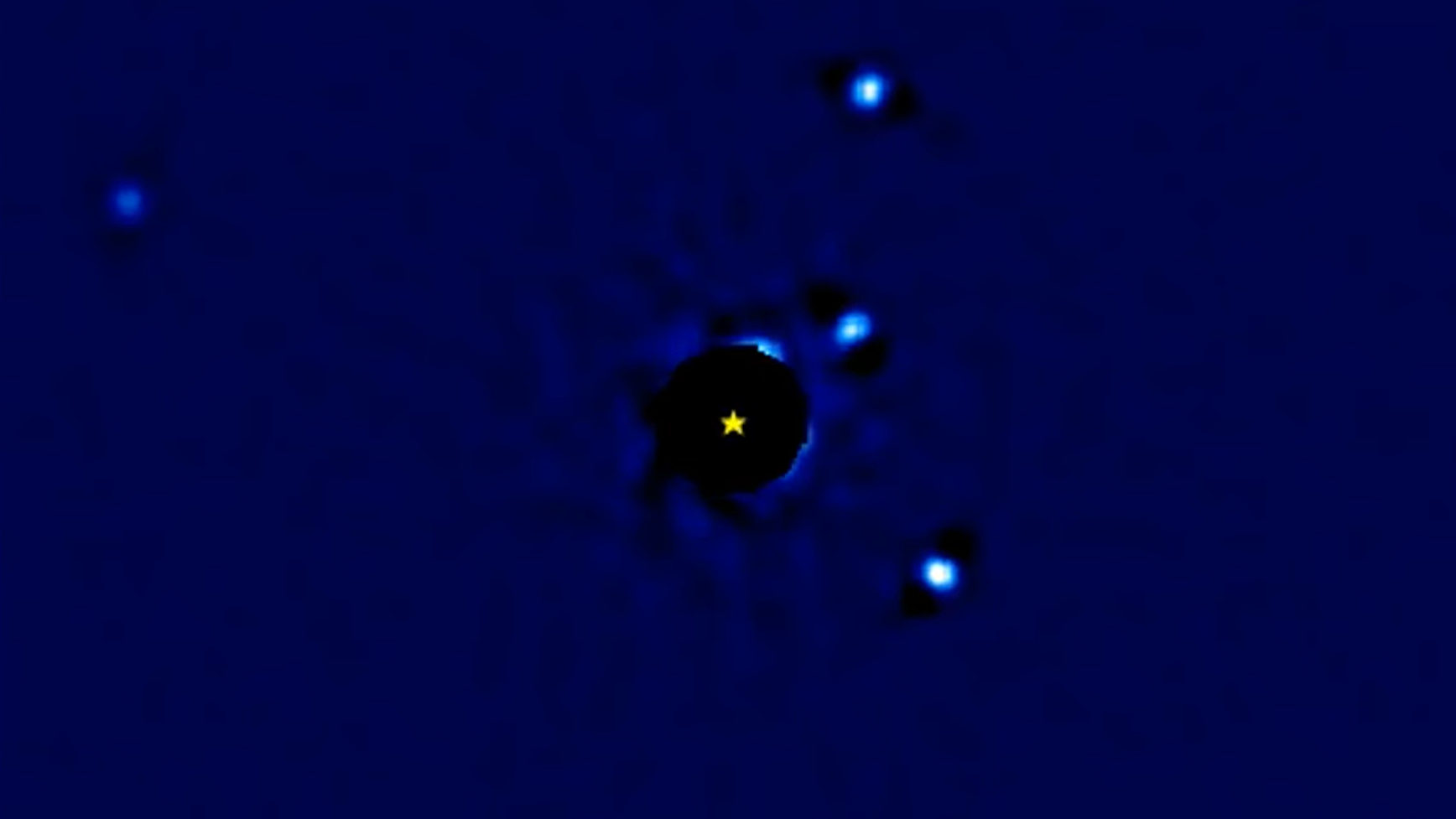
A group of researchers claims to have found what may be the first exoplanet ever discovered in a different galaxy.


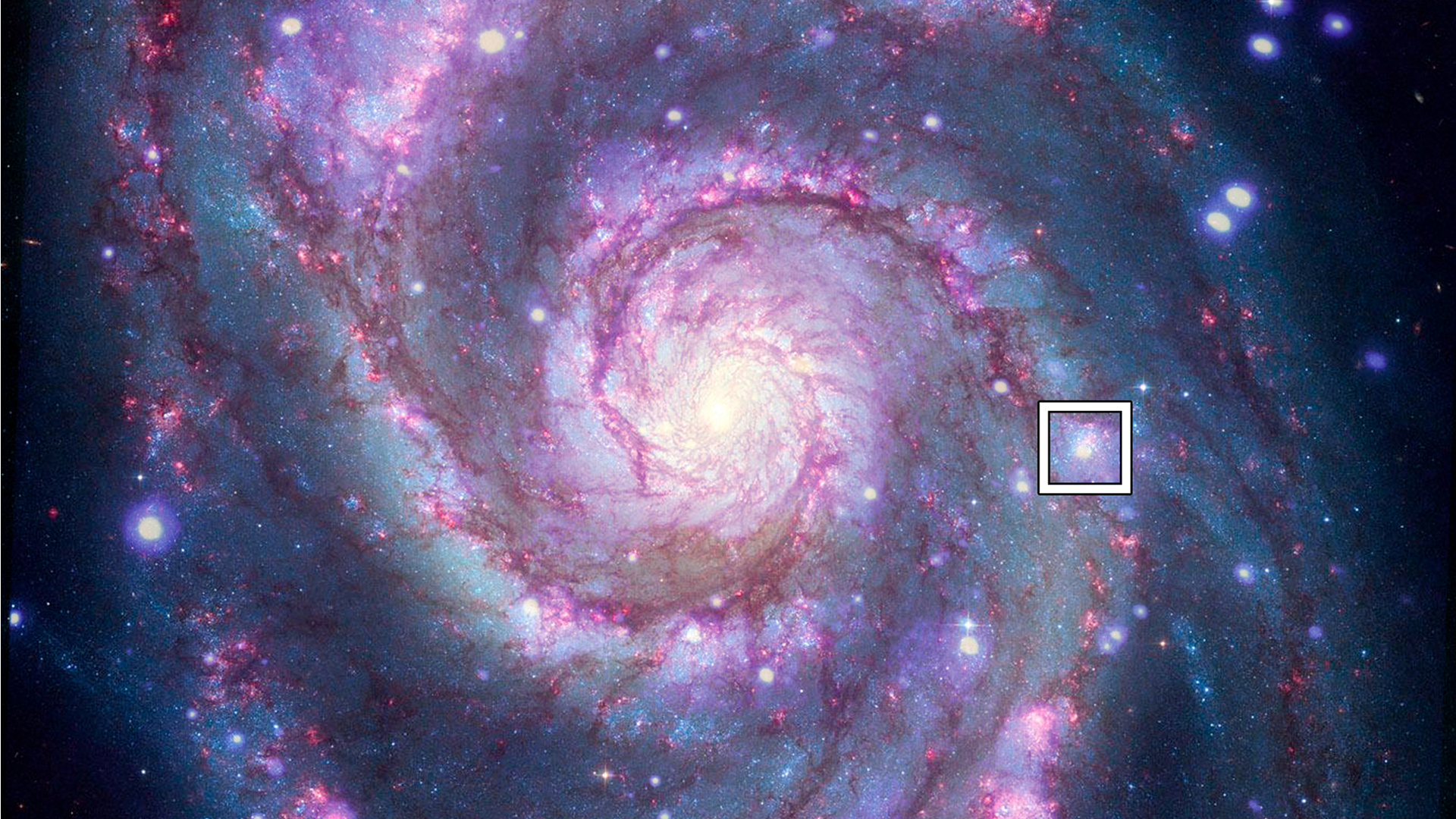
Although our galaxy may have billions of exoplanets, it is much more difficult to discover new planets even in the nearby galaxies. Now, according to a story in New Scientist, a team of Harvard-Smithsonian scientists may have finally overcome that limit thanks to evidence that a planet-sized object is orbiting a binary system in the Whirlpool galaxy.


Over the years, a few scientists found signs of exoplanets in other galaxies, but none have ever been confirmed. The same is true for this potential exoplanet, according to preprint research shared online last week. But still, scientists are cautiously optimistic.


“It’s exciting, but not unexpected,” Angelle Tanner, a Mississippi State University astronomer who didn’t work on the study, told New Scientist. “There’s absolutely no reason to think there wouldn’t be planets in other galaxies.”


Unfortunately, any confirmation could be entire decades away, New Scientist reports. The team found evidence that an object the size of Saturn — potentially a gas giant itself — passed in front of one of the stars in its binary system. But because it’s also orbiting at about the same distance as Saturn does our Sun, it might be decades before it does so again, at which point scientists could confirm the discovery.


“It could be something that just passed in front of this system, never returning again,” Tanner said.


READ MORE: Astronomers may have found the first planet in another galaxy [New Scientist]