Showing posts with label Earth-Like-Planets. Show all posts

Scientists Spot a Solar System With 3 Super-Earths in a Rare Find


Astronomers have identified a star system with three Super-Earths and two Super-Mercuries, a form of planet that is exceptionally rare and unique. In fact, super-Mercuries are so uncommon that only eight have been discovered to date.


ESPRESSO’s spectrograph detected two ‘super-Mercury’ worlds in the star system HD 23472. Astronomers have discovered that these planets are extremely rare. This study, published in Astronomy & Astrophysics, looked at how the composition of tiny planets varies with planet position, temperature, and star attributes.


The reason for observing this planetary system, according to Susana Barros, a researcher at the Institute of Astrophysics e Ciências do Espaço (IA) who led the project, is to characterise the composition of small planets and to study the transition between having an atmosphere and not having an atmosphere.


The evaporation of the atmosphere could be related to star irradiation. “Surprisingly, the team found that this system is composed of three super-Earths with a significant atmosphere and two Super-Mercuries, which are the closest planets to the star,” the researcher revealed.


HD 23472 has five exoplanets, three of which have masses less than that of the Earth. The five planets were discovered to be among the lightest exoplanets ever detected using the radial velocity approach. This approach can detect minor fluctuations in a star’s velocity produced by orbiting planets.


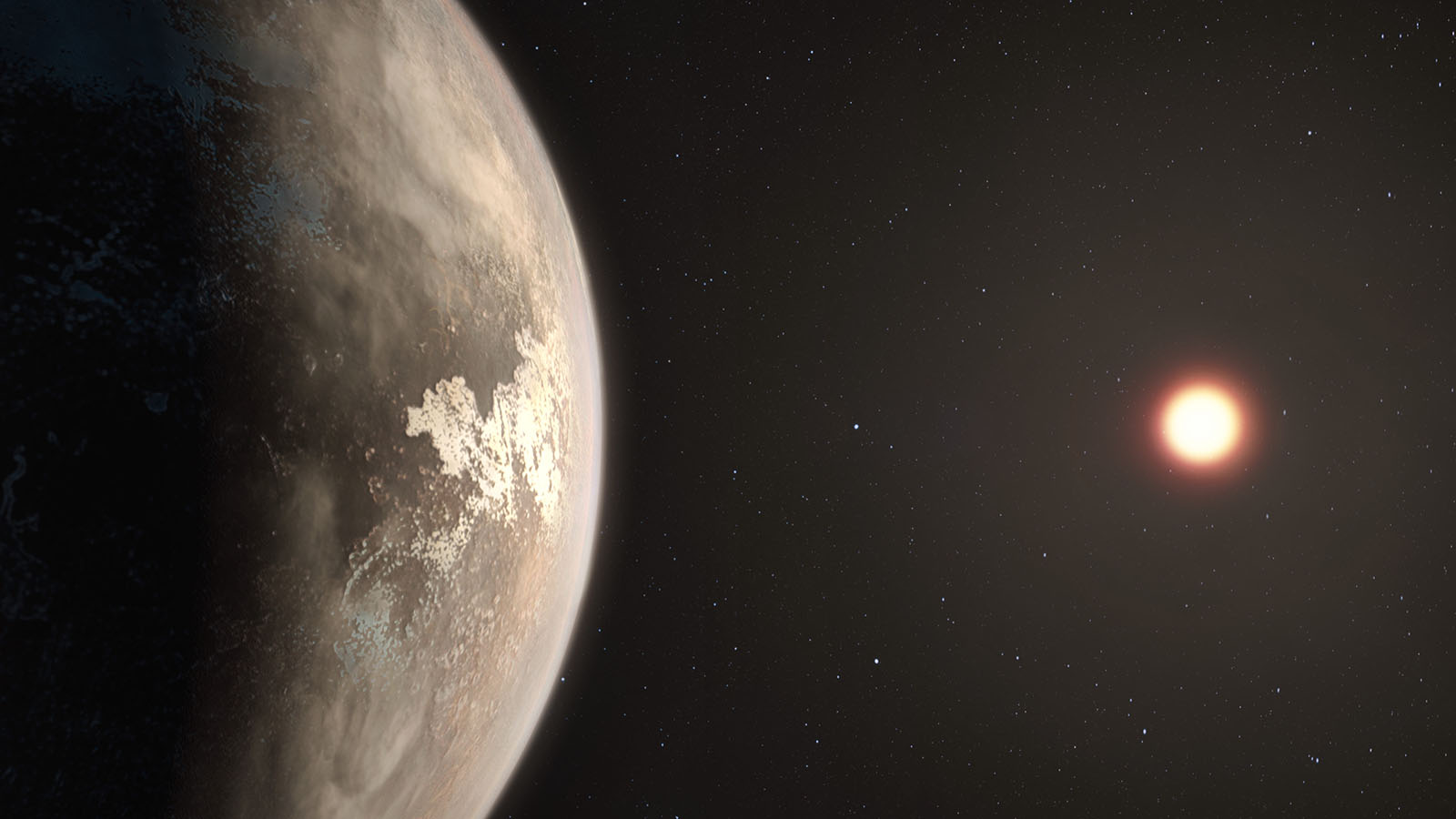
An artist’s depiction of a super-Earth exoplanet. (Image credit: NASA/Ames/JPL-Caltech)


The high accuracy that permitted the finding was provided by ESPRESSO, a spectrograph situated on the VLT at the European Southern Observatory (ESO) in Chile. Super-Earths and super-Mercuries are the higher mass analogues to Earth and Mercury in terms of composition. The key distinction between them is that super-Mercuries contain more iron. This form of exoplanet is extremely rare.


In fact, only eight are known, including the two that were recently discovered. We don’t know why Mercury has a larger and more massive core than Earth and the other planets in our Solar System, while being one of the densest planets.


Mercury’s mantle could have been lost by a massive impact, or because Mercury is the hottest planet in the solar system, its high temperatures could have melted some of its mantle. To comprehend the development of such objects, it is necessary to locate other dense, Mercury-like planets orbiting other stars.


It’s worth noting that the discovery of two super-Mercuries in the same planetary system, rather than just one, paints a clear picture for scientists. “We identified a system with two super-Mercuries for the first time utilising the ESPRESSO spectrograph.” This helps us understand how these planets developed,” says Alejandro Suárez, an IAC researcher and co-author of this work.


(Image credit: NASA/Ames/JPL-Caltech)


“The idea of a massive impact creating a Super-Mercury is already extremely implausible; two giant impacts in the same system appears extremely unlikely.” According to co-author and IAC researcher Jonay González, additional characterization of the planet’s composition would be required to comprehend how these two super-Mercuries evolved.


For the first time, scientists will be able to examine the surface composition or the existence of a hypothetical atmosphere using the Extremely Large Telescope (ELT) and its first-generation high-resolution spectrograph ANDES. Finally, the team’s ultimate goal is to discover another planet like Earth.


Scientists can better comprehend the origin and evolution of planetary systems because of the presence of an atmosphere. It can also determine whether a planet is habitable. “We would like to continue this type of investigation to longer period planets with more suitable temperatures,” Barros says.

There are 6 Billion Earth-Like Planets in the Milky Way Galaxy Alone, Astronomers Suggest

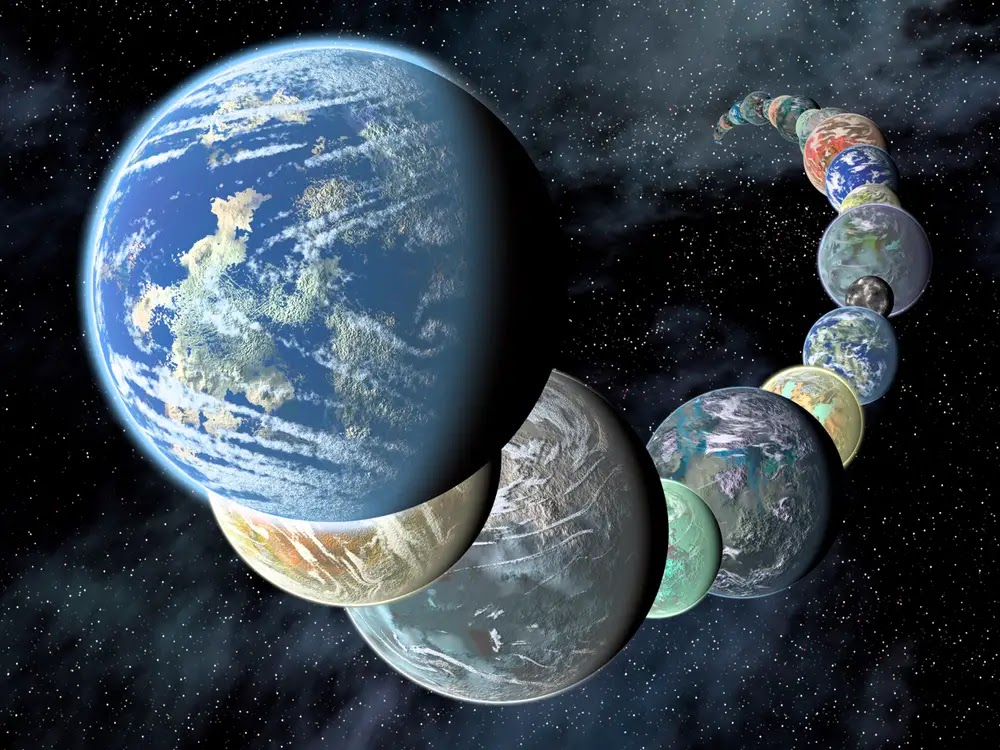
Maybe you think one Earth is enough. But what if there were billions? Researchers make a new estimate that the number of Earth-like planets in our Milky Way galaxy can reach as high as 6 billion.

Astronomers at the University of British Columbia (UBC) analyzed data from NASA’s Kepler mission to reach a stunning conclusion. The information on 200,000 stars was gathered by the Kepler planet-hunting spacecraft from 2009 to 2018.

The criteria used by the scientists for selecting such a planet maintained it had to be rocky, about the same size as Earth, and orbiting a star like our Sun. This planet also had to be in the habitable zone of its star, where the conditions would be just right to potentially allow for water and life.

UBC researcher Michelle Kunimoto, who co-authored the new study, and previously discovered 17 new planets (“exoplanets”) outside our Solar System, said their calculations “place an upper limit of 0.18 Earth-like planets per G-type star.” In other words, that’s about 5 planets per Sun.

The study’s co-author UBC astronomer Jaymie Matthews put this from another perspective, explaining that “Our Milky Way has as many as 400 billion stars, with seven percent of them being G-type. That means less than six billion stars may have Earth-like planets in our Galaxy.”

Bottom of Form

To conduct the study, Kunimoto utilized a technique known as ‘forward modeling,’ which allowed her to overcome the issue that Earth-like planets are hard to spot on account of being small and orbiting far from their star.

“I started by simulating the full population of exoplanets around the stars Kepler searched,” expounded the researcher in UBC’s press release. “I marked each planet as ‘detected’ or ‘missed’ depending on how likely it was my planet search algorithm would have found them. Then, I compared the detected planets to my actual catalogue of planets. If the simulation produced a close match, then the initial population was likely a good representation of the actual population of planets orbiting those stars.”

While the scientists came up with an impressive number of possible Earths, this likely doesn’t mean that’s how many such planets there are and if they would have a life like ours. But this new estimate definitely expands the possibility that similar planets are out there.

Check out the new study in The Astronomical Journal.

Scientists Spot a Solar System With 3 Super-Earths in a Rare Find


Astronomers have identified a star system with three Super-Earths and two Super-Mercuries, a form of planet that is exceptionally rare and unique. In fact, super-Mercuries are so uncommon that only eight have been discovered to date.


ESPRESSO’s spectrograph detected two ‘super-Mercury’ worlds in the star system HD 23472. Astronomers have discovered that these planets are extremely rare. This study, published in Astronomy & Astrophysics, looked at how the composition of tiny planets varies with planet position, temperature, and star attributes.


The reason for observing this planetary system, according to Susana Barros, a researcher at the Institute of Astrophysics e Ciências do Espaço (IA) who led the project, is to characterise the composition of small planets and to study the transition between having an atmosphere and not having an atmosphere.


The evaporation of the atmosphere could be related to star irradiation. “Surprisingly, the team found that this system is composed of three super-Earths with a significant atmosphere and two Super-Mercuries, which are the closest planets to the star,” the researcher revealed.


HD 23472 has five exoplanets, three of which have masses less than that of the Earth. The five planets were discovered to be among the lightest exoplanets ever detected using the radial velocity approach. This approach can detect minor fluctuations in a star’s velocity produced by orbiting planets.


An artist’s depiction of a super-Earth exoplanet. (Image credit: NASA/Ames/JPL-Caltech)


The high accuracy that permitted the finding was provided by ESPRESSO, a spectrograph situated on the VLT at the European Southern Observatory (ESO) in Chile. Super-Earths and super-Mercuries are the higher mass analogues to Earth and Mercury in terms of composition. The key distinction between them is that super-Mercuries contain more iron. This form of exoplanet is extremely rare.


In fact, only eight are known, including the two that were recently discovered. We don’t know why Mercury has a larger and more massive core than Earth and the other planets in our Solar System, while being one of the densest planets.


Mercury’s mantle could have been lost by a massive impact, or because Mercury is the hottest planet in the solar system, its high temperatures could have melted some of its mantle. To comprehend the development of such objects, it is necessary to locate other dense, Mercury-like planets orbiting other stars.


It’s worth noting that the discovery of two super-Mercuries in the same planetary system, rather than just one, paints a clear picture for scientists. “We identified a system with two super-Mercuries for the first time utilising the ESPRESSO spectrograph.” This helps us understand how these planets developed,” says Alejandro Suárez, an IAC researcher and co-author of this work.


(Image credit: NASA/Ames/JPL-Caltech)


“The idea of a massive impact creating a Super-Mercury is already extremely implausible; two giant impacts in the same system appears extremely unlikely.” According to co-author and IAC researcher Jonay González, additional characterization of the planet’s composition would be required to comprehend how these two super-Mercuries evolved.


For the first time, scientists will be able to examine the surface composition or the existence of a hypothetical atmosphere using the Extremely Large Telescope (ELT) and its first-generation high-resolution spectrograph ANDES. Finally, the team’s ultimate goal is to discover another planet like Earth.


Scientists can better comprehend the origin and evolution of planetary systems because of the presence of an atmosphere. It can also determine whether a planet is habitable. “We would like to continue this type of investigation to longer period planets with more suitable temperatures,” Barros says.

NASA Just Discovered a Rare Earth-Sized Planet in a Habitable Zone

When it comes to finding life outside of our Solar System, planets that closely resemble Earth seem like a good place to start. We can now welcome celestial object TOI 700 e to that group of promising leads.


TOI 700 e has been confirmed orbiting inside the habitable zone of its star, TOI 700. That's the region of space where significant quantities of water on its surface would be at a temperature suitable for a liquid form. Too warm for a blanket of ice, yet still cool enough for vapor to condense, these kinds of planets are considered 'just right' for life as we know it.


We can thank NASA's Transiting Exoplanet Survey Satellite, or TESS, for finding TOI 700 e, and for giving it its name (TOI means TESS Object of Interest). It's the second planet in the habitable zone in this system, joining TOI 700 d that was spotted in 2020.


Illustration showing TOI 700 e in the foreground and TOI 700 d off in the distance. (NASA/JPL-Caltech/Robert Hurt)


"This is one of only a few systems with multiple, small, habitable-zone planets that we know of," says planetary scientist Emily Gilbert, from the NASA Jet Propulsion Laboratory (JPL) in California.

"That makes the TOI 700 system an exciting prospect for additional follow up. Planet e is about 10 percent smaller than planet d, so the system also shows how additional TESS observations help us find smaller and smaller worlds."


TOI 700 is a small, cool star (known as an M dwarf star), located around 100 light-years away from us in the Dorado constellation. These stars are nowhere near as big or as hot as our own Sun, so planets need to be closer to them for conditions to be warm enough for water to avoid freezing.


As for TOI 700 e, it's believed to be 95 percent the size of Earth and mainly rocky. It sits in the 'optimistic' habitable zone – a zone where water may have existed at some point in time. TOI 700 d is in the narrower 'conservative' habitable zone, which is where astronomers think liquid water might exist for the majority of a planet's existence.


Telescopes see these exoplanets (planets outside our Solar System) as regular blips in the light of their parent stars as they pass in front of it, in what's known as a transit. With more surface blocking the star's light, larger planets present easier opportunities to be seen than small, rocky worlds, making Earth-like discoveries like this one a rare treat.


TOI 700 e takes 28 days to do a single orbit, whereas TOI 700 d – which is a little further out than its neighbor – takes 37 days. As TOI 700 e is smaller than TOI 700 d, it took more data to confirm the silhouette really did represent a new planet.


"If the star was a little closer or the planet a little bigger, we might have been able to spot TOI 700 e in the first year of TESS data," says astrophysicist Ben Hord from the University of Maryland. "But the signal was so faint that we needed the additional year of transit observations to identify it."


TESS is monitoring around 100 million stars, and so any way we can find to narrow down the search for life is going to be useful. Finding exoplanets in their respective habitable zones is one of the best ways we've got of doing that.


Both TOI 700 e and TOI 700 d are thought to be tidally locked: in other words, one side of the planet is always facing its star (in the same way that the same side of the Moon is always visible from Earth). Having one side of a planet constantly baking in the sunlight does reduce the likelihood of complex life getting off to a smooth start, admittedly.


Even if these 'just right' planets aren't exactly perfect for life, they do tell us a thing or two about finding solar systems that might be better suited for it. By studying star systems like the one we're in, astronomers can also better understand the evolution of our home and how neighboring planets came to their current orbits.


"Even with more than 5,000 exoplanets discovered to date, TOI 700 e is a key example that we have a lot more to learn," says astronomer Joey Rodriguez from Michigan State University.


The research has been accepted for publication in the Astrophysical Journal Letters, and is currently available to view on arXiv.

New Estimates Suggest There Are Around 300 Million Habitable Planets in Our Galaxy

In the Milky Way galaxy alone, there are over 300 million potentially habitable exoplanets. This indicates that 300 million planets are likely to have the necessary conditions for life—and sophisticated life—to evolve on their surfaces. Are we the only ones in the universe?

How vast is the universe in which we live? Given our existing technology and measurement of the universe, we are unable to acquire this answer. We can make educated guesses, but we are still a long way from investigating the universe.

We can get a better idea of the size of our galaxy. Overall, it's a vast location packed with planets. But how many of these worlds are like Earth, and how many of them are habitable? This is another difficult solution to obtain, but we can do the math based on observations over the years.

According to new research based on data from the Kepler space observatory, there could be up to 300 million potentially habitable planets in our galaxy. The nice news about the new estimations is that they could be very close to Earth; none of these possibly habitable exoplanets are more than 30 light-years away.

Researchers from NASA, the SETI Institute, and other institutions from around the world collaborated in one large project to help us better comprehend the galaxy we live in.

While 300 million planets may appear to be a large number, it is far from the total number of planets thought to exist in our galaxy. According to our best calculations, the Milky Way has at least one planet for every star, implying that the galaxy we dwell in could have anywhere from 100 billion to 400 billion planets.

The visible universe

The observable universe, on the other hand, has at least 125 billion galaxies.

According to co-author Jeff Coughlin, a SETI Institute scientist who studies exoplanets, "this is the first time that all of the components have been put together to produce a solid count of the number of potentially habitable planets in the galaxy."

The best aspect is that once we know how many habitable exoplanets there are in the galaxy, we can reconsider the Drake Equation.

“This is a key term of the Drake Equation, used to estimate the number of communicable civilizations — we’re one step closer on the long road to finding out if we’re alone in the cosmos,” the researcher revealed.

The Drake Equation assesses the likelihood of how many possibly advanced alien civilizations exist in our galaxy and how many of them we can contact from Earth.

Estimate Revised

Researchers looked for worlds similar to Earth in their revised estimate of possible habitable planets in our galaxy. They also took into account planets that are most likely stony in nature.

Scientists then looked for Sun-like stars in the universe, seeking for stars that are around the same age and temperature as our sun.

Another crucial element to evaluate is whether exoplanets match the conditions for liquid water to exist on their surfaces, as this has a significant impact on the habitability of faraway worlds. All of this was taken into account in the latest study, which varies from prior studies that merely looked for potentially habitable planets in the galaxy, relying mainly on the planet's distance from the star to make their estimates.

The new study takes into account a few extra factors, such as how much light from the star strikes the planet; this is an essential component in evaluating the likelihood of liquid water on the planet's surface.

Researchers examined data obtained by the Kepler Space Telescope as well as data collected by the European Space Agency's Gaia Mission.

The Kepler space telescope, which stopped searching for exoplanets in 2018, discovered over 2,800 exoplanets throughout the cosmos. Many of these worlds are still awaiting confirmation, which might increase the number of planets identified in the cosmos to date.

There are 4,935 confirmed exoplanets, 8709 NASA exoplanet candidates, and 3,706 solar systems as of March 3, 2022. More information is available here.

SETI's news release can be found here.

Reference(s): The Astronomical Journal

2 alien water worlds with oceans 500 times deeper than Earth’s

Astronomers said in December 2022 that they’ve identified the first true water worlds, unlike any in our solar system. 

These exoplanets are both slightly larger than Earth. Yet their density lies between that of a rocky world like ours, and our solar system’s gas-giant outer planets. These astronomers believe these worlds must have global oceans at least 500 times deeper than the average depth of Earth’s oceans, which, by contrast, they called simply a wet veneer on a rocky ball.

This artist’s illustration shows Kepler-138 d in the foreground, Kepler-138 c and Kepler 138 b, seen in silhouette transiting its star. Kepler-138 c and Kepler-138 d are water worlds a little larger than Earth. 

But their global oceans are much deeper than Earth’s and warmer, with a hot, steamy water vapor atmosphere above them. Image via NASA/ ESA/ Leah Hustak (STScI)/ Hubblesite.

The two worlds orbit a red dwarf star called Kepler-138, which is 218 light-years away in the direction of our constellation Lyra the Harp. Scientists have theorized that global water worlds like these exist. They’ve had some tantalizing hints before now. 

But these are the first specific worlds for which there is now good evidence. The astronomers made the discovery using data from the Hubble and Spitzer space telescopes.

Caroline Piaulet of the Trottier Institute for Research on Exoplanets (iREx) at the University of Montreal, Canada, led the team effort. The researchers published their peer-reviewed findings in Nature Astronomy on December 15, 2022. A free preprint version of the paper is also available on arXiv.

Water worlds with deep, global oceans

We think of Earth, of course, as a water world, with its surface mostly covered by oceans. But these two new exoplanets – Kepler-138 c and Kepler-138 d – appear to have oceans at least 1,000 miles (1,600 km) deep. That’s about 500 times deeper than the average depth of Earth’s oceans.

The ocean moons in our own solar system, such as Europa, Enceladus and others, would be the closest analogy. But both of those are much smaller moons, not planets, with a crust of ice over their oceans. These new planets are kind of like much larger and warmer versions of the ocean moons. As Piaulet said:

Imagine larger versions of Europa or Enceladus, the water-rich moons orbiting Jupiter and Saturn, but brought much closer to their star. Instead of an icy surface, they would harbor large water-vapor envelopes.

Weird densities provide clues

So, how did the astronomers discover these water worlds? The Hubble and now-retired Spitzer space telescopes provided the data. When the researchers studied the data, they found something unusual. Both planets are just a little larger than Earth. But they aren’t nearly as dense as Earth or other known rocky planets. They are, however, still denser than the gas or ice giants in the outer solar system. How could that be?


Co-author Björn Benneke at the University of Montreal said:

We previously thought that planets that were a bit larger than Earth were big balls of metal and rock, like scaled-up versions of Earth, and that’s why we called them super-Earths. However, we have now shown that these two planets, Kepler-138 c and d, are quite different in nature and that a big fraction of their entire volume is likely composed of water. It is the best evidence yet for water worlds, a type of planet that was theorized by astronomers to exist for a long time.


Water worlds, but not like Earth


While the oceans are composed of water, as on Earth, the researchers believe them to be quite unlike our own oceans. The evidence suggests that they are significantly warmer and under very high pressure. There may not even be a sharp boundary between the top of the oceans and the atmospheres of the planets. For example, Kepler-138 d’s atmosphere is hot and probably composed of steam. Piaulet said:


The temperature in Kepler-138 d’s atmosphere is likely above the boiling point of water, and we expect a thick dense atmosphere made of steam on this planet. Only under that steam atmosphere there could potentially be liquid water at high pressure, or even water in another phase that occurs at high pressures, called a supercritical fluid.


Both planets also orbit close to their star, and are not in the habitable zone where temperatures on rocky planets could allow liquid water to exist. This means liquid water in the ways we are used to seeing it, in lakes or more Earth-like oceans. But because these two planets are much closer to their star, their atmospheres are overheated and steamy, with liquid water deeper down at high pressure.

Comparison of the interior structures of Earth and Kepler-138 d. Image via Benoit Gougeon. (University of Montreal)/ Hubblesite.


2 other planets in the Kepler-138 system


The Kepler-138 system also contains two additional planets.


Kepler-138 b is also rocky and even smaller, close to the size of Mars, with a mass calculated to be 0.07 times that of Earth. Kepler-138 e, on the other hand, is the farthest from the star. It is just inside the inner edge of the habitable zone, and orbits its star in 38 days. Astronomers aren’t sure yet exactly how large it is, but the study suggests it is larger than Kepler-138 b, with a mass 0.43 times that of Earth. Unlike the first three planets, however, its orbit doesn’t transit in front of its star, making it harder to study. The paper says:


The transits of Kepler-138 b, c and d are detected in the Kepler light curve, but while Kepler-138 e should be larger than Kepler-138 b, its transit is not detected. We interpret this as originating from a likely non-transiting configuration of Kepler-138 e’s orbit.


Overall, the findings show that not all super-Earths are rocky. Some, like Kepler-138 c and d, can be largely water. And astronomers expect to find more of them, as Benneke noted:


As our instruments and techniques become sensitive enough to find and study planets that are farther from their stars, we might start finding a lot more of these water worlds.


Bottom line: An international team of astronomers says that two exoplanets 218 light-years away are true water worlds, with global oceans 500 times deeper than Earth’s oceans.


Source: Evidence for the volatile-rich composition of a 1.5-Earth-radius planet


Source (preprint): Evidence for the volatile-rich composition of a 1.5-R? planet


Via Hubblesite

Scientists Discover NEW Earth-Like Planet Within Habitable Zone Orbiting Proxima Centauri

Astronomers have discovered evidence for a new planet orbiting Proxima Centauri, the sun's nearest neighbour.

The alien planet is only one-tenth the size of Earth and orbits its parent star at one-tenth the distance between the sun and Mercury, the solar system's innermost planet.

Researchers discovered the new planet by examining minor wobbles in Proxima Centauri's velocity caused by the gravitational pull it exerts as it swings around the star. Observations with the European Southern Observatory's Very Large Telescope (VLT) in Chile indicate that the planet orbits the star once every five days.

The discovery demonstrates that our nearest stellar neighbour is "filled with exciting new worlds" that can be studied further and explored in the future, according to Joo Faria, a researcher at the Institute of Astrophysics and Space Sciences in Portugal and the study's primary author.

Scientists believe the planet orbits Proxima Centauri around 2.4 million miles (4 million kilometres), putting it closer to the star than its habitable zone, where the temperature range is just right for water to run freely. The findings have been published in the journal Astronomy & Astrophysics.

Named Proxima d, the planet is the third – and the lightest – to be spotted around Proxima Centauri, which at four light years away is the closest star to the solar system. It joins Proxima b, a planet with a mass comparable to that of Earth, which completes an orbit every 11 days, and Proxima c, which is believed to take about five years to circle the star.

The first hints of the planet came in 2020 when astronomers were observing Proxima Centauri to confirm the existence of Proxima b. The measurements revealed a weak signal in the star’s motion that had the hallmarks of being caused by a planet orbiting every five days.

Further observations taken with an instrument on ESO’s telescope called Espresso confirmed astronomers’ suspicions that a planet was the cause and not changes in the star itself.

“This is a very low mass planet, and is the third candidate around the star closest to us,” Faria said. “It shows that these planets, similar to the Earth, may be common in our galaxy, and just close by. And it makes us wonder about the possible conditions for habitability in these planet systems and if it’s possible for life to appear in other places in the universe.”

Reference(s): Astronomy & Astrophysics

Exoplanet KOI-3010.01 is considered habitable with a probability of 84% - Highest EVER

The Kepler mission discovered a planet orbiting the star KOI-3010 using the transit method. Researchers are drawn to this world because it has traits that are similar to those found on Earth.

The red dwarf KOI-3010 is located in the constellation Lyra and is 1213 light-years away from us. This is an ancient star, with a possible age of 13.9 billion years. The planet KOI-3010.01 (or KOI-3010 b) is classified as a warm super earth (it is more than Earth on a mass, but it is much inferior to gas giants). One orbit around the star lasts around 60 Earth days.

Diagram showing Kepler’s discoveries with radii less than twice that of the Earth as a function of mean stellar flux and the temperature of the star they orbit. The green band shows the approximate limits of the habitable zone while the size of the planets is proportional to their measured radii. Click on image to enlarge. (NASA Ames/N. Batalha and W. Stenzel)

The genesis and development of life on the planet are influenced by environmental factors. Its average temperature is 19.6 degrees Celsius. The radius is 1.35 times that of the Earth. They know very little about the atmosphere's makeup, yet it exists (there is an assumption that it is almost identical to the earth). The mass index has yet to be determined. 

The researchers believe that the exoplanet KOI-3010.01 will have not just a temperate climate like Earth, but also a liquid ocean spanning approximately 65% of its surface.

It is thought that the chemical composition of exoplanets nearly totally converges with that of the Earth. It is worth noting that it is in the habitable zone, and its index of similarity to Earth is 0.84. (maximum - 1). As a result, researchers believe she has a good probability of having a life.

BREAKING: Astronomers Have Found an Earth-Like Planet Practically Next-Door to Us

Astronomers have discovered a new exoplanet that is slightly larger than Earth and orbits a red dwarf star 66.5 light-years away. 

It's a good prospect, scientists think, to help cover our massive information vacuum regarding our Milky Way galaxy's small, rocky planet population.

Since the initial discovery of an exoplanet in 1992, our detection capabilities and understanding of exoplanets has almost exploded. Over 4,100 exoplanets have been confirmed in our galaxy as of this writing, and we now have a far better knowledge of planetary systems and how they develop and evolve.

However, because we're seeking for small, dim, or dark objects that are difficult to view from afar, the vast majority of verified exoplanets are chonkers - ice and gas giants the size of Neptune and larger.

The Kepler and TESS exoplanet-hunting missions have increased the number of detections of smaller exoplanets: those with masses similar to Earth and Venus, and so likely to be rocky rather than gaseous. (This is one of the requirements for life as we know it.) 

However, these rocky planets are difficult to measure and define, according to an international team led by astronomer Avi Shporer of MIT's Kavli Institute for Astrophysics and Space Research.

This is because we don't typically find them near stars bright enough to allow for comprehensive follow-up examinations.

That’s why the discovery of this new exoplanet is so cool. The team’s paper has been uploaded to arXiv, and is yet to be peer reviewed, but their results are tantalization, to say the least.“Here we present the discovery of GJ 1252 b, a small planet orbiting an M dwarf. The planet was initially discovered as a transiting planet candidate using TESS data,” the researchers write.

“Based on the TESS data and additional follow-up data we are able to reject all false positive scenarios, showing it is a real planet.”

GJ 1252 b is roughly 1.2 times the size of Earth and roughly twice the mass of Earth (so a bit denser than our home planet). It's orbiting a red dwarf star called GJ 1252, which is around 40% the size and mass of the Sun.

The exoplanet orbits its star once every 12.4 hours, which is far too near for habitability and likely tidally locked, with one side always facing the star, but that tight orbit makes it appealing for another reason.

The system is only 66.5 light-years distant, which is close enough for the star to be brilliant enough for the follow-up observations we specified. Furthermore, the red dwarf is exceptionally tranquil for a star of its type, and the planet's frequent orbit means there are plenty of possibilities to see it travelling in front of its host.

This is referred to as a transit, and if the planet has an atmosphere, it will be back-lit by the star's light during transits, potentially allowing astronomers to view what's within it through spectroscopic investigations.

And here's another amazing fact: GJ 1252 b is simply the most recent of several nearby rocky worlds discovered by TESS.

Pi Mensae c and LHS 3844 b were announced in September of last year, respectively; TOI-270b is 73 light-years distant; Teegarden b and Teegarden c are 12.5 light-years away; and Gliese b, Gliese c, and Gliese d are 12 light-years away.

The more of these nearby rocky planets we discover, the more data we can collect on them to determine how common they are and what they are like - whether Earth is a total anomaly, and most rocky planets are barren wastelands like Mercury, Venus, and Mars, or whether they are a more common type of planet in the Milky Way.

Of course, this has ramifications for the quest for extraterrestrial life. But first, more rocky exoplanets must be discovered. GJ 1252 b could be a good place to start. "The proximity and brightness of the host star, as well as the short orbital period, make this star-planet system an appealing candidate for comprehensive characterization," the researchers stated in their report.

"These research involve examining the planet's atmosphere and looking for any currently unknown star, brown dwarf, or giant planet orbiting the host star using future Gaia astrometric data combined with long term radial velocity monitoring."

The study has been submitted to the American Astronomical Society and may be found on arXiv.

You can find more info related to this Earth-Like-Planet here on NASA's official site.

There are 6 Billion Earth-Like Planets in the Milky Way Galaxy Alone, Astronomers Suggest

Perhaps you believe that one Earth is sufficient. But what if the number was in the billions? 

According to new research, the number of Earth-like planets in our Milky Way galaxy could approach 6 billion.

Astronomers at the University of British Columbia (UBC) examined data from NASA's Kepler project and came to a startling conclusion. From 2009 to 2018, the Kepler planet-hunting satellite collected data on 200,000 stars.


The scientists' criterion for picking such a planet included that it had to be rocky, around the same size as Earth, and orbiting a star like our Sun. This planet had to be in the habitable zone of its star, where the conditions would be ideal for the presence of water and life.

Michelle Kunimoto, a UBC researcher who previously identified 17 new planets ("exoplanets") outside our Solar System, stated that their calculations "set an upper limit of 0.18 Earth-like planets per G-type star." In other words, there are approximately 5 planets for every Sun.


Kunimoto used a technique known as 'forward modelling' to undertake the study, which allowed her to overcome the problem that Earth-like planets are difficult to detect due to their tiny size and orbital distance from their star.


“I started by simulating the full population of exoplanets around the stars Kepler searched,” expounded the researcher in UBC’s press release. “I marked each planet as ‘detected’ or ‘missed’ depending on how likely it was my planet search algorithm would have found them. Then, I compared the detected planets to my actual catalogue of planets. If the simulation produced a close match, then the initial population was likely a good representation of the actual population of planets orbiting those stars.” 


While the scientists came up with an astounding number of hypothetical Earths, this does not necessarily imply the number of such planets exists or whether they have life similar to ours. However, this new estimate increases the likelihood that comparable worlds exist. 


Updated version of the previous article.


Check out the latest research in The Astronomical Journal.

Astronomers Find A Potential ‘Major Planet’ Orbiting A Dead Star That Can Support Life For At Least 1 Billion Years Into The Future

It turns out that the existence of life on planets orbiting stars like our sun does not require those stars to be vibrant and powerful. 

A potential "major planet" that orbits a dying sun and could support life in the future has been found by scientists.

The “surprising” discovery was made by researchers from University College London while watching a white dwarf, the burning remnants of a star that ran out of hydrogen fuel. It is about 117 light-years away from us. This star, known as WD1054-226, has a ring of planetary rubble in its orbital habitable zone, also known as the Goldilocks zone, where temperatures should enable the planet to have liquid water on its surface.


If the newfound planet is proved to be a life-sustaining world, it will be the first time a life-sustaining planet has been identified around a dying sun.


Scientists made the discovery while monitoring the light from the white dwarf and reported their results in the Royal Astronomical Society’s Monthly Notices. They discovered strong dips in light that matched to 65 uniformly distributed clouds of debris that orbited WD1054-226 every 25 hours, according to their findings.


Jay Farihi, the lead author of the study and professor at UCL Physics and Astronomy, said: “The moon-sized structures we have observed are irregular and dusty (e.g. comet-like) rather than solid, spherical bodies”


He described the structures as a “mystery we cannot explain,” but suggested one possible and “unexpected” explanation: a nearby planet.


He said: “”An exciting possibility is that these bodies are kept in such an evenly-spaced orbital pattern because of the gravitational influence of a nearby planet. Without this influence, friction and collisions would cause the structures to disperse, losing the precise regularity that is observed. A precedent for this ‘shepherding’ is the way the gravitational pull of moons around Neptune and Saturn help to create stable ring structures orbiting these planets. We were not looking for this.”


The idea of a “major planet” in the star’s habitable zone is thrilling, but he emphasises that such a planet has yet to be proven. Farihi stated that his team still requires further proof, which may be tough to get due to the inability to directly view the planet. To gain a clearer explanation, they may have to depend on computer models along with additional observations of the star and its circling debris.


The team anticipates that, if a planet exists, it was just recently formed — and that it would be habitable for at least 2 billion years, including at least 1 billion years in the future.


Their finding may also aid scientists in developing a better knowledge of our solar system, as more than 95% of all stars, including our sun, will ultimately become white dwarfs.


Updated version of the previous article.


Reference(): Royal Astronomical Society’s Monthly Notices

There are 6 Billion Earth-Like Planets in the Milky Way Galaxy Alone, Astronomers Suggest

Perhaps you believe that one Earth is sufficient. But what if the number was in the billions? According to new research, the number of Earth-like planets in our Milky Way galaxy could approach 6 billion.


Astronomers at the University of British Columbia (UBC) examined data from NASA's Kepler project and came to a startling conclusion. From 2009 to 2018, the Kepler planet-hunting satellite collected data on 200,000 stars.

The scientists' criterion for picking such a planet included that it had to be rocky, around the same size as Earth, and orbiting a star like our Sun. This planet had to be in the habitable zone of its star, where the conditions would be ideal for the presence of water and life.

Michelle Kunimoto, a UBC researcher who previously identified 17 new planets ("exoplanets") outside our Solar System, stated that their calculations "set an upper limit of 0.18 Earth-like planets per G-type star." In other words, there are approximately 5 planets for every Sun.

Kunimoto used a technique known as 'forward modelling' to undertake the study, which allowed her to overcome the problem that Earth-like planets are difficult to detect due to their tiny size and orbital distance from their star.

“I started by simulating the full population of exoplanets around the stars Kepler searched,” expounded the researcher in UBC’s press release. “I marked each planet as ‘detected’ or ‘missed’ depending on how likely it was my planet search algorithm would have found them. Then, I compared the detected planets to my actual catalogue of planets. If the simulation produced a close match, then the initial population was likely a good representation of the actual population of planets orbiting those stars.” 

While the scientists came up with an astounding number of hypothetical Earths, this does not necessarily imply the number of such planets exists or whether they have life similar to ours. However, this new estimate increases the likelihood that comparable worlds exist. 

Updated version of the previous article.

Check out the latest research in The Astronomical Journal.

Astronomers Find A Potential ‘Major Planet’ Orbiting A Dead Star That Can Support Life For At Least 1 Billion Years Into The Future


It turns out that the existence of life on planets orbiting stars like our sun does not require those stars to be vibrant and powerful. A potential "major planet" that orbits a dying sun and could support life in the future has been found by scientists.


The “surprising” discovery was made by researchers from University College London while watching a white dwarf, the burning remnants of a star that ran out of hydrogen fuel. It is about 117 light-years away from us. This star, known as WD1054-226, has a ring of planetary rubble in its orbital habitable zone, also known as the Goldilocks zone, where temperatures should enable the planet to have liquid water on its surface.


If the newfound planet is proved to be a life-sustaining world, it will be the first time a life-sustaining planet has been identified around a dying sun.


Scientists made the discovery while monitoring the light from the white dwarf and reported their results in the Royal Astronomical Society’s Monthly Notices. They discovered strong dips in light that matched to 65 uniformly distributed clouds of debris that orbited WD1054-226 every 25 hours, according to their findings.


Jay Farihi, the lead author of the study and professor at UCL Physics and Astronomy, said: “The moon-sized structures we have observed are irregular and dusty (e.g. comet-like) rather than solid, spherical bodies”


He described the structures as a “mystery we cannot explain,” but suggested one possible and “unexpected” explanation: a nearby planet.


He said: “”An exciting possibility is that these bodies are kept in such an evenly-spaced orbital pattern because of the gravitational influence of a nearby planet. Without this influence, friction and collisions would cause the structures to disperse, losing the precise regularity that is observed. A precedent for this ‘shepherding’ is the way the gravitational pull of moons around Neptune and Saturn help to create stable ring structures orbiting these planets. We were not looking for this.”


The idea of a “major planet” in the star’s habitable zone is thrilling, but he emphasises that such a planet has yet to be proven. Farihi stated that his team still requires further proof, which may be tough to get due to the inability to directly view the planet. To gain a clearer explanation, they may have to depend on computer models along with additional observations of the star and its circling debris.


The team anticipates that, if a planet exists, it was just recently formed — and that it would be habitable for at least 2 billion years, including at least 1 billion years in the future.


Their finding may also aid scientists in developing a better knowledge of our solar system, as more than 95% of all stars, including our sun, will ultimately become white dwarfs.


Updated version of the previous article.


Reference(): Royal Astronomical Society’s Monthly Notices

There are 6 Billion Earth-Like Planets in the Milky Way Galaxy Alone, Astronomers Suggest


Perhaps you believe that one Earth is sufficient. But what if the number was in the billions? According to new research, the number of Earth-like planets in our Milky Way galaxy could approach 6 billion.


Astronomers at the University of British Columbia (UBC) examined data from NASA's Kepler project and came to a startling conclusion. From 2009 to 2018, the Kepler planet-hunting satellite collected data on 200,000 stars.


The scientists' criterion for picking such a planet included that it had to be rocky, around the same size as Earth, and orbiting a star like our Sun. This planet had to be in the habitable zone of its star, where the conditions would be ideal for the presence of water and life.


Michelle Kunimoto, a UBC researcher who previously identified 17 new planets ("exoplanets") outside our Solar System, stated that their calculations "set an upper limit of 0.18 Earth-like planets per G-type star." In other words, there are approximately 5 planets for every Sun.


Kunimoto used a technique known as 'forward modelling' to undertake the study, which allowed her to overcome the problem that Earth-like planets are difficult to detect due to their tiny size and orbital distance from their star.


“I started by simulating the full population of exoplanets around the stars Kepler searched,” expounded the researcher in UBC’s press release. “I marked each planet as ‘detected’ or ‘missed’ depending on how likely it was my planet search algorithm would have found them. Then, I compared the detected planets to my actual catalogue of planets. If the simulation produced a close match, then the initial population was likely a good representation of the actual population of planets orbiting those stars.” 


While the scientists came up with an astounding number of hypothetical Earths, this does not necessarily imply the number of such planets exists or whether they have life similar to ours. However, this new estimate increases the likelihood that comparable worlds exist. 


Updated version of the previous article.


Check out the latest research in The Astronomical Journal.

There are 6 Billion Earth-Like Planets in the Milky Way Galaxy Alone, Astronomers Suggest


Perhaps you believe that one Earth is sufficient. But what if the number was in the billions? According to new research, the number of Earth-like planets in our Milky Way galaxy could approach 6 billion.


Astronomers at the University of British Columbia (UBC) examined data from NASA's Kepler project and came to a startling conclusion. From 2009 to 2018, the Kepler planet-hunting satellite collected data on 200,000 stars.


The scientists' criterion for picking such a planet included that it had to be rocky, around the same size as Earth, and orbiting a star like our Sun. This planet had to be in the habitable zone of its star, where the conditions would be ideal for the presence of water and life.


Michelle Kunimoto, a UBC researcher who previously identified 17 new planets ("exoplanets") outside our Solar System, stated that their calculations "set an upper limit of 0.18 Earth-like planets per G-type star." In other words, there are approximately 5 planets for every Sun.


Kunimoto used a technique known as 'forward modelling' to undertake the study, which allowed her to overcome the problem that Earth-like planets are difficult to detect due to their tiny size and orbital distance from their star.


“I started by simulating the full population of exoplanets around the stars Kepler searched,” expounded the researcher in UBC’s press release. “I marked each planet as ‘detected’ or ‘missed’ depending on how likely it was my planet search algorithm would have found them. Then, I compared the detected planets to my actual catalogue of planets. If the simulation produced a close match, then the initial population was likely a good representation of the actual population of planets orbiting those stars.” 


While the scientists came up with an astounding number of hypothetical Earths, this does not necessarily imply the number of such planets exists or whether they have life similar to ours. However, this new estimate increases the likelihood that comparable worlds exist. 


Updated version of the previous article.


Check out the latest research in The Astronomical Journal.

BREAKING: Astronomers Have Found an Earth-Like Planet Practically Next-Door to Us

Astronomers have discovered a new exoplanet that is slightly larger than Earth and orbits a red dwarf star 66.5 light-years away. It's a good prospect, scientists think, to help cover our massive information vacuum regarding our Milky Way galaxy's small, rocky planet population.


Since the initial discovery of an exoplanet in 1992, our detection capabilities and understanding of exoplanets has almost exploded. Over 4,100 exoplanets have been confirmed in our galaxy as of this writing, and we now have a far better knowledge of planetary systems and how they develop and evolve.


However, because we're seeking for small, dim, or dark objects that are difficult to view from afar, the vast majority of verified exoplanets are chonkers - ice and gas giants the size of Neptune and larger.


The Kepler and TESS exoplanet-hunting missions have increased the number of detections of smaller exoplanets: those with masses similar to Earth and Venus, and so likely to be rocky rather than gaseous. (This is one of the requirements for life as we know it.) However, these rocky planets are difficult to measure and define, according to an international team led by astronomer Avi Shporer of MIT's Kavli Institute for Astrophysics and Space Research.


This is because we don't typically find them near stars bright enough to allow for comprehensive follow-up examinations.


That’s why the discovery of this new exoplanet is so cool. The team’s paper has been uploaded to arXiv, and is yet to be peer reviewed, but their results are tantalization, to say the least.“Here we present the discovery of GJ 1252 b, a small planet orbiting an M dwarf. The planet was initially discovered as a transiting planet candidate using TESS data,” the researchers write.

“Based on the TESS data and additional follow-up data we are able to reject all false positive scenarios, showing it is a real planet.”


GJ 1252 b is roughly 1.2 times the size of Earth and roughly twice the mass of Earth (so a bit denser than our home planet). It's orbiting a red dwarf star called GJ 1252, which is around 40% the size and mass of the Sun.


The exoplanet orbits its star once every 12.4 hours, which is far too near for habitability and likely tidally locked, with one side always facing the star, but that tight orbit makes it appealing for another reason.


The system is only 66.5 light-years distant, which is close enough for the star to be brilliant enough for the follow-up observations we specified. Furthermore, the red dwarf is exceptionally tranquil for a star of its type, and the planet's frequent orbit means there are plenty of possibilities to see it travelling in front of its host.


This is referred to as a transit, and if the planet has an atmosphere, it will be back-lit by the star's light during transits, potentially allowing astronomers to view what's within it through spectroscopic investigations.


And here's another amazing fact: GJ 1252 b is simply the most recent of several nearby rocky worlds discovered by TESS.


Pi Mensae c and LHS 3844 b were announced in September of last year, respectively; TOI-270b is 73 light-years distant; Teegarden b and Teegarden c are 12.5 light-years away; and Gliese b, Gliese c, and Gliese d are 12 light-years away.


The more of these nearby rocky planets we discover, the more data we can collect on them to determine how common they are and what they are like - whether Earth is a total anomaly, and most rocky planets are barren wastelands like Mercury, Venus, and Mars, or whether they are a more common type of planet in the Milky Way.


Of course, this has ramifications for the quest for extraterrestrial life. But first, more rocky exoplanets must be discovered. GJ 1252 b could be a good place to start. "The proximity and brightness of the host star, as well as the short orbital period, make this star-planet system an appealing candidate for comprehensive characterization," the researchers stated in their report.

"These research involve examining the planet's atmosphere and looking for any currently unknown star, brown dwarf, or giant planet orbiting the host star using future Gaia astrometric data combined with long term radial velocity monitoring."


The study has been submitted to the American Astronomical Society and may be found on arXiv.


You can find more info related to this Earth-Like-Planet here on NASA's official site.