Our Sun Is Spitting Out More Powerful And Erratic Storms Than Expected

What do you feel when you see the aurora?

Otherwise known as the northern or southern lights, an aurora is light emitted by upper atmospheric particles as they interact with energized ones from the magnetosphere.

It's an awe-inspiring and otherworldly event that those living at high latitudes can experience often. In Cree and Ojibwe teachings, the northern lights are ancestral spirits who remain and communicate from the sky.

To scientists, the aurora is an infinitely complex amalgamation of ionospheric dynamics, a manifestation of Earth's intrinsic connection to the sun. To industry, it's a risk factor.

The aurora borealis seen above the Saskatoon SuperDARN space weather radar. (A. Reimer)

The Starlink destruction event

In February 2022, SpaceX launched 49 Starlink internet satellites into a low-Earth orbit (LEO). This was the 36th Starlink launch that SpaceX had carried out, and one that they anticipated to go off without a hitch, just like the 35 before.

On launch day, a coronal mass ejection – a large burst of plasma expelled from the sun – struck Earth. It caused a geomagnetic storm in the atmosphere between around 100 and 500 kilometers in altitude, the target range for Starlink.

This event injected an immense amount of electromagnetic energy straight into Earth's upper atmosphere.

It produced beautiful auroral displays, but the energy also increased the density of the air. A higher air density typically isn't a big deal for LEO satellites, because it's already extremely low at usual operational altitudes (upwards of 400 kilometers).

Starlink, however, was initially launched into an altitude of 210 kilometers. That's much closer to Earth, with an exponentially higher air density. Thirty-eight out of those 49 initial launch satellites were subsequently lost due to atmospheric drag from the dense atmosphere, pulling them back to Earth.

Surprising solar cycle

The sun undergoes a cycle – an 11-year one, to be exact – from which its activity increases and decreases periodically.

At the peak of a cycle, we see more sunspots on the solar surface, more radiation emitted, and more solar flares.

Geomagnetic storms like the one that caused the Starlink destruction event are a relatively common occurrence, especially when the sun reaches the peak of its 11-year cycle of strengthening and weakening activity.

In the previous cycle, which ended in 2019 (the 24th tracked cycle since 1755), there were 927 storms classed as moderate or weak alone – an average of one every five or so days.

We're currently four years into solar cycle 25, but this one has already proven surprising.

The maximum activity of the 25th cycle was predicted to occur in 2025, but solar activity has already exceeded that. This means we've been seeing more geomagnetic storms, more auroral displays (and at lower latitudes than usual) and, potentially, more hazardous conditions for LEO satellites.

A plotted graph showing solar cycle sunspots

Solar activity as the number of sunspots visible on the solar surface. The number of sunspots seen is already considerably higher than what is expected from the solar maximum, two years ahead of schedule. (National Oceanic and Atmospheric Administration)

Space weather – the unseen force of nature

If geomagnetic storms are so common, why don't they cause more issues? The reality is that they do, but the consequences are much less obvious than satellites burning up in the atmosphere.

When space weather energy enters Earth's upper atmosphere, for example, the ionospheric composition changes in addition to the air getting denser. High-frequency, or "shortwave," radio communication depends on a predictable ionosphere to broadcast long distances.

Geomagnetic storms that affect ionospheric composition can cause radio blackouts, such as a disruption in North America on Aug. 7. Even minor storms can cause the degradation of radio signals used in military and maritime systems, aviation communication or ham radio.

Extreme storms can cause radio blackouts lasting hours, and for an entire side of the globe. Storms that big can also cause more discernible problems, such as the nine-hour electricity outage experienced by Hydro-Québec in 1989.

Space weather warning systems

It's not all doom and disintegrating rockets, however. We can detect when a solar flare leaves the surface of the sun and predict roughly when it will affect the Earth, giving forewarning to certain types of storms and chances to see the aurora.

For many storms however, there is very little or no predictive capability because it depends on how the Earth's magnetic field interacts with the solar wind, which is harder to see.

Nowcasting – using real-time data to understand conditions as they occur – is one of our best tools. With instruments such as ground-based radar and magnetometers on satellites, we can estimate the electromagnetic space weather energy entering the atmosphere almost instantaneously.

As for why SpaceX lost satellites in February 2022 during a minor geomagnetic storm, that was just a matter of timing. The loss of the satellites, however, is a stunning reminder of the power of the universe we live in.The Conversation

Daniel Billett, Postdoctoral Fellow in Space Physics, University of Saskatchewan

Black Hole Theory Finally Explains How Galaxies Form

One of the great mysteries in astronomy is how galaxies form. At issue is why stars gather into “island universes” rather than spreading out evenly through the universe.

One clue comes from the observation that most galaxies contain massive black holes at their centers. That has led to the proposal that galaxies form around black holes which act as seeds for this process.

But there is a problem with this idea. If it is true, something must stop stars from falling into black holes as they form, but nobody knows what.

Winds of Change

Now a new theory of black holes explains this process. The new theory “gives a general mechanism by which a central black hole can catalyze galaxy formation,” says Stephen Adler, at Princeton University in New Jersey.

Adler’s new theory is based on the way black holes interact with dark energy, which astronomers think fills the universe. This energy, he says, causes black holes to leak matter, creating a “wind” of particles that stream away.

When this wind collides with infalling matter, the momentum cancels out leaving the products of the collision a certain distance from the black hole. It is this matter that then forms into stars.

That’s an interesting idea that could finally explain how galaxies form and why black holes play an essential part in the process.

However, Adler is the first to admit that his new theory needs to be developed further. For example, his early calculations focus on non-rotating black holes, which are simpler to tackle theoretically. More work is needed to understand how a rotating black hole can produce this kind of “wind”.

Then there is the issue of the angular momentum that stars must acquire to end up in orbit around a black hole. The new theory will have to account for this momentum. Adler has raised these and other issues that his theory needs to address.

Supermassive Black Hole

Beyond that is observational evidence. If Adler is correct, and black holes do emit a “wind” in this way, astronomers ought to be able to see evidence of it, perhaps even in our own galaxy which hides a supermassive black hole called Sagittarius A* at its center. What form this evidence should take is an important question for Adler.

The process of star formation near black holes should also be visible, particularly for the first generations of stars in the early universe. However, this early epoch is not currently visible to astronomers.

Fortunately, astronomers have built a telescope capable of observing these conditions in the early universe. The device, called the James Webb Space Telescope, was successfully launched earlier this month and is currently on course to begin observations later this year.

With any luck, by then Adler will have a better idea of exactly what to look for.

Ref: Mechanism By Which a “Leaky” Black Hole can Catalyze Galaxy Formation : arxiv.org/abs/2112.12491

Chandrayaan-3 captures 1st ever photos of the moon's south pole by lunar lander

The first images from India's Chandrayaan-3 mission taken after the probe's historic moon touchdown reveal a pockmarked surface near the lunar south pole.

The Indian Space Research Organisation (ISRO) shared the images on X, formerly Twitter, on Wednesday (Aug. 23), about four hours after the Chandrayaan-3 spacecraft completed its smooth descent. 

The first set of four images were taken by the lander's Horizontal Velocity Camera as it was nearing the surface of the moon. An additional image from the Landing Imager Camera, shared a little later, shows a glimpse of the landing site, including a portion of the spacecraft's landing leg and its shadow. 

"The communication link is established between the Ch-3 Lander and MOX-ISTRAC, Bengaluru," ISRO said in a post on X. "Chandrayaan-3 chose a relatively flat region on the lunar surface," the agency added in the subsequent post.

The landing made India only the fourth country in history to successfully put a spacecraft on the surface of the moon, after the United States, the former Soviet Union and China. Chandrayaan-3 is also the first spacecraft in history to touch down near the lunar south pole, an area that is currently attracting the attention of scientists and space agencies from all over the world. 

Scientists think that the permanently shadowed polar craters contain water ice trapped in the rocks, which could be extracted and used to support a permanent human presence on Earth's natural companion. Moreover, these lunar craters could be used to build next-generation telescopes that would allow astronomers to see farther than they can today. 

A sequence of images of the moon's surface taken by India's Chandrayaan-3 spacecraft during its descent to the lunar south pole.

A sequence of images of the moon's surface taken by India's Chandrayaan-3 spacecraft during its descent to the lunar south pole on Aug. 23, 2023. (Image credit: ISRO)

A small rover called Pragyan arrived on board Chandrayaan-3 and will soon deploy and commence its exploration of the exciting region, so many more fascinating images are likely to come soon. Both the rover and the lander, however, are unlikely to remain operational for more than two weeks, as ISRO doesn't expect the vehicles' batteries to make it through the two-week lunar night. 

Chandrayaan-3 was India's second try at landing near the moon's south pole. The country's first attempt at a lunar touchdown, in September 2019, failed when the Chandrayaan-2 lander crashed into the moon due to a software glitch.

India's triumph comes only three days after Russia lost its Luna-25 mission, its first attempt to put a spacecraft on the moon's surface in 47 years. Luna-25, too, was aiming for the lunar south pole, but crashed into the moon instead after a botched orbital maneuver on Saturday (Aug. 19). 

BREAKING: Mysterious Dark Vortex on Neptune Seen From Earth For First Time

Ever since Voyager 2 flew past Neptune in 1989, the giant dark smudges that appear in the distant planet's atmosphere have presented a strange puzzle.

Now, for the first time, we have observed one with Earth-based instruments in unprecedented resolution, helping scientists figure out why those patches appear so dark and why they are so different from spots on other planets.


"Since the first discovery of a dark spot, I've always wondered what these short-lived and elusive dark features are," says astronomer Patrick Irwin of the University of Oxford in the UK.

"I'm absolutely thrilled to have been able to not only make the first detection of a dark spot from the ground, but also record for the very first time a reflection spectrum of such a feature."

Neptune's dark vortices are actually anticyclonic storms, like the Great Red Spot on Jupiter, but they differ in several key, and mysterious, ways. For one thing, they are comparatively short-lived, appearing and dissipating every few years.

Neptune as it appears to the Very Large Telescope's MUSE. (ESO/P. Irwin et al.)

They are also thought to be relatively devoid of cloud in their centers, compared to storm vortices on Saturn and Jupiter. The clouds we can detect are fluffy white clouds that appear around the edges, probably as a result of gasses freezing into methane ice crystals as they are lifted up from lower altitudes.

But learning anything more has been challenging due to Neptune's distance and the short-lived nature of the vortices. Since 1994, the Hubble Space Telescope has been the only instrument capable of observing and tracking them, which limits the range of wavelengths in which the planet can be seen.

When a large storm vortex appeared in 2018, however, Irwin and his team got to work with another instrument: the Very Large Telescope's Multi Unit Spectroscopic Explorer (MUSE). MUSE was able to detect the sunlight reflecting off Neptune, and split it into its constituent wavelengths to reconstruct a 3D spectrum of the planet.

Different wavelengths are associated with different altitudes in Neptune's atmosphere, so the researchers were able to work out the altitude of the dark spot. And they found something surprising: it didn't appear to be a "hole" in Neptune's atmosphere after all.

Rather, the deeper color seems to be the result of a darkening of particles in the layer of hydrogen sulfide that sits below the top layer of Neptune's atmospheric aerosol haze. This, the researchers believe, could be the result of local heating in the deep part of an anticyclonic vortex, which vaporizes the hydrogen sulfide ice to reveal a darker vortex core. The researcher's observations are consistent with the particles in the aerosol layer above becoming smaller, reducing opacity.

They found another surprise, too: a bright cloud accompanying the vortex. This was not one of the methane clouds often found accompanying Neptune vortices, but a type of cloud never seen before. Rather than sitting higher in the atmosphere, it seemed to be at the same altitude as the dark vortex.

What this is, and whether any of the team's proposed mechanisms for Neptune's atmospheric darkening are correct, will need to be investigated further. But, with ground-based observations of Neptune now possible, we seem to be much closer to answers.

"This is an astounding increase in humanity's ability to observe the cosmos," says astronomer Michael Wong of the University of California, Berkeley.

"At first, we could only detect these spots by sending a spacecraft there, like Voyager. Then we gained the ability to make them out remotely with Hubble. Finally, technology has advanced to enable this from the ground."

The research has been published with Nature Astronomy.

NASA’s Juno Spacecraft Beams Back The Sharpest Images Of Jupiter—Ever

NASA's Juno probe performed its 43rd close flyby of Jupiter on July 5, 2022, analyzing the intricate hues and structure of the giant planet's clouds.

These two photos were generated by citizen scientist Björn Jónsson using raw data from the JunoCam instrument aboard the spacecraft. When the raw photograph was acquired, Juno was roughly 3,300 miles (5,300 kilometres) above Jupiter's cloud tops at a latitude of about 50 degrees. The north is rising. At the moment, the spacecraft was flying at around 130,000 mph (209,000 kilometres per hour) relative to the earth.


The first image (on the left) was altered to depict the colours seen by the human eye from Juno's vantage point. Jónsson digitally altered the second image (right) to boost colour saturation and contrast, sharpen small-scale features, and minimise compression artefacts and noise that are frequent in raw photographs. This vividly exposes some of Jupiter's most remarkable features, including colour variation due by changes in chemical composition, the three-dimensional character of Jupiter's swirling vortices, and the little, bright "pop-up" clouds that occur in the upper atmosphere.


The raw photos from JunoCam are available for viewing and processing into image products at https://missionjuno.swri.edu/junocam/processing. NASA citizen science information can be found at https://science.nasa.gov/citizenscience and https://www.nasa.gov/solve/opportunities/citizenscience.


Juno can be found at https://www.nasa.gov/juno and https://missionjuno.swri.edu. More information about this discovery and other scientific findings may be found at https://www.missionjuno.swri.edu/science-findings.

There is a "Highly Habitable" Planet Just 4 light years from Us, Study Suggests


A neighbouring exoplanet orbiting within the habitable zone of a star only 4.2 light-years away from Earth may have a large ocean, increasing its chances of harbouring life. Since its discovery, doubts regarding the circumstances on Proxima b's surface have swirled; the planet's mass is roughly 1.3 times that of Earth, and the red dwarf star it orbits is similar in age to our sun.

However, studies in recent years have both boosted and dashed hopes for its habitability. A recent study has increased the prospect that Proxima b could support life, implying that the exoplanet could survive liquid water under the correct conditions.


Updated version of the previous article.


“The major message from our simulations is that there’s a decent chance that the planet would be habitable,” Anthony Del Genio, a planetary scientist at the NASA Goddard Institute for Space Studies, told LiveScience.


The researchers conducted what are thought to be the first climate simulations of Proxima b with a dynamic ocean in the study, which was published this month in the journal Astrobiology. The planet is thought to be tidally locked with its star, Proxima Centauri, which means it has a constant 'dayside' and 'nightside.'


While any water on the side left in the dark would be frozen, the opposite side would not necessarily be the case.


“Climate models with static oceans suggest that Proxima b could harbor a small dayside surface ocean despite its weak instellation,” the researchers explain in the new study. “With a dynamic (moving) ocean considered for the first time, the extent of this liquid water becomes much more significant, in some cases even dipping into parts of the nightside. The simulations showed that ‘with a dynamic ocean, a hypothetical ocean-covered Proxima Centauri b with an atmosphere similar to modern Earth’s can have a habitable climate with a broad region of open ocean, extending to the nightside at low latitudes.”


The researchers considered varied salinity levels as well as atmospheric greenhouse gas concentrations, all of which could influence the size of the watery zones. The study discovered that the exoplanet almost always had some kind of liquid ocean in more than a dozen simulations. But don't get too thrilled about taking a dive just yet.


“We find that an ocean-covered Proxima b could have a much broader area of surface liquid water but at much colder temperatures than previously suggested, due to ocean heat transport and/or depression of the freezing point by salinity,” the researchers wrote.

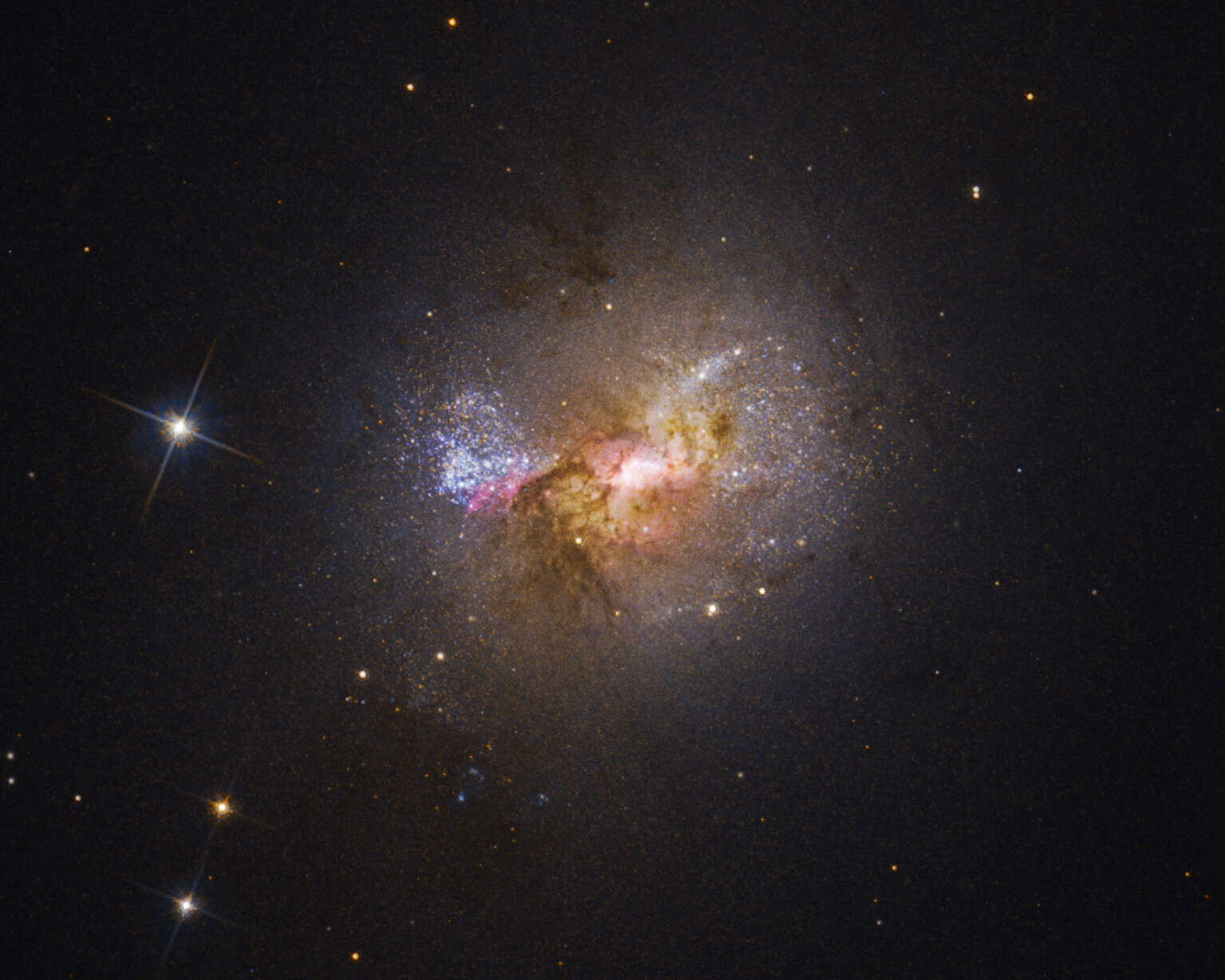
The Hubble telescope captures a black hole that forms stars instead of absorbing them


Astronomers in charge of the Hubble Space Telescope have discovered a black hole in the heart of a dwarf galaxy that, rather than absorbing stars, generates them. This revelation challenges the commonly held belief that black holes are matter destroyers.

Henize 2-10 | Image credit: NASA, ESA, Zachary Schutte (XGI), Amy Reines (XGI); Image processing: Alyssa Pagan (STScI).

The process by which these stars form is peculiar and differs from what is found in larger galaxies. Gas may be observed circling about the black hole known as Henize 2-10 before merging with a dense core of gas within the galaxy, according to the astronomers.


“Hubble's spectroscopy shows that the outflow was moving at a million miles per hour, hitting the dense gas like a garden hose hitting a mound of dirt. Clusters of newborn stars dot the path of the outflow propagation,” explains NASA .


Next, a video in which you can observe this curious phenomenon: